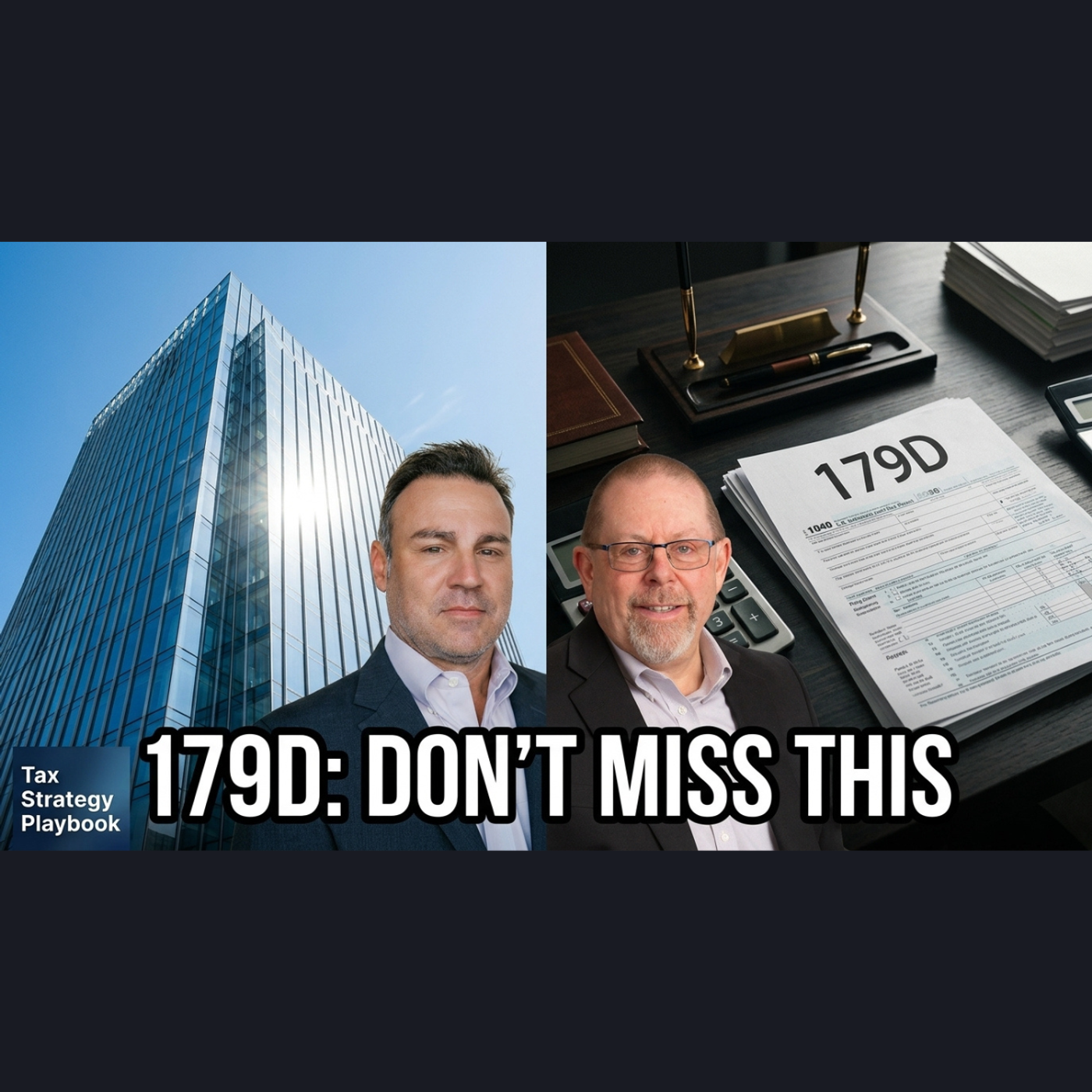
Section 179D Explained: Your Key to Unlocking Over $1M in Tax Savings

Introduction: The Power of Section 179D for Commercial Property Owners
Welcome back to the blog, and if you just tuned into our latest podcast episode, welcome to you as well! This week, we’re diving deep into a topic that has the potential to put a significant amount of money back into the pockets of commercial property owners, developers, and designers. We’re talking about the Section 179D tax deduction, specifically as it pertains to energy-efficient commercial buildings. In our latest podcast, Section 179D Tax Deduction Ends June 30 2026: Unlock $1M+ Savings Before It's Gone!, we sat down with expert Brian Broussard to unpack the ins and outs of this incredible opportunity. This blog post is designed to expand on those crucial points, offering a more detailed look at what Section 179D is, who can benefit, and most importantly, how you can leverage it to achieve substantial tax savings, especially with the approaching June 30, 2026 deadline. This is not just about minor deductions; we're talking about the potential for six and even seven-figure savings that can fundamentally change your company's financial outlook. If you’re involved in the construction, ownership, or design of commercial properties, you absolutely need to understand this.
What is Section 179D? A Deep Dive into the Energy Efficient Commercial Buildings Deduction
At its core, Section 179D of the Internal Revenue Code, often referred to as the Energy Efficient Commercial Buildings Deduction, incentivizes the installation of qualifying energy-efficient improvements in new or existing commercial buildings. The primary goal of this legislation is to encourage businesses to reduce their energy consumption and, consequently, their carbon footprint. It provides a dollar-for-dollar deduction for the cost of installing specific energy-efficient systems. The deduction is specifically for "qualifying energy efficient commercial building property." This definition includes improvements to the interior lighting systems, HVAC (heating, ventilation, and air conditioning) systems, and the building envelope. The building envelope refers to the elements that enclose the building, such as insulation and windows, which play a crucial role in regulating internal temperatures and reducing the need for heating and cooling. To qualify for the deduction, these improvements must be placed in service in a building located in the United States and must be certified to reduce the energy consumption of the building’s systems by a certain percentage compared to a baseline standard. The baseline standard is typically based on the minimum energy efficiency requirements of ASHRAE (American Society of Heating, Refrigerating and Air-Conditioning Engineers) Standard 90.1 in effect for the year the building was placed in service or for renovations, the year the renovation is placed in service. The deduction amount is calculated based on the square footage of the building and the extent to which energy efficiency is improved. For new construction, the maximum deduction available is $1.80 per square foot, provided the building meets specific energy reduction targets. This $1.80 per square foot is broken down into three categories:
- Up to $0.60 per square foot for improvements to the interior lighting system.
- Up to $0.60 per square foot for improvements to the HVAC system.
- Up to $0.60 per square foot for improvements to the building envelope.
To achieve the full $1.80 per square foot deduction, a building must demonstrate a 50% reduction in total energy costs compared to the baseline. For partial deductions within each category, the reduction must be proportional to the system's contribution to the building's overall energy consumption. For instance, a 20% reduction in HVAC energy costs might yield a proportional deduction for that specific system. It's important to note that the legislation has undergone several modifications over the years, most recently through the Inflation Reduction Act of 2022. These updates have made the deduction more accessible and have retroactively extended its availability, bringing us to the current crucial deadline.
Who Qualifies for Section 179D? Building Owners, Developers, and Designers Explained
One of the most exciting aspects of Section 179D is its broad eligibility. It’s not just for traditional building owners; it extends to developers and even the designers of qualifying projects. This inclusive nature opens up a wealth of opportunities for various stakeholders in the commercial real estate sector.
Building Owners
This is the most straightforward category. If you own a commercial building and have made or are planning to make energy-efficient upgrades, you are likely eligible. This includes owners of office buildings, retail spaces, warehouses, industrial facilities, hotels, apartment complexes (with some nuances for commercial spaces within them), and more. The key is that the building must be a commercial property, and the improvements must meet the energy efficiency standards. The deduction directly reduces your taxable income, leading to lower tax liabilities.
Developers
For developers, Section 179D is a powerful tool to enhance the attractiveness and profitability of their projects. When constructing new commercial buildings or undertaking significant renovations, developers can incorporate energy-efficient features that qualify for the deduction. This not only reduces their tax burden on the project but also allows them to market the buildings as more sustainable and cost-effective to future tenants or buyers, potentially increasing property value and lease rates. The deduction can be claimed by the entity that owns the property when the improvements are placed in service.
Designers (Architects and Engineers)
This is where Section 179D gets particularly interesting for a broader group of professionals. For buildings that are owned by a tax-exempt entity (like a government building or a non-profit organization), the building owner itself cannot claim the tax deduction. However, the law allows for the designer of the energy-efficient systems to claim the deduction instead. This means architects and engineers who design qualifying energy-efficient systems for public buildings or non-profit facilities can benefit directly. This provision was established to ensure that the incentive for energy efficiency still flows, even when the direct owner cannot claim a tax benefit. This can be a significant revenue stream for design firms, particularly those specializing in government or public sector projects. The key for all qualifying parties is meticulous documentation. Proving that the installed systems meet the specific energy reduction requirements and accurately calculating the deduction are paramount. This often involves energy modeling and third-party certifications.
How Section 179D Works: New Builds vs. Renovations
The application of Section 179D differs slightly between new construction and renovations, though the underlying principle of energy efficiency remains the same.
New Builds
When constructing a new commercial building, developers and owners have the advantage of designing and incorporating energy-efficient systems from the ground up. This integrated approach often leads to higher efficiency levels and, consequently, larger deductions. The baseline for comparison is ASHRAE Standard 90.1 as it existed in the year the building is placed in service. The goal is to demonstrate a reduction in the building's total energy costs compared to this baseline. As mentioned earlier, achieving a 50% reduction in energy costs can result in the maximum deduction of $1.80 per square foot. However, even partial reductions in lighting, HVAC, or the building envelope can qualify for proportional deductions. The deduction is taken in the tax year the building is placed in service.
Renovations
For existing buildings, Section 179D offers an opportunity to upgrade older, less efficient systems and reap tax benefits. This is particularly relevant for owners looking to modernize their properties or reduce operating expenses. In the case of renovations, the baseline for comparison is typically ASHRAE Standard 90.1 as it existed in the year the *renovation* is placed in service, or the minimum standard in effect for the original construction of the building, whichever is more stringent. This can make it more challenging to achieve the same level of energy reduction as in new builds, as older building codes were less demanding. However, significant renovations that replace outdated lighting, HVAC systems, or improve insulation can still lead to substantial deductions. For example, upgrading from older fluorescent lighting to LED lighting can drastically reduce energy consumption for illumination. Similarly, replacing an inefficient boiler or air conditioning unit with a modern, high-efficiency model can yield significant energy savings. The deduction is claimed in the tax year the qualifying renovation is placed in service. The key here is demonstrating that the *renovated systems* improve the building's overall energy performance relative to the established baseline.
Unlocking Six and Seven-Figure Savings: Real-World Examples
The numbers associated with Section 179D can seem impressive, but the reality is that these deductions translate into tangible, significant savings for businesses. Let’s look at some hypothetical, yet representative, scenarios:
Scenario 1: New Office Building Construction
Imagine a developer constructing a 100,000-square-foot office building. They design the building with a highly efficient HVAC system, LED lighting throughout, and superior insulation in the walls and roof. Through detailed energy modeling, they demonstrate that these upgrades reduce the building's total energy consumption by 40% compared to the ASHRAE baseline. If the deduction is calculated at, say, $1.40 per square foot (representing a proportional reduction across systems), the total deduction would be: 100,000 sq ft * $1.40/sq ft = $140,000 This $140,000 deduction directly reduces the taxable income of the entity that placed the building in service. At a corporate tax rate of 21%, this translates to a tax saving of: $140,000 * 0.21 = $29,400 Now, consider a larger development, perhaps a 500,000-square-foot facility that achieves the full $1.80 per square foot deduction. 500,000 sq ft * $1.80/sq ft = $900,000 deduction. At a 21% tax rate, this would result in a saving of $189,000.
Scenario 2: Renovation of a Large Warehouse
Consider the owner of a 300,000-square-foot warehouse built in the 1980s. They decide to upgrade the entire lighting system to high-efficiency LEDs and improve the insulation of the roof and bay doors. The renovation results in a 25% reduction in energy consumption compared to the applicable baseline. If the deduction for the lighting and insulation improvements is calculated at $0.80 per square foot, the total deduction would be: 300,000 sq ft * $0.80/sq ft = $240,000 deduction. At a 21% tax rate, this saves the owner $50,400 in taxes.
Scenario 3: Non-Profit Facility Design
A non-profit organization is building a new community center. An architectural firm designs the HVAC and lighting systems to be exceptionally energy-efficient, exceeding standard requirements. The building is 50,000 square feet. The firm can claim the Section 179D deduction for the qualifying portions of their design. If the design contributes to a $1.00 per square foot eligible deduction, the firm could claim: 50,000 sq ft * $1.00/sq ft = $50,000 deduction. This deduction reduces the firm's taxable income, leading to substantial tax savings. These examples highlight the power of Section 179D. For larger projects, the deductions can easily reach six figures, and for very large developments or multiple projects, they can certainly surpass the million-dollar mark in total tax savings over time.
Supercharging Savings: Pairing Section 179D with Cost Segregation Studies
For an even more potent tax-saving strategy, consider combining the Section 179D deduction with a cost segregation study. This is a technique that real estate investors and owners have used for years to accelerate depreciation deductions. A cost segregation study involves reclassifying certain real property assets (like building components and land improvements) into shorter recovery periods for depreciation purposes. Typically, buildings are depreciated over 39 years (for commercial properties) or 27.5 years (for residential rental properties). However, a cost segregation study can identify components like dedicated electrical or plumbing for specialized equipment, decorative lighting, or certain site improvements that can be depreciated over 5, 7, or 15 years. Here's how the synergy works: 1. Section 179D Deduction: This is a direct, dollar-for-dollar deduction against your taxable income for the cost of qualifying energy-efficient improvements. It reduces your current tax liability. 2. Cost Segregation Study: This study accelerates depreciation. Instead of taking a small depreciation deduction each year over 39 years, you can take much larger deductions in the early years of the property's life. This creates a significant deferral of taxes and improves cash flow. When you implement energy-efficient upgrades that qualify for Section 179D, the cost of those upgrades becomes part of the capital expenditure for the building. A cost segregation study can then be performed on the *entire* project, including these new energy-efficient components. This means that not only do you get the immediate Section 179D deduction, but the underlying costs of those energy-efficient upgrades can also be identified and reclassified into shorter depreciation schedules by the cost segregation study. This combination is incredibly powerful because it offers both an immediate reduction in taxable income (from 179D) and accelerated depreciation deductions (from cost segregation), maximizing tax benefits in the early years of ownership or after a renovation. This can lead to substantial improvements in cash flow and overall tax efficiency.
The Crucial Deadline: Why Act Before June 30, 2026?
The urgency surrounding Section 179D is directly tied to its expiration date. As it stands, the provision allowing for these energy-efficient commercial building deductions is set to expire for property placed in service after June 30, 2026. This deadline is critical for several reasons: * **Opportunity Window:** It signifies a limited time to take advantage of these significant tax incentives. Once this date passes, unless further legislation extends it, the opportunity will be gone. * **Project Planning:** If you have new construction projects in the pipeline or are planning major renovations, understanding this deadline is essential for budgeting and financial planning. Incorporating qualifying upgrades *before* June 30, 2026, ensures eligibility. * **Retroactive Claims:** The good news is that the Inflation Reduction Act of 2022 retroactively reinstated Section 179D for property placed in service starting January 1, 2022. This means you may be able to claim the deduction for qualifying improvements made in 2022, 2023, and 2024, even if you haven't acted yet. However, this retroactive window also closes with the overall expiration. * **Maximizing Investment:** For projects that will extend beyond this deadline, incorporating energy-efficient measures now, to qualify for the deduction, can make those investments more financially viable and appealing. Given that the process of qualifying for and claiming Section 179D involves detailed analysis, energy modeling, and proper documentation, it's not something that can be rushed at the last minute. Starting the process well in advance of the June 30, 2026 deadline is highly recommended to ensure all requirements are met and the maximum benefit is achieved.
Next Steps: Grab Your 179D Playbook and Eligibility Checklist
Understanding Section 179D is the first step; taking action is the next. Given the complexity and the approaching deadline, it's wise to partner with experts who can guide you through the process. We’ve put together a comprehensive resource to help you navigate this opportunity. In our latest podcast episode, we mentioned the Section 179D Tax Deduction Ends June 30 2026: Unlock $1M+ Savings Before It's Gone!, which provides an excellent overview and introduces our proprietary tools. To help you get started, we encourage you to: 1. Download Our Section 179D Playbook: This detailed guide will walk you through the intricacies of the deduction, including eligibility criteria, qualifying improvements, and the documentation required. It’s designed to demystify the process. 2. Complete Our Eligibility Checklist: This checklist will help you quickly assess whether your property or projects might qualify for the Section 179D deduction. It’s a practical tool to determine if further investigation is warranted. 3. Consult with Experts: The specifics of energy modeling, IRS regulations, and tax law can be complex. Working with tax professionals experienced in Section 179D is crucial to ensure you maximize your claim and remain compliant. Don't let this significant tax-saving opportunity pass you by. The June 30, 2026 deadline is a firm date, and the benefits of acting sooner rather than later are substantial. Whether you're a building owner looking to reduce your tax liability, a developer aiming to enhance project profitability, or a designer seeking new avenues for revenue, Section 179D offers a compelling solution. Thank you for joining us on the blog and in our latest podcast. We hope this expanded explanation provides clarity and inspires you to explore the potential of Section 179D for your business.

CEO of Cashflow Strategies, Inc., Tax Strategist, Speaker, Educator
David “Mr. Cash Flow” Wiener is a nationally recognized authority on real estate tax strategy and cash flow optimization, and the host of The Tax Strategy Playbook podcast. As Founder and CEO of Cash Flow Strategies, Inc., David has spent decades helping real estate investors, business owners, and their advisory teams legally reduce taxes, unlock hidden cash flow, and put more money back into productive assets instead of into the IRS.
Over the course of his career, David has become especially known for his work with cost segregation, 179D energy-efficient commercial building deductions, and other engineering-based tax incentives that accelerate depreciation and free up capital. He has also built a long track record in cash flow and accounts receivable optimization, helping clients improve profitability and financial stability without simply “working harder” or taking on more risk.
David is a sought‑after speaker, trainer, and educator, with audiences ranging from national industry conferences to small mastermind groups and professional associations. He is known for his clear, practical teaching style and his ability to translate complex tax concepts into simple, actionable plays that investors and advisors can use right away. Whether he is speaking to CPAs, medical and dental practice owners, or real estate investors, David’s message is consistent: tax strategy is one of the most powerful—and most overlooked—wealth multipliers available.
On The Tax Strategy Playbook, David brings that same real‑world experience and teaching approach to the microphone. Each epis… Read More
What Counts as a Land Improvement, and Why Does It Depreciate Over 15 Years?