Stop Capitalizing Everything: How the IRS Tangible Property Regulations Can Save Real Estate Investors Thousands
TL;DR: Repair vs Improvement Deductions. Most CPAs capitalize repair expenses when the IRS regulations allow immediate deductions. This costs business owners and real estate investors tens of thousands in year-one cash flow. The 2014 tangible property regulations provide clear tests and safe harbors that permit expensing far more than people realize, but few advisors apply them correctly.
Core Framework:
-
CPAs default to capitalizing everything above a dollar threshold (usually $500-$1,000), ignoring the actual regulatory tests
-
Three improvement tests determine capitalization: betterment, restoration, or adaptation to new use
-
Safe harbors (de minimis, routine maintenance, small taxpayer) allow immediate deductions even when work qualifies as an improvement
-
Materiality thresholds mean partial replacements (under 40% of a system) often qualify as deductible repairs
-
You can retroactively correct years of miscategorized expenses using Form 3115
I've analyzed hundreds of cost segregation studies and depreciation schedules over the years. The pattern shows up consistently: when a business owner or real estate investor spends money fixing or improving property, the CPA capitalizes it. Spread the deduction over 27.5 years for residential rental property. Over 39 years for commercial buildings. Over 15 years for land improvements.
This default costs real money. The difference between capitalizing an expense and deducting it immediately often means $20,000 to $50,000 in year-one cash flow for a single property.
CPAs aren't incompetent. They capitalize because the safe answer is to capitalize. If you capitalize something that could have been expensed, the IRS won't challenge you. If you expense something that should have been capitalized, you face questions. The path of least resistance is to capitalize everything and move to the next return.
That approach prioritizes safety over your cash flow.
What Are the IRS Rules for Repairs vs. Improvements?
The IRS released comprehensive tangible property regulations in 2014. These rules synthesized decades of case law into a clear framework for determining whether a cost is deductible as a repair or must be capitalized as an improvement.
Most CPAs ignore this framework. They still use an old method: expense anything under a certain dollar amount, capitalize everything above that threshold. If the invoice is under $500 or $1,000, deduct it. Above that, capitalize it.
The regulations don't work that way. You analyze each expenditure against specific tests. If the work meets certain criteria, you deduct it immediately, regardless of the dollar amount.
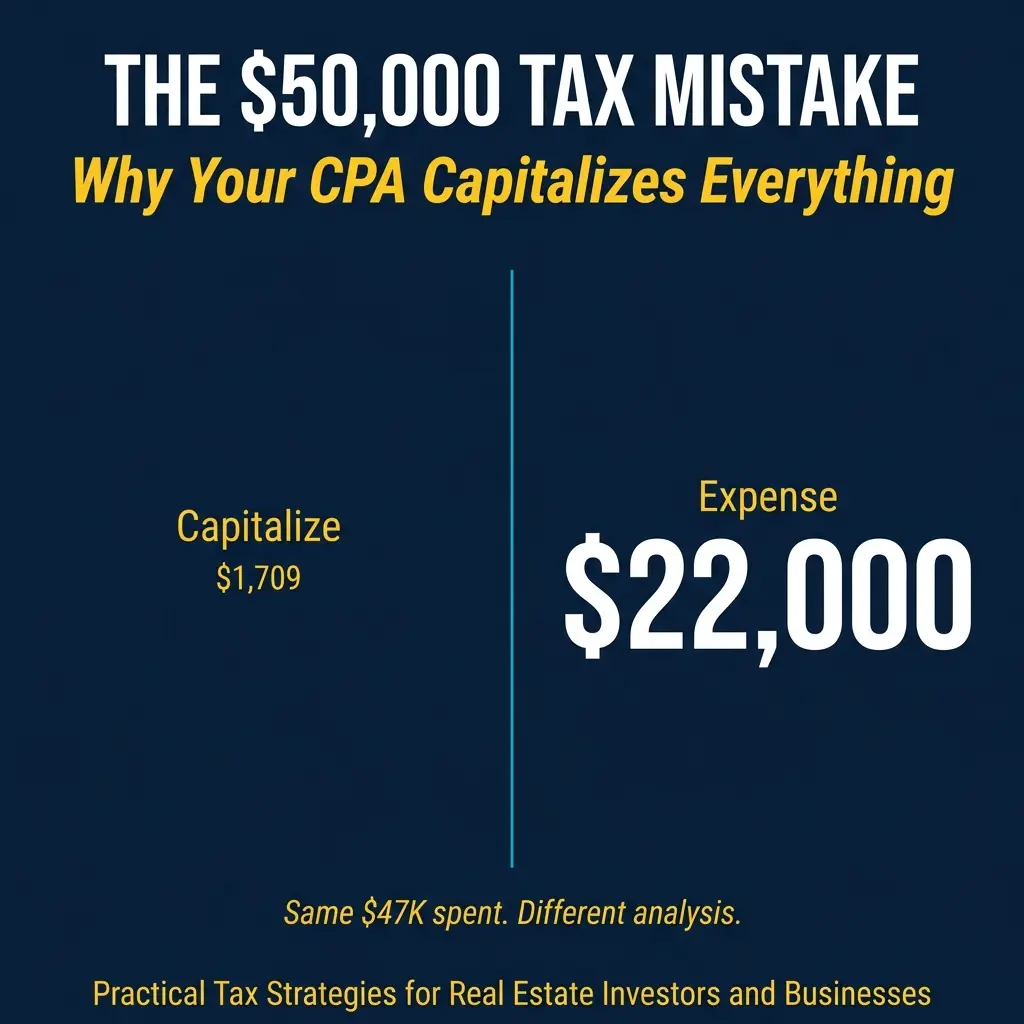
Jennifer owns three rental properties and spent $47,000 on improvements in 2024. Her accountant capitalized everything for 27.5-year depreciation, giving her about $1,709 in deductions for year one. A new CPA reviewed the work and found that $22,000 qualified as deductible repairs under safe harbor provisions. That immediate deduction saved Jennifer $7,040 in year-one taxes.
Same expenditures. Different analysis. Different cash flow outcome.
Bottom line: The regulations allow more immediate deductions than CPAs typically claim, but only if you apply the actual tests instead of defaulting to a dollar threshold.
How Do You Determine if an Expense Is a Repair or Improvement?
The regulations break down property into units of property. For buildings, you don't analyze the entire structure as one asset. You analyze the building structure separately from each major system:
-
HVAC
-
Plumbing
-
Electrical
-
Fire protection
-
Security
-
Elevators and escalators
-
Gas distribution
This separation matters because an improvement to one system doesn't automatically mean you capitalize the entire cost. You analyze each system independently.
The improvement analysis asks three questions:
1. Does the work result in a betterment?
This means fixing a material defect that existed when you acquired the property, fixing damage from a casualty event, or making the property materially more suitable for its intended use.
2. Does the work restore the property?
This means returning the property to ordinary operating condition after it fell into disrepair, replacing a major component or substantial structural part, or rebuilding property to like-new condition after the end of its economic useful life.
3. Does the work adapt the property to a new or different use?
This is the rarest category and typically involves converting a building from one purpose to another.
If the answer to all three questions is no, the work is a deductible repair. If the answer to any question is yes, you capitalize.
The analysis doesn't stop there. Even if the work qualifies as an improvement under these tests, you might still deduct it immediately using one of the safe harbors.
Key point: The nature of the work determines the treatment, not the dollar amount or the type of expense.
What Safe Harbors Allow Immediate Deductions?
The IRS created several safe harbor elections that allow immediate deductions for expenditures that would otherwise be capitalized. These elections require annual documentation and proactive planning. Most CPAs skip them.
De Minimis Safe Harbor
This allows you to deduct items up to $2,500 per invoice or item if you don't have audited financial statements. Most business owners and real estate investors qualify for this threshold. You have to make the election each year on your tax return, and you need to have a written accounting policy in place.
I see depreciation schedules where someone spent $2,200 on a water heater and capitalized it over 27.5 years. The year-one deduction is $80 instead of $2,200. The IRS explicitly allows the immediate deduction, but the CPA didn't make the election.
Routine Maintenance Safe Harbor
This is more powerful. If you perform maintenance on a building more than once during a 10-year period, or more than once during the class life for equipment, you deduct the cost immediately. There's no dollar limit.
If you repaint a building every eight years, the cost is deductible under this safe harbor. If you replace HVAC filters annually, deductible. If you resurface a parking lot every seven years, deductible.
The work has to keep the property in ordinary operating condition and you have to reasonably expect to perform it more than once. When the safe harbor applies, there's no dollar limitation.
Small Taxpayer Safe Harbor
This applies if your average annual gross receipts are under $10 million and you own a building with an unadjusted basis under $1 million. You deduct up to the lesser of $10,000 or 2% of the building's unadjusted basis each year for repairs and improvements.
Most small real estate investors qualify. You have to make the election annually, and most CPAs don't know this safe harbor exists.
Key point: Safe harbors convert what would be multi-decade depreciation into immediate deductions, but you have to elect them annually and maintain proper documentation.
How Does the Materiality Test Affect Capitalization?
When you're analyzing whether work constitutes an improvement, you apply a materiality test. If the improvement affects less than 40% of the unit of property, the IRS might not consider the work material enough to require capitalization.
You own a commercial building and replace the roof. A full roof replacement is a major component of the building structure, so you capitalize. But what if you only replace 35% of the roof because the rest is still functional?
Under the materiality threshold, that partial replacement might qualify as a deductible repair because the work doesn't rise to the level of a material improvement to the building structure unit.
The same logic applies to building systems. If you replace two of six HVAC units in a building, you're not replacing a substantial portion of the HVAC system. You're maintaining the system. That distinction determines whether you capitalize over 39 years or deduct immediately.
Key point: Partial replacements below the 40% materiality threshold often qualify as deductible repairs even when full replacements would be capitalized.
When Can You Expense HVAC and Roof Replacements?
HVAC and roofing expenditures represent the biggest missed opportunities I see in depreciation schedules.
The default assumption is that if you replace an HVAC system or a roof, you capitalize the cost. In many cases, this is correct. But the proper treatment depends on what you're replacing and why.
If you're replacing an HVAC unit because the unit broke down and you're restoring the system to ordinary operating condition, the analysis is different from upgrading to a more efficient system that materially improves the property. If you're replacing a portion of a roof because of storm damage, the analysis is different from replacing the entire roof at the end of its useful life.
I've seen cases where a $180,000 roof and HVAC replacement was fully expensed in year one because the analysis showed the work qualified as a deductible repair under the regulations. The cash flow impact is significant.
Key point: Context matters. The same expenditure might be capitalized or expensed depending on whether you're restoring existing function or creating material improvement.
Can You Fix Prior Years' Capitalization Errors?
If you capitalized expenditures in prior years that should have been expensed under the tangible property regulations, you can go back and correct the error.
You file a Form 3115 change in accounting method and take a negative 481(a) adjustment. This removes the incorrectly capitalized amounts from your depreciation schedule and allows you to deduct them in the current year.
I've seen situations where expenditures made 10, 15, even 20 years ago were sitting on depreciation schedules when they should have been expensed immediately. Correcting those errors reduces your depreciation recapture when you sell the property. The correction also gives you a larger deduction in the year you make the adjustment.
Most CPAs don't pursue this correction because the work requires detailed analysis of historical expenditures. But if you're sitting on a depreciation schedule full of expenses that were incorrectly capitalized, you're leaving money on the table. I can help with reviewing depreciation schedules and making the proper adjustments to become compliant with the regulations.
Key point: Retroactive corrections through Form 3115 can recover deductions from expenditures capitalized years ago, reducing both current taxes and future recapture.
Why Do CPAs Default to Capitalizing Everything?
CPAs default to capitalization for defensible reasons. Most still use an old method: expense anything under a certain dollar amount (usually $500 or $1,000) and capitalize everything above that threshold. The approach is simple. The approach is consistent. The approach creates a clear policy they can apply across all clients without analyzing individual expenditures.
The problem is that this dollar-threshold approach ignores the actual regulations. The tangible property regulations don't work that way. They require analyzing the nature of the expenditure, not the dollar amount. A $50,000 roof repair might be fully deductible while a $3,000 improvement to a building system gets capitalized, but only if you run the analysis.
There's a second problem. If you continue to capitalize and depreciate repairs that should have been expensed under the regulations, the IRS could potentially disallow the depreciation expense. You face double jeopardy: you missed the current deduction and you risk losing the future depreciation.
The correct approach is to analyze each expenditure properly and document the decision. That means understanding the regulations, applying the tests, and making the appropriate safe harbor elections when they're available.
Key point: The dollar-threshold method is simple but incorrect. Proper analysis requires applying the regulatory tests to each expenditure regardless of amount.
What Should You Do Next?
If you own rental property or operate a business with significant repair and maintenance expenditures, you need to know whether your CPA is applying the tangible property regulations correctly.
Most aren't. They're defaulting to capitalization because the approach is easier and safer. That default costs you cash flow every single year.
The difference between capitalizing a $50,000 roof replacement over 39 years and deducting the expense immediately is about $1,282 in depreciation versus a $50,000 deduction. At a 32% effective tax rate, the difference is a $15,590 swing in year-one cash flow.
Multiply that across multiple properties and multiple years, and the capitalize-everything approach leaves significant money on the table.
The regulations exist to provide clarity. The safe harbors exist to simplify compliance and reduce disputes. But if your CPA isn't using them, you're not getting the benefit.
Have a conversation with your tax advisor about how they're handling repair versus capitalization decisions. Ask whether they're making the de minimis election. Ask whether they've analyzed your expenditures under the routine maintenance safe harbor. Ask whether they've considered the small taxpayer safe harbor if you qualify.
If they don't know what you're talking about, you might need a different advisor. Or at minimum, you need someone who can review your depreciation schedules and make the proper adjustments to bring you into compliance with the regulations.
The capitalize versus expense decision isn't a minor technical detail. The decision is a cash flow lever that directly impacts how much money stays in your business versus how much goes to taxes. In most cases, the regulations allow far more immediate deductions than people think.
You need to know the framework. You need to work with someone who will apply the framework correctly instead of defaulting to the safe answer that costs you money.
Frequently Asked Questions
What is the difference between a repair and an improvement for tax purposes?
A repair keeps property in ordinary operating condition without materially adding value or extending useful life. An improvement results in betterment (fixing defects or making property more suitable), restoration (returning property to like-new condition), or adaptation (converting to a new use). Repairs are deductible immediately. Improvements must be capitalized and depreciated.
What is the de minimis safe harbor threshold?
The de minimis safe harbor allows you to deduct items up to $2,500 per invoice or item if you don't have audited financial statements. You must make an annual election on your tax return and maintain a written accounting policy. This applies regardless of whether the expenditure would otherwise qualify as an improvement.
Can I deduct routine maintenance expenses immediately?
Yes, if you perform the maintenance more than once during a 10-year period for buildings or more than once during the class life for equipment. The routine maintenance safe harbor has no dollar limitation. The work must keep property in ordinary operating condition and you must reasonably expect to perform the work more than once.
What is the materiality threshold for improvements?
If an improvement affects less than 40% of a unit of property, the IRS might not consider the work material enough to require capitalization. This means partial replacements of building systems or structural components often qualify as deductible repairs when full replacements would be capitalized.
Can I correct capitalization errors from prior years?
Yes. You file Form 3115 to change your accounting method and take a negative Section 481(a) adjustment. This removes incorrectly capitalized amounts from your depreciation schedule and allows you to deduct them in the current year. This correction also reduces depreciation recapture when you sell property.
Do the tangible property regulations apply to residential rental property?
Yes. The regulations apply to all types of property, including residential rental property. The same improvement tests, safe harbors, and materiality thresholds apply whether you own residential or commercial property.
What is the small taxpayer safe harbor?
If your average annual gross receipts are under $10 million and you own a building with an unadjusted basis under $1 million, you can deduct up to the lesser of $10,000 or 2% of the building's unadjusted basis each year for repairs and improvements. You must make an annual election.
How do I know if my CPA is applying these regulations correctly?
Ask your CPA whether they're making the de minimis election, whether they've analyzed your expenditures under the routine maintenance safe harbor, and whether they've considered the small taxpayer safe harbor if you qualify. If they're unfamiliar with these elections, they're likely defaulting to capitalization and costing you deductions.
Key Takeaways
-
Most CPAs use an outdated dollar-threshold method (expense below $500-$1,000, capitalize above) instead of applying the actual tangible property regulations, costing you immediate deductions.
-
The three improvement tests (betterment, restoration, adaptation) determine whether you capitalize, but safe harbors can override these tests and allow immediate deductions.
-
The routine maintenance safe harbor has no dollar limit and allows immediate deductions for work performed more than once during a specified period.
-
Partial replacements below the 40% materiality threshold often qualify as deductible repairs even when full replacements would be capitalized.
-
You can retroactively correct years of capitalization errors using Form 3115, recovering deductions and reducing future depreciation recapture.
-
HVAC and roofing expenditures represent the largest missed opportunities because CPAs default to capitalizing without analyzing whether the work restores existing function or creates material improvement.
-
The capitalize versus expense decision typically creates a $15,000 to $50,000 year-one cash flow difference per property, making proper analysis worth the effort.
Want to learn more tax strategies that keep money in your pocket instead of sending it to the IRS? Follow the Tax Strategy Playbook for ongoing insights on tax strategy for real estate investors and businesses.

CEO of Cashflow Strategies, Inc., Tax Strategist, Speaker, Educator
David “Mr. Cash Flow” Wiener is a nationally recognized authority on real estate tax strategy and cash flow optimization, and the host of The Tax Strategy Playbook podcast. As Founder and CEO of Cash Flow Strategies, Inc., David has spent decades helping real estate investors, business owners, and their advisory teams legally reduce taxes, unlock hidden cash flow, and put more money back into productive assets instead of into the IRS.
Over the course of his career, David has become especially known for his work with cost segregation, 179D energy-efficient commercial building deductions, and other engineering-based tax incentives that accelerate depreciation and free up capital. He has also built a long track record in cash flow and accounts receivable optimization, helping clients improve profitability and financial stability without simply “working harder” or taking on more risk.
David is a sought‑after speaker, trainer, and educator, with audiences ranging from national industry conferences to small mastermind groups and professional associations. He is known for his clear, practical teaching style and his ability to translate complex tax concepts into simple, actionable plays that investors and advisors can use right away. Whether he is speaking to CPAs, medical and dental practice owners, or real estate investors, David’s message is consistent: tax strategy is one of the most powerful—and most overlooked—wealth multipliers available.
On The Tax Strategy Playbook, David brings that same real‑world experience and teaching approach to the microphone. Each epis… Read More

What Counts as a Land Improvement, and Why Does It Depreciate Over 15 Years?