The Tax Deduction Most CPAs Never Mention - PAD
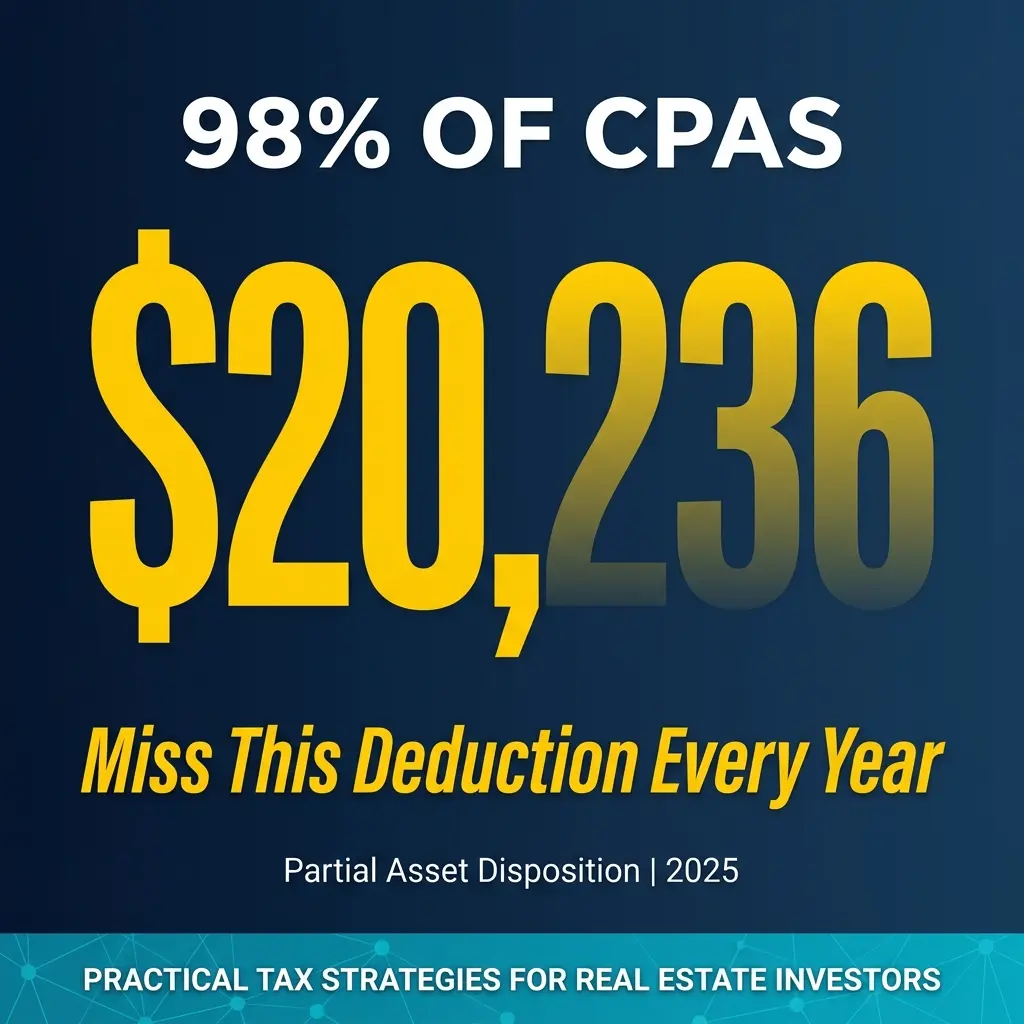
TL;DR: Partial Asset Disposition (PAD) is a tax election that lets real estate investors, both residential rental and commercial, write off the remaining basis of building components like roofs, HVAC, flooring, and plumbing when those components are replaced after the property is already in service. The election is taken in the year of replacement, not spread over the original depreciation schedule. It's been in the tax code since 2014. Most property owners have never heard of it.
-
PAD lets you deduct the remaining depreciable basis of a replaced component immediately, in the year you dispose of it.
-
It applies to both residential rental property (27.5-year depreciation) and commercial property (39-year depreciation).
-
The election is annual and must be made on a timely-filed original return. It cannot be amended in later.
-
Cost segregation studies provide the component-level cost data needed to support the deduction.
-
The One Big Beautiful Bill Act (signed July 4, 2025) permanently restored 100% bonus depreciation for qualified property acquired after January 19, 2025, creating a second accelerated deduction on top of PAD.
-
The IRS runs a dedicated compliance campaign on partial disposition elections for buildings.
What Is Partial Asset Disposition?
Property owners replace roofs, swap out HVAC systems, renovate floors. And their depreciation schedules treat these events like they never happened. The old component stays on the books. The new one gets added. Both sit there generating deductions over decades, when the law allows something very different.
This isn't aggressive tax planning or a creative workaround. It's a specific election that's been in the tax code since 2014. The IRS created it to fix a real problem. And yet, it's one of the most consistently overlooked elections in real estate tax planning, even among CPAs who are well-versed in cost segregation, bonus depreciation, and other advanced strategies.
The election is called Partial Asset Disposition, or PAD. If you own residential rental or commercial real estate and you've replaced any building components in the last few years, there's a strong chance you've left real money on the table.
Key Point: PAD is not a loophole or an aggressive position. It's a formal election the IRS created specifically to prevent double-dipping on depreciation.
How PAD Works
Here's how it works. PAD applies only to building components that are replaced or retired after the property is already in service. When that replacement happens (a roof, flooring, plumbing, electrical systems, HVAC), the tax code lets you write off the remaining depreciable basis of what you removed, in the year you removed it.
Without the PAD election, that remaining basis keeps depreciating on its original 27.5- or 39-year schedule, right alongside the new component that replaced it. With the election, you take the loss immediately, in the year you made the replacement, and the new component starts depreciating fresh on its own schedule.
The IRS created this rule to solve a specific problem. Before 2014, when a taxpayer replaced a component on an already-in-service building, both the old component and the new one ended up depreciating at the same time. You'd put a new roof on, capitalize it, start depreciating it. And the old roof would still be sitting on your books, generating deductions. Two roofs. Same building. That's double-dipping. The Tangible Property Regulations were created to fix it.
PAD was the solution. You write off the old component right away, then depreciate the new one from scratch. No overlap. No double-dipping. Just a clean transition that accelerates deductions you were already entitled to.
Key Point: PAD resolves the double-depreciation problem the IRS identified before 2014, and it benefits the taxpayer in the process.
Why This Matters Right Now
The One Big Beautiful Bill Act, signed into law on July 4, 2025, permanently restored 100% bonus depreciation for qualified property acquired after January 19, 2025. Every renovation you complete going forward now carries two tax breaks, not one.
You get the immediate write-off on what you removed through PAD. Then you get 100% bonus depreciation on the new component, if it qualifies. When you layer these two strategies with cost segregation, the deductions generated can exceed your actual cash outlay.
Here's what that looks like in practice. A client replaced a $60,000 roof. The old roof had $54,691 in remaining basis. With the PAD election, that became an ordinary loss in the same year. At a 37% federal tax rate, that's $20,236 in immediate tax savings, not spread over 23 more years of depreciation.
Another client had a real estate portfolio with missed PAD elections across multiple properties. These were components that had been replaced years earlier, but no one had made the election. The remaining basis was still sitting there, depreciating slowly, when it should have been deducted in full.
Timing is everything here. The PAD election is annual and cannot be made on a late or amended return. If you miss it, the disposed component's basis stays on its original schedule. There's no going back. The transitional window that once existed under Rev. Proc. 2014-54, which allowed taxpayers to claim missed partial dispositions for prior years through Form 3115, has closed.
Key Point: Bonus depreciation is now permanent at 100% for qualifying property acquired after January 19, 2025, making the PAD + cost segregation combination more valuable than it's ever been.
The Documentation Problem
Most people get stuck here. You can't claim a PAD without knowing the original cost of the component you're retiring. Without that number, the election doesn't hold up.
That's where cost segregation becomes essential. A detailed cost segregation study breaks a property down into its individual components (roofing, HVAC, plumbing, electrical, flooring, lighting) and assigns specific dollar amounts to each one. When you replace one of those components later, the study gives you the exact figures needed to back up the PAD deduction. Without it, you're estimating. And the IRS doesn't accept estimates.
The IRS Cost Segregation Audit Technique Guideline describes the engineering-based approach as "the most methodical and accurate approach... and generally provides the most accurate cost allocations." This is why getting a cost segregation study done before renovations start makes sense, not after. It might seem counterintuitive to document assets you're about to remove, but that documentation is exactly what makes the PAD election work.
Key Point: Without component-level cost data from a cost segregation study, there's no reliable way to substantiate a PAD election, and the IRS won't accept rough estimates.
The IRS Is Watching This
The IRS Large Business and International division runs a compliance campaign titled "Partial Disposition Election for a Building." A campaign means the agency has singled out an issue for focused examination resources instead of leaving it to routine return selection. That is a signal about where scrutiny lands, and it is worth knowing before you make the election.
Two things are on the table: proper substantiation and accurate calculations. This isn't the time for online calculators or back-of-the-napkin math. The IRS wants engineering-based studies, detailed component breakdowns, and clear documentation of what was removed and when.
Returns get flagged when taxpayers use rough estimates instead of proper studies. The deduction gets disallowed, and suddenly you're defending a position you can't substantiate. That's a fight nobody wants.
Key Point: The IRS has singled out this election for a compliance campaign, which is exactly why the cost segregation documentation behind it needs to be rigorous.
Renovations Create the Highest Opportunities
If you're doing a renovation, the PAD opportunity is even larger than it is for routine replacements. Renovation cost segregation studies tend to reclassify a much larger share of the spend than whole-building studies do.
The reason is simple. Renovations are made up of the exact components cost segregation is designed to find. There's no foundation or structural framing diluting the percentages. You're replacing finishes, systems, and fixtures, the items that qualify for accelerated depreciation.
Here's a concrete example. On one $80,000 renovation, a cost segregation study reclassified $65,000, which was 81% of that specific project. That produced roughly $24,050 in federal tax savings in the first year alone, before adding the PAD loss on the components that were replaced. Another renovation would come out differently.
When you combine PAD with cost segregation and bonus depreciation, practitioners call it the "triple dip." You write off the old component right away. You reclassify the new component into shorter depreciation schedules. And you take 100% bonus depreciation on the qualifying property. The result is a deduction that can exceed what you actually spent on the improvement, in the year you make it.
Key Point: Renovations produce the highest PAD opportunities because they concentrate exactly the types of components that qualify for accelerated treatment.
The Hidden Benefit You Don't Hear About
PAD doesn't just lower your tax bill today. It also reduces your depreciation recapture when you sell the property.
When you dispose of a component through PAD, you remove its accumulated depreciation from your books. That means there's less depreciation to recapture later. You're converting what would have been ordinary income at sale into an ordinary loss today.
That's a timing advantage. You take the deduction when your income is high. You avoid the recapture when you sell. The math works in your favor on both ends.
Key Point: PAD reduces future depreciation recapture at sale, a second-order benefit that most investors never factor into their planning.
Why CPAs Miss This
This isn't a criticism. Most CPAs are focused on compliance, not strategy. Their job is to file accurate returns based on the information they receive. If you don't tell them you replaced a roof or renovated a floor, they have no reason to ask about PAD.
Even when they know about it, PAD is considered too detailed or too buried in the code to apply routinely. It requires engineering-based documentation, careful component tracking, and a level of proactive planning that most compliance-focused firms don't build into their process.
The result is a massive missed opportunity. Property owners assume their CPA is optimizing their tax position when they're really just handling compliance. The strategies exist. The law allows them. But they don't get applied because no one is asking the right questions.
Key Point: The gap between compliance and strategy is where most of the tax savings go missing, and PAD sits squarely in that gap.
What You Should Do Next
If you own residential rental or commercial real estate and you've done any renovations or component replacements in the last few years, start by reviewing your fixed asset schedule. Look for components that were replaced but are still showing up on your depreciation schedule.
If you're planning renovations or replacements soon, get a cost segregation study done before you start. Document what's there now so you can support the PAD election when the time comes.
And if you've already missed the election on prior-year replacements, there's no mechanism to go back and fix it. But you can make sure it doesn't happen again going forward.
PAD is not a loophole. It's not aggressive. It's a specific election the IRS created to prevent double-dipping and keep depreciation accurate. But it only works if you make the election in the year you dispose of the asset. Most property owners, residential and commercial alike, are leaving money on the table because they don't know this election exists. Now you do.
If you'd like to talk through how PAD might apply to your specific properties, and whether there are deductions you've been missing, I'm happy to have that conversation. There's no charge for the discussion. Reach out directly at david.wiener@cashflowstrategies.us and we'll take a look at what's actually available to you.
Frequently Asked Questions
What is a Partial Asset Disposition election?
A PAD election is a formal tax position under the Tangible Property Regulations. It lets a real estate investor, residential or commercial, write off the remaining depreciable basis of a building component, such as a roof, HVAC system, or flooring, in the year it's removed or replaced. Without the election, that basis keeps depreciating on its original schedule.
When was the PAD election introduced?
The PAD election became available for tax years beginning on or after January 1, 2014, as part of the IRS Tangible Property Regulations. It applies to MACRS property, meaning the property must already be in service and depreciating before a component replacement qualifies for the election.
Can I make a PAD election on an amended return?
No. The election must be made on a timely-filed original return, including extensions, for the year in which the component is disposed. It cannot be made retroactively on an amended return.
Why do I need a cost segregation study to claim PAD?
To support a PAD deduction, you need to know the original cost basis of the component you're retiring. A cost segregation study assigns specific dollar amounts to individual building components, giving you the data needed to calculate and defend the deduction. Without it, there's no reliable way to know what to write off.
What is the "triple dip" strategy?
The triple dip refers to combining three tax strategies on a renovation: (1) the PAD election to write off the replaced component's remaining basis, (2) cost segregation to reclassify new components into shorter depreciation schedules, and (3) bonus depreciation to deduct 100% of qualifying property in the first year. Together, these can generate deductions that exceed the actual cost of the improvement.
Does the One Big Beautiful Bill Act affect PAD?
Yes, indirectly. The OBBBA, signed July 4, 2025, permanently restored 100% bonus depreciation for qualified property acquired after January 19, 2025. This means new components installed as part of a renovation may now qualify for full first-year expensing, on top of the PAD loss on the component they replaced.
Is the IRS auditing PAD elections?
The Large Business and International division runs a compliance campaign specifically on the partial disposition election for a building, which means examination resources are pointed at this issue rather than reaching it by chance. Documentation matters accordingly.
How does PAD reduce depreciation recapture?
When you elect PAD, you remove the disposed component's accumulated depreciation from your books. This lowers the total depreciation subject to recapture when you sell the property, converting future ordinary income into a current ordinary loss.
Key Takeaways
-
PAD allows both residential rental and commercial real estate investors to deduct the remaining depreciable basis of replaced building components in the year of disposal, not over the remainder of the original depreciation schedule.
-
The election has been available since 2014 and must be made on a timely-filed original return. It cannot be made retroactively.
-
Cost segregation studies are essential to support PAD deductions. Without component-level cost data, the election can't be properly calculated or defended.
-
The One Big Beautiful Bill Act permanently restored 100% bonus depreciation for qualifying property acquired after January 19, 2025, making the PAD and cost segregation combination more valuable than ever.
-
Combining PAD, cost segregation, and bonus depreciation (the "triple dip") can produce deductions that exceed the actual cost of the improvement in the year it's made.
-
The IRS targets partial disposition elections through a named LB&I compliance campaign, which makes thorough documentation the price of taking the deduction.
-
PAD also reduces future depreciation recapture at sale, creating a tax benefit on both ends of the investment timeline.
Let's Talk About Your Properties
Every property is different. The deductions available to you depend on what you own, what you've replaced, and how your depreciation schedule is currently set up. If you're a residential rental or commercial real estate investor and you're not sure whether PAD has been applied to your portfolio, that's worth knowing, and worth fixing going forward.
Reach out at david.wiener@cashflowstrategies.us to start a conversation. There's no charge, no pressure, and no obligation. Just a straightforward discussion about what the tax code actually allows, and whether you're taking full advantage of it.

CEO of Cashflow Strategies, Inc., Tax Strategist, Speaker, Educator
David “Mr. Cash Flow” Wiener is a nationally recognized authority on real estate tax strategy and cash flow optimization, and the host of The Tax Strategy Playbook podcast. As Founder and CEO of Cash Flow Strategies, Inc., David has spent decades helping real estate investors, business owners, and their advisory teams legally reduce taxes, unlock hidden cash flow, and put more money back into productive assets instead of into the IRS.
Over the course of his career, David has become especially known for his work with cost segregation, 179D energy-efficient commercial building deductions, and other engineering-based tax incentives that accelerate depreciation and free up capital. He has also built a long track record in cash flow and accounts receivable optimization, helping clients improve profitability and financial stability without simply “working harder” or taking on more risk.
David is a sought‑after speaker, trainer, and educator, with audiences ranging from national industry conferences to small mastermind groups and professional associations. He is known for his clear, practical teaching style and his ability to translate complex tax concepts into simple, actionable plays that investors and advisors can use right away. Whether he is speaking to CPAs, medical and dental practice owners, or real estate investors, David’s message is consistent: tax strategy is one of the most powerful—and most overlooked—wealth multipliers available.
On The Tax Strategy Playbook, David brings that same real‑world experience and teaching approach to the microphone. Each epis… Read More

Section 280C Election: Take the Full R&D Credit, or Keep the Full Deduction?