Passive vs. Active Real Estate: Decoding the IRS's Big Distinction
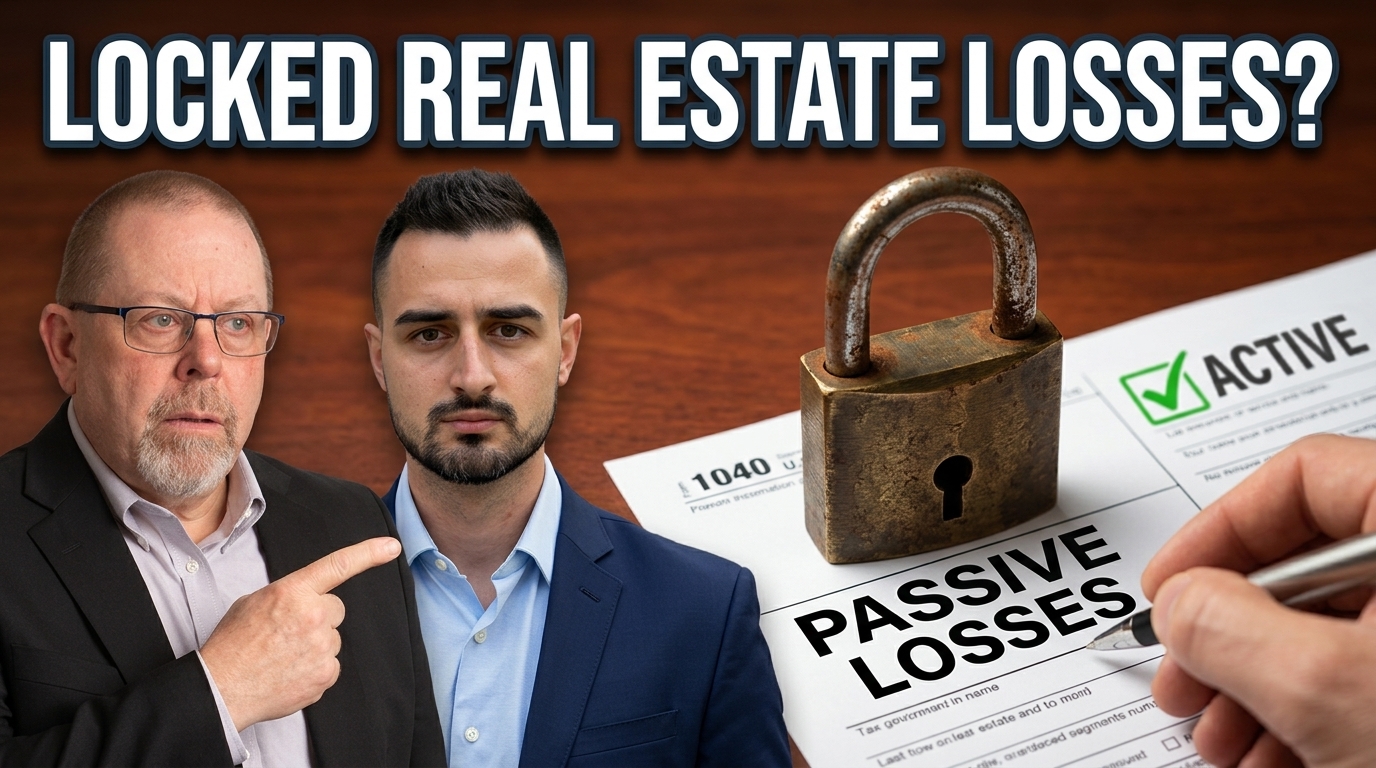
Welcome back to the blog! In our latest podcast episode, "Your Rental Losses Might Be Useless Unless You Know This IRS Rule," we dove headfirst into a topic that can make or break a real estate investor's tax strategy: the IRS's classification of real estate income as either passive or active. Passsive vs Active is a distinction that often gets overlooked, leading to missed opportunities for tax savings and, in some cases, unexpected tax liabilities. In this post, we're going to expand on those crucial concepts, unpack what they mean for your bottom line, and illuminate why understanding this difference is absolutely vital if you're serious about maximizing your deductions and keeping more of your hard-earned money.
Passive vs. Active Real Estate Income: Defining the Terms
Let's start with the fundamentals. The Internal Revenue Service (IRS) categorizes income from various sources into different buckets, and two of the most significant for real estate investors are "passive" and "active." Understanding the definitions is the first step to navigating the complex world of real estate taxation.
What is Passive Real Estate Income?
Generally speaking, passive income is income generated from an enterprise in which the taxpayer does not materially participate. In the realm of real estate, this most commonly applies to rental activities. If you own rental properties and are not actively involved in the day-to-day operations or management to a significant degree, the income (or losses) generated from these properties are typically considered passive.
Think about it this way: if you've invested in a property, hired a property manager to handle everything from tenant screening to maintenance requests, and your involvement is limited to receiving a monthly statement and cashing checks, that's a classic example of a passive real estate investment. The income derived from the rent collected is passive income. Similarly, if your rental property incurs a loss (expenses exceed income), that loss is also classified as a passive loss.
What is Active Real Estate Income?
Active income, on the other hand, is income derived from activities in which the taxpayer materially participates. This typically includes income from a trade or business where you are actively engaged, such as your primary job (W-2 income), or if you are running your own business where you are deeply involved in its operations. In the context of real estate, active income can also arise from certain real estate-related activities, such as being a real estate developer, a broker, or someone who flips houses where you are heavily involved in the renovation and sale process.
For example, if you are a licensed real estate agent who spends your days showing properties, negotiating deals, and closing transactions, the commissions you earn are considered active income. Similarly, if you buy distressed properties, spend a significant amount of time and effort renovating them, and then sell them for a profit, this type of "flipping" activity, when performed regularly and with substantial involvement, can also generate active income.
Why the IRS Cares: The Impact on Your Tax Deductions
The distinction between passive and active income isn't just an academic exercise for tax purposes. It has profound implications for how you can utilize losses generated from your real estate investments. The IRS has specific rules, often referred to as the passive activity loss (PAL) rules, designed to prevent taxpayers from using losses from passive activities to offset their income from active sources, such as salaries, wages, or income from active businesses.
The General Rule: Limiting Passive Losses
Under the PAL rules, losses from passive activities can generally only be used to offset income from other passive activities. This means that if you have a rental property that generates a $10,000 loss, and your only other income is your W-2 salary of $100,000, you typically cannot use that $10,000 loss to reduce your taxable income from your W-2 job. That $10,000 loss would be suspended and carried forward to future tax years, to be used against future passive income or when you ultimately dispose of the passive activity in a taxable transaction.
Why This Matters for Investors
This rule is a significant hurdle for many real estate investors. The allure of real estate investing often lies in its potential to generate cash flow and appreciate in value. However, early in the life of a property, or due to significant expenses like depreciation, repairs, or capital improvements, rental properties often generate losses. If these losses are passive and you don't have other passive income to offset them, they provide little immediate tax benefit against your primary income sources.
This is where the podcast episode's central theme comes into play: your rental losses might be useless unless you understand how to potentially reclassify them or find exceptions to the PAL rules. The goal for many investors is to find ways to use these valuable losses to reduce their overall tax burden, and this often hinges on demonstrating that your real estate activities are not purely passive.
Unlocking Your Losses: The Power of Real Estate Professional Status
This is where things get particularly interesting and where many investors can find significant tax advantages. The IRS recognizes that for some individuals, real estate is more than just a hobby or a side investment; it's their primary vocation. For these individuals, there's a special designation: "Real Estate Professional Status." If you qualify as a Real Estate Professional, your rental real estate activities are generally treated as an active trade or business, not a passive one.
What Constitutes Real Estate Professional Status?
To qualify as a Real Estate Professional, you must meet two specific tests under IRS regulations:
- More than half of the personal services you perform in all trades or businesses during the year are performed in real property trades or businesses in which you materially participate. This means that over 50% of your working hours must be dedicated to real estate activities in which you are actively involved.
- You perform more than 750 hours of services during the year in real property trades or businesses in which you materially participate. This is a quantitative test. You must be able to demonstrate that you've spent at least 750 hours working on real estate activities where you materially participate.
It's crucial to understand that "real property trades or businesses" includes things like developing, redeveloping, constructing, reconstructing, acquiring, converting, renting, operating, managing, leasing, or selling real property. It's not just about being a landlord; it encompasses a broad range of activities related to the real estate industry.
The Game-Changing Impact of Qualification
If you can successfully meet both of these tests and properly document your time, your rental real estate activities will be reclassified as active. This means that any losses generated from these properties can then be used to offset your W-2 income, your income from other active businesses, and other non-passive income sources. This can lead to substantial tax savings. For example, if you have $50,000 in rental property losses and qualify as a Real Estate Professional, you could potentially reduce your taxable income by $50,000, leading to significant tax dollars saved.
Material Participation: What It Really Means for Investors
The concept of "material participation" is central to both defining passive versus active income and qualifying for Real Estate Professional Status. It's not enough to simply own property or be involved in real estate; you must be involved in a way that the IRS considers substantial and regular.
The IRS's Seven Tests for Material Participation
The IRS provides seven tests to determine if a taxpayer materially participates in an activity. You only need to meet one of these tests to be considered materially participating:
- You participate in the activity for more than 500 hours during the year.
- Your participation in the activity constitutes substantially all of the participation in the activity of all individuals (including individuals who are not owners of interests in the activity).
- You participate in the activity for more than 100 hours during the year, and no other individual (including individuals who are not owners of interests in the activity) participates more than you do.
- The activity is a significant participation activity (SPA) for the tax year, and your aggregate participation in all SPAs during the year exceeds 500 hours. (An SPA is an activity in which you participate for more than 100 hours but less than 500 hours.)
- You materially participated in the activity for any 5 (or more) tax years (whether or not consecutive) during the 10 tax years that immediately precede the tax year.
- The activity is a personal service activity, and you materially participated in the activity for any 3 (or more) tax years (whether or not consecutive) preceding the tax year. (Examples of personal service activities include health, law, engineering, architecture, accounting, actuarial science, the performing arts, or consulting.)
- Based on all the facts and circumstances, you participate in the activity on a regular, continuous, and substantial basis during the year.
For real estate investors, meeting tests 1, 3, or 7 is often the most relevant for day-to-day management. This means keeping detailed records of your time spent on property management, renovations, tenant communication, vendor oversight, marketing vacant units, and any other activities directly related to your rental properties.
The Importance of Documentation
It cannot be stressed enough: documentation is key. If the IRS questions your material participation or your Real Estate Professional Status, you will need to be able to provide evidence. This includes keeping a detailed log of your activities, the dates, the time spent, and a description of the task performed. This documentation can be in the form of a spreadsheet, a dedicated time-tracking app, or even detailed notes. Without solid records, your claims could be challenged and disallowed.
Short-Term Rentals: A Special Case to Consider
The landscape of short-term rentals, like those facilitated through platforms such as Airbnb and VRBO, has introduced new complexities to the passive versus active income debate. Historically, many short-term rentals were automatically classified as passive activities. However, recent IRS guidance and court cases have created an exception that can allow certain short-term rental operations to be treated as active trades or businesses.
The Seven-Day Rule Exception
Under IRS Section 469(k), an exception to the passive activity loss rules exists for taxpayers who engage in a "qualified real estate trade or business." For rental real estate activities, this means that if you materially participate in the rental activity, and the average period of customer stay is seven days or less, the activity can be treated as an active trade or business, provided you also meet certain other criteria. This significantly changes the game for hosts who operate short-term rentals, as it can allow their rental losses to offset other income sources, similar to qualifying as a Real Estate Professional.
Key Considerations for Short-Term Rentals
To take advantage of this exception, you still need to demonstrate material participation. This means actively engaging in services that rise to the level of a trade or business, such as cleaning between guests, marketing, handling bookings, and providing guest services. Simply listing a property and having a third-party management company handle everything may not qualify. The average customer stay is a critical factor, so understanding your typical booking patterns is essential. Furthermore, if you have multiple rental properties, you can elect to treat each as a separate activity, or aggregate them under certain conditions, which can impact how the material participation rules are applied.
Common Pitfalls: Mistakes to Avoid with Your CPA and Bookkeeper
Navigating the nuances of passive versus active real estate income is complex, and missteps can be costly. Many investors rely heavily on their Certified Public Accountants (CPAs) and bookkeepers to manage their tax affairs. However, it's crucial to be an informed investor and to ensure your team is up to speed on these specific real estate tax rules.
Misclassifying Activities
One of the most common pitfalls is simply misclassifying an activity. If your CPA or bookkeeper doesn't fully understand the IRS's definitions of passive and active income, or the requirements for Real Estate Professional Status, they might incorrectly categorize your rental income and losses. This can lead to missed opportunities for deductions or, worse, the incorrect application of tax laws.
Lack of Proper Documentation
As we've emphasized throughout this post, documentation is paramount. A frequent mistake is failing to keep adequate records of your time spent on real estate activities. If you claim Real Estate Professional Status or argue for material participation in a short-term rental, the IRS will want to see proof. If you don't have it, your claims can be easily disallowed, and you could face penalties and back taxes.
Not Understanding the "At-Risk" Rules and Basis Limitations
Even if you have passive losses that you want to deduct, you can only deduct them up to your "at-risk" amount and your tax basis in the property. If you have borrowed money to acquire a property and haven't personally guaranteed the loan, or if your basis in the property is low, you may not be able to deduct all of your losses, even if they are passive. Understanding these limitations is crucial for accurate tax planning.
Ignoring Short-Term Rental Nuances
With the rise of the sharing economy, many investors who operate short-term rentals are not aware of the specific rules that can allow them to treat these activities as active. They might be missing out on significant tax benefits by assuming all rental income is passive.
The Importance of Proactive Communication
It's your responsibility as the taxpayer to understand your tax situation and to communicate effectively with your tax professionals. Don't be afraid to ask questions. Discuss your real estate activities in detail with your CPA. Ask them about your potential to qualify for Real Estate Professional Status, how you should be tracking your time, and the implications of your rental activities. The more your tax preparer understands your specific situation, the better they can advise you and ensure your tax returns are accurate and optimized.
Conclusion: Maximizing Your Tax Savings Through Smart Classification
The distinction between passive and active real estate income is not just a technicality; it's a cornerstone of effective tax strategy for real estate investors. As we explored in our recent podcast episode, "Your Rental Losses Might Be Useless Unless You Know This IRS Rule," understanding and correctly classifying your real estate activities can mean the difference between valuable tax deductions that offset your income and passive losses that are suspended for years. Whether it's diligently tracking your hours to qualify as a Real Estate Professional, properly managing your short-term rental operations to take advantage of specific exceptions, or simply ensuring your CPA understands the nuances of your investments, proactive engagement with these rules is essential.
By demystifying passive versus active income, understanding the critical role of material participation, and being aware of special considerations like short-term rentals, you empower yourself to make informed decisions. This knowledge allows you to unlock the full tax-saving potential of your real estate portfolio, ensuring that your hard-earned profits are not unnecessarily eroded by taxes. Remember, tax laws are complex, and it's always advisable to consult with a qualified tax professional who specializes in real estate to tailor strategies to your unique circumstances. Until next time, happy investing and happy strategizing!

CEO, Tax Strategist, Speaker, Educator
David “Mr. Cash Flow” Wiener is a nationally recognized authority on real estate tax strategy and cash flow optimization, and the host of The Tax Strategy Playbook podcast. As Founder and CEO of Cash Flow Strategies, Inc., David has spent decades helping real estate investors, business owners, and their advisory teams legally reduce taxes, unlock hidden cash flow, and put more money back into productive assets instead of into the IRS.
Over the course of his career, David has become especially known for his work with cost segregation, 179D energy-efficient commercial building deductions, and other engineering-based tax incentives that accelerate depreciation and free up capital. He has also built a long track record in cash flow and accounts receivable optimization, helping clients improve profitability and financial stability without simply “working harder” or taking on more risk.
David is a sought‑after speaker, trainer, and educator, with audiences ranging from national industry conferences to small mastermind groups and professional associations. He is known for his clear, practical teaching style and his ability to translate complex tax concepts into simple, actionable plays that investors and advisors can use right away. Whether he is speaking to CPAs, medical and dental practice owners, or real estate investors, David’s message is consistent: tax strategy is one of the most powerful—and most overlooked—wealth multipliers available.
On The Tax Strategy Playbook, David brings that same real‑world experience and teaching approach to the microphone. Each epis…Read More

Beyond the LLC: Understanding the True Tax Impact of Your Business Entity