The $120,000 Tax Credit Architecture Firms Keep Missing
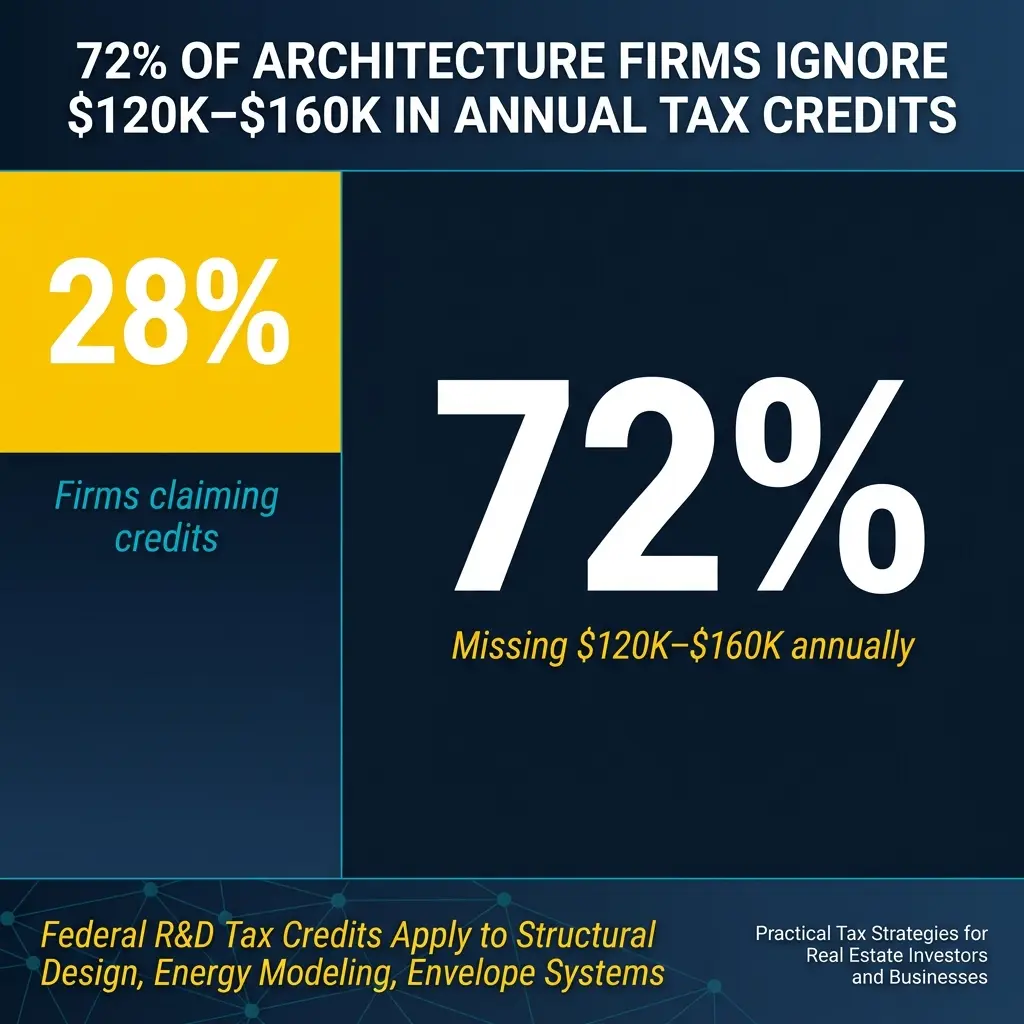
TL;DR: Most architecture firms qualify for the federal R&D Tax Credit based on their everyday technical project work, and most of them have never claimed it. A firm with $2 million in qualifying payroll is looking at $120,000 to $160,000 in annual recovery, plus up to three years of retroactive credits through amended returns.
-
Architecture firms qualify based on routine technical work: structural systems, energy modeling, building envelope design, and more.
-
The credit equals roughly 6-8% of qualified wages and supply costs, a dollar-for-dollar reduction against taxes owed.
-
Most eligible firms never claim it, which leaves capital on the table every year.
-
Firms can look back up to three open tax years to recover missed credits through amended returns.
-
Most states run their own R&D incentive on top of the federal credit.
Why Most Firms Don't Know They Qualify
Most architecture firms assume the federal R&D Tax Credit is reserved for biotech labs and software companies. That assumption is wrong, and it's costing firms six figures a year. The technical problem-solving that happens in an architect's office every day (the structural systems developed, the energy modeling iterated through, the building envelope designs tested) qualifies for substantial tax recovery. And most firms have never claimed it.
David Wiener has watched this pattern repeat for years. Architecture firms with $2 million in qualifying payroll walk past $120,000 to $160,000 in annual tax credits because they don't realize their everyday project work meets the IRS definition of qualified research. The credit typically equates to roughly 6-8% of total qualified wages and supply costs, which translates to 7-10% of qualified research expenses as a dollar-for-dollar credit against taxes owed.
The work that qualifies here is work architects already bill for. Design iteration on a structural system. Energy modeling that goes through six versions before it clears code. A facade detail nobody on the team has built before. That is the pattern the statute describes, and most firms never connect it to the credit at all.
Bottom line: The awareness gap, not the eligibility gap, is what's keeping most architecture firms from recovering the capital they're already entitled to.
What's Actually Blocking Firms From Claiming
The primary barrier isn't eligibility. It's awareness. Most architects either don't know the credit exists or don't believe they qualify. The misconception runs deep: if you're not wearing a lab coat or writing code, the assumption is that the credit isn't for you.
David sees this knowledge gap create unnecessary financial burden across the industry. Firms that do understand the credit often find it years into practice, after they have already paid more tax than they owed. The ones who found it earlier have been recovering capital and putting it back into the business the whole time.
The second barrier is the relationship between architects and their tax advisors. Most CPAs focus on compliance, not strategy. They prepare returns, ensure accuracy, and keep firms out of trouble. That's valuable work. But tax preparation and tax strategy are not the same thing. If a CPA hasn't mentioned the R&D Tax Credit, it doesn't mean a firm doesn't qualify. It means the conversation hasn't happened yet.
Bottom line: Awareness and advisor focus are the two friction points standing between architecture firms and substantial annual tax recovery.
What Activities Actually Qualify
The IRS defines qualified research in a way that captures the kind of technical problem-solving architects do routinely. There's no requirement to invent a new building type or pioneer a revolutionary system. The work needs to meet a four-part test evaluating whether it involves a permitted purpose, technological in nature, elimination of uncertainty, and a process of experimentation.
Here's what qualifying work looks like in practice:
-
Novel structural systems, developing new approaches to spanning, support, or lateral stability that go beyond standard engineering solutions.
-
Energy performance modeling, iterative analysis to achieve energy efficiency targets beyond code minimums, testing variables to optimize performance.
-
Building envelope design, testing new materials, cladding systems, or façade configurations to meet specific performance criteria.
-
MEP integration, coordinating mechanical, electrical, and plumbing systems in technically complex or constrained conditions where standard solutions don't apply.
-
Sustainable design, developing passive systems, net-zero strategies, or LEED-targeted solutions that require experimentation and technical problem-solving.
-
Computational and parametric design, using algorithms or scripts to evaluate design options and solve technical challenges through iteration.
-
Historic preservation with engineering challenges, adapting existing structures for new uses while meeting modern codes, often requiring creative technical solutions.
Architecture is an inherently iterative, experimental discipline. If a firm has worked on projects involving any of these activities, it's likely been performing qualified research without realizing it. The work already being done meets the criteria. The question is whether the credit's being claimed.
Bottom line: The IRS four-part test is broader than most architects realize, and the work architecture firms already perform routinely satisfies it.
The Retroactive Opportunity
One of the most underutilized aspects of the R&D Tax Credit is the ability to look back. Architecture firms can typically look back up to three open tax years to claim missed credits through amended returns. This allows firms to recover credits for prior qualifying projects without changing current operations at all.
If a firm has been performing qualifying work for years, and most architecture firms have, there's a meaningful sum of unclaimed credits sitting in prior returns. This is one of the most significant tax recovery opportunities available to professional services firms. It requires no change to how a firm operates, no adjustment to its business model, and no new risk. It's a matter of claiming what was already earned.
David has seen firms recover hundreds of thousands of dollars through this process. The recovered capital doesn't just reduce tax liability. It frees up resources to hire, invest in technology, or take on projects that wouldn't have been financially viable otherwise. For firms that have been operating lean, an unexpected influx of capital creates strategic options that simply didn't exist before.
Bottom line: The retroactive window is a rare, low-friction opportunity to recover real capital from work already completed, without changing a thing about how a firm operates.
The Risk Myth
Some architects worry that claiming the R&D Tax Credit will trigger an audit. The concern is reasonable, and there is no reliable public figure on how much a credit claim moves examination odds. What matters more is what an exam actually turns on. The IRS wants to see that the work meets the four-part test and that you can prove it. Firms that keep project narratives, time records, and technical documentation as the work happens are in a defensible position. Firms that reconstruct it all afterward are not.
Architecture firms with well-defined project narratives, thorough documentation, and IRS-aligned methodology are well positioned to defend their claims. The key isn't avoiding the credit out of fear. It's working with someone who understands how to structure the claim correctly from the beginning.
David's approach prioritizes documentation and clarity. If the work meets the criteria and the documentation supports it, there's no rational reason to leave the money on the table over an overblown fear of audit risk. A claim that's structured correctly doesn't need to hide. It stands up on its own merits.
Bottom line: Documentation built during the project, not after it, is what makes an R&D Tax Credit claim hold up.
Legislative Changes Worth Knowing
The tax landscape around R&D credits has shifted recently, and the changes favor architecture firms. The One Big Beautiful Bill Act, signed into law on July 4, 2025, reversed the 2022 requirement to amortize R&D expenses over five years. U.S. businesses can now fully deduct domestic R&D expenses in the year incurred, starting with the 2025 tax year.
Eligible taxpayers with average annual receipts of $31 million or less for the three tax years prior to 2025 may elect expensing treatment retroactively to expenditures incurred after December 31, 2021. This improves cash flow and simplifies tax planning for firms that have been navigating the amortization requirement over the past few years.
For firms in that category, the retroactive option creates an immediate opportunity to adjust prior returns and recover capital that was previously tied up in amortization schedules. The legislative shift is meaningful, and it's worth a careful evaluation of how it applies to a firm's specific situation. The same law also set an end date for the 179D energy-efficiency deduction, and architects who designed government or tax-exempt buildings can still claim allocated deductions for projects that began construction in time.
Bottom line: The One Big Beautiful Bill Act (July 2025) restores full same-year deductibility of R&D expenses and opens retroactive options for smaller firms, representing a significant improvement in cash flow potential.
Small Firms Qualify Too
The R&D credit is not limited to large firms with dedicated research departments. Many small and mid-sized architecture firms qualify, particularly those working on technically complex or customized projects. The credit is often applied against income tax, and in some cases payroll tax, depending on circumstances.
David has worked with firms across the size spectrum. The misconception that only large firms benefit from the credit keeps smaller practices from even exploring the option. But small firms often perform more qualifying work than they realize, precisely because they take on projects that require creative problem-solving and technical experimentation rather than rote replication of standard solutions.
Complexity qualifies firms, not size. If a firm is working on projects that push beyond standard solutions, it's likely performing qualified research whether it recognizes it or not.
Bottom line: Firm size isn't a barrier to qualification. The complexity and technical nature of the work is what matters.
State Credits Add to the Federal Benefit
The federal R&D Tax Credit is the primary opportunity, but it is not the only one. Plenty of states have their own version, and a state credit stacks on top of the federal one. Rules and rates vary widely, so the state piece is worth checking against where the firm actually files.
State credits vary in structure and eligibility, but the compounding effect is substantial. A firm claiming both federal and state credits may see total recovery that significantly exceeds the federal credit alone. This is particularly relevant for firms operating in states with robust incentive programs designed to encourage innovation and technical development.
The state-level opportunity gets overlooked because firms focus exclusively on federal tax strategy. But if a firm is already going through the process of documenting and claiming the federal credit, evaluating state eligibility is a natural extension that increases total recovery with relatively little additional effort.
Bottom line: State incentives layer on top of the federal credit, and firms already documenting for federal claims are well positioned to pursue them with minimal extra work.
How the Evaluation Process Works
If the scenarios described in this piece sound familiar, the next step is evaluation. Not every project qualifies, and not every firm will benefit equally, but the only way to know is to analyze project history, payroll structure, and technical activities against the IRS criteria.
David's process starts with understanding what a firm has been working on. The goal isn't to force a claim that doesn't fit. The goal is to determine whether the work already being done meets the standard, and if it does, to recover the capital the firm was already entitled to.
The firms that benefit most from the R&D Tax Credit approach it strategically. They document their work clearly, understand the criteria, and work with advisors who prioritize accuracy over aggressive positioning. The credit isn't a loophole. It's a legislatively intended incentive designed to reward technical innovation and problem-solving. Architecture firms perform that work every day. The question is whether they're capturing the value.
Bottom line: The evaluation process is straightforward, an analysis of project history and technical activities against IRS criteria, with the goal of recovering capital that was already earned.
Frequently Asked Questions
Do architecture firms really qualify for the R&D Tax Credit?
Yes. Architecture firms qualify based on the technical problem-solving they perform routinely: structural systems development, energy modeling, building envelope design, MEP integration, sustainable design, computational design, and historic preservation challenges. The IRS four-part test captures this kind of iterative, experimental work.
How much is the R&D Tax Credit worth to an architecture firm?
The credit typically equals 6-8% of qualified wages and supply costs, translating to 7-10% of qualified research expenses as a dollar-for-dollar credit against taxes owed. A firm with $2 million in qualifying payroll is looking at $120,000 to $160,000 in annual recovery.
Can a firm claim credits for prior years?
Yes. Architecture firms can typically look back up to three open tax years and claim missed credits through amended returns. This retroactive option allows firms to recover credits for qualifying work already completed without changing current operations.
Will claiming the R&D Tax Credit trigger an audit?
Claiming a legitimate credit is not itself a red flag. There is no credible public figure on how much it shifts examination odds, so this post will not quote one. What draws trouble is a claim without support behind it. Firms with project narratives, contemporaneous time records, and a methodology that tracks the four-part test are positioned to defend what they filed.
What is the IRS four-part test for qualified research?
The four-part test evaluates whether work involves: (1) a permitted purpose, developing or improving a business component; (2) technological in nature, grounded in engineering or physical science; (3) elimination of uncertainty, genuine technical uncertainty about capability or design; and (4) a process of experimentation, systematic testing or iteration to resolve that uncertainty. Most architecture firms meet this standard through their routine project work.
Does firm size affect eligibility for the R&D Tax Credit?
No. Small and mid-sized firms qualify just as readily as large practices. In some cases, smaller firms perform more qualifying work than larger ones because they take on technically complex projects that require creative problem-solving rather than replicating standard solutions.
What changed with the One Big Beautiful Bill Act?
Signed on July 4, 2025, the One Big Beautiful Bill Act reversed the 2022 requirement to amortize R&D expenses over five years. Businesses can now fully deduct domestic R&D expenses in the year incurred starting with 2025, and eligible firms with average annual receipts of $31 million or less may elect retroactive expensing treatment back to December 31, 2021.
Are there state-level R&D tax credits for architecture firms?
Yes. A majority of states offer R&D tax incentives that compound the federal benefit. Firms already documenting work for a federal claim are well positioned to evaluate state eligibility with relatively little additional effort, potentially increasing total recovery well beyond the federal credit alone.
Key Takeaways
-
Most eligible architecture firms skip the credit for one reason. Nobody ever told them they qualified.
-
The credit equals 6-8% of qualified wages and supply costs, with firms generating $2 million in qualifying payroll recovering $120,000 to $160,000 annually.
-
Routine architectural work (structural systems, energy modeling, envelope design, MEP integration, sustainable design, and computational design) routinely meets the IRS four-part test.
-
Firms can look back up to three open tax years through amended returns to recover missed credits from prior qualifying work.
-
The One Big Beautiful Bill Act (July 2025) restores full same-year deductibility of R&D expenses, with retroactive options available for smaller firms.
-
State R&D incentives compound federal recovery, and firms already documenting federal claims can evaluate state eligibility with little extra work.
-
A claim backed by project narratives and contemporaneous records is the one that survives scrutiny.

CEO of Cashflow Strategies, Inc., Tax Strategist, Speaker, Educator
David “Mr. Cash Flow” Wiener is a nationally recognized authority on real estate tax strategy and cash flow optimization, and the host of The Tax Strategy Playbook podcast. As Founder and CEO of Cash Flow Strategies, Inc., David has spent decades helping real estate investors, business owners, and their advisory teams legally reduce taxes, unlock hidden cash flow, and put more money back into productive assets instead of into the IRS.
Over the course of his career, David has become especially known for his work with cost segregation, 179D energy-efficient commercial building deductions, and other engineering-based tax incentives that accelerate depreciation and free up capital. He has also built a long track record in cash flow and accounts receivable optimization, helping clients improve profitability and financial stability without simply “working harder” or taking on more risk.
David is a sought‑after speaker, trainer, and educator, with audiences ranging from national industry conferences to small mastermind groups and professional associations. He is known for his clear, practical teaching style and his ability to translate complex tax concepts into simple, actionable plays that investors and advisors can use right away. Whether he is speaking to CPAs, medical and dental practice owners, or real estate investors, David’s message is consistent: tax strategy is one of the most powerful—and most overlooked—wealth multipliers available.
On The Tax Strategy Playbook, David brings that same real‑world experience and teaching approach to the microphone. Each epis… Read More

Can You Claim the R&D Tax Credit for Research You Pay a Contractor to Do?