The R&D Tax Credit Most Startups Don't Know They Can Use
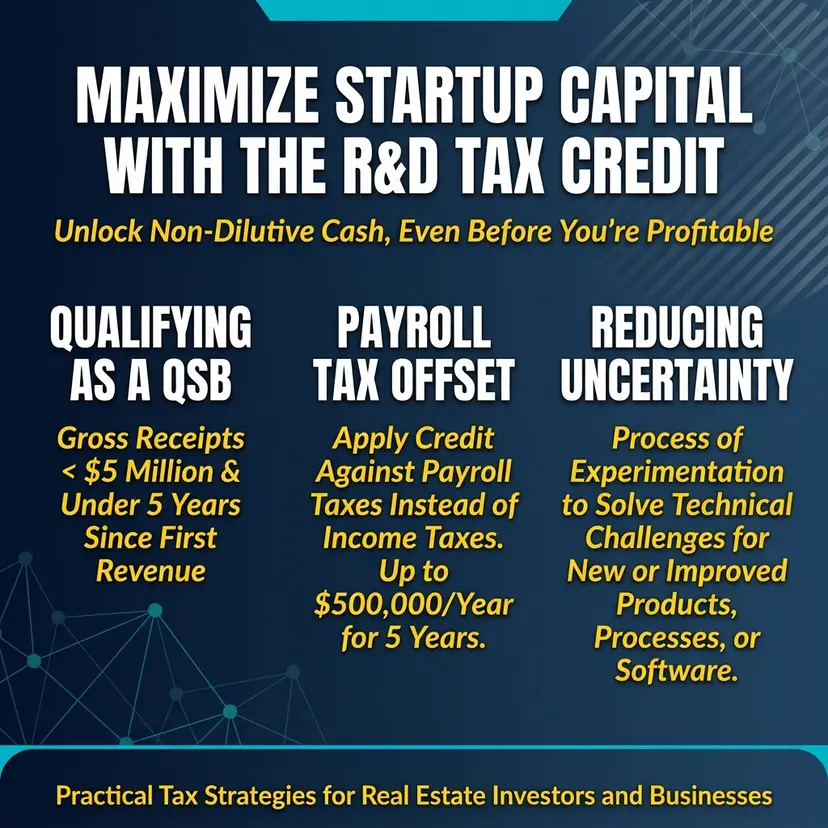
TL;DR: Pre-profit startups doing product development, software work, or technical problem-solving likely qualify for the R&D Tax Credit, and they don't need income tax liability to benefit. The PATH Act of 2015 created a payroll-tax offset that turns the credit into real, usable cash, up to $500,000 per year for five years.
-
Startups don't need to be profitable to use the R&D Tax Credit.
-
The payroll-tax offset (Section 41(h)) lets qualifying companies reduce payroll taxes instead of income taxes.
-
Qualifying Small Businesses (QSBs) with less than $5 million in gross receipts are eligible.
-
The credit covers wages, supplies, and contractor costs tied to qualified research activities.
-
Most eligible startups never claim it, because no one told them they could.
I spend a lot of time talking to founders who assume tax credits are something you worry about after you turn a profit. That assumption costs them real money.
The R&D tax credit exists specifically for companies doing what startups do naturally, building new products, testing procedures, solving technical problems. It's a dollar-for-dollar tax credit for innovation work. What most founders miss is this: you don't need income tax liability to benefit from it. Congress solved that problem in 2015, and the fix is sitting in the tax code right now, unclaimed by the companies that need it most.
What Is the R&D Tax Credit Payroll Offset?
When the R&D credit was created, it had an obvious limitation. A company that owes no income tax can't benefit from a credit that reduces income tax. For profitable companies, the credit is valuable. For pre-profit startups burning through runway, it seemed irrelevant, until it wasn't.
The PATH Act of 2015 changed that. It created Section 41(h), which allows qualifying startups to apply the R&D credit against payroll taxes instead of income taxes. This isn't a workaround or a loophole. It's intentional policy, designed specifically for the startup ecosystem.
The mechanism is straightforward. If you qualify as a Qualified Small Business (QSB), you can offset up to $500,000 of payroll taxes per year using your R&D credit. The Inflation Reduction Act of 2022 doubled that limit from $250,000. The election is available for five years. That's real cash, paid to you, starting the first calendar quarter after your income tax return is filed.
Key Point: The payroll-tax offset transforms the R&D credit from a profitable-company perk into a pre-profit cash flow tool, and it's been available since 2015.
Who Qualifies? The QSB Requirements Explained
The Qualified Small Business definition has three requirements. Your company must have gross receipts of less than $5 million in the current tax year. You can't have had gross receipts for any tax year before the five-year period ending with the current year. And the entity must be a corporation or partnership, not a sole proprietorship.
That five-year test runs from first gross receipts, not from incorporation. Pre-revenue startups still qualify. The clock starts when you generate your first dollar of revenue, which means companies in development mode have time to build their credit before the window opens. Most startups burning capital to build product stay under $5 million in revenue during their first five years. The structure recognizes that innovation happens before profitability.
Key Point: The QSB rules are more accessible than founders expect. If you're early-stage and generating less than $5 million in annual revenue, you're almost certainly inside the qualifying window.
How Much Is the Credit Worth? The Math That Matters
A startup that spends $1 million on domestic research activities can convert that spending into up to $500,000 in payroll tax refunds per year, for five years, without owing a dollar of federal income tax. That's the practical ceiling for a domestic startup using only the payroll offset.
For a company burning $500,000 per year in engineering salaries, this effectively turns five years of R&D into a funded workforce. The credit doesn't just reduce your tax burden. It extends your runway. A qualifying startup that uses the full five-year window and generates at least $500,000 of research credit per year can offset up to $2.5 million in payroll taxes over that period. That's not theoretical future value. That's operational cash flow.
Key Point: Over five years, the payroll offset can return up to $2.5 million in cash to qualifying startups, without a single dollar of income tax liability required.
What Counts as Qualified Research?
The IRS definition of qualified research is broader than most founders assume. You don't need lab coats and centrifuges. You need to be developing new or improved products, processes, software, or techniques. The work must involve technological uncertainty, follow a process of experimentation, and be aimed at eliminating that uncertainty.
Software development qualifies if you're solving technical problems without obvious solutions. Product iteration qualifies if you're testing different approaches to achieve functionality. Process improvement qualifies if you're developing new methods that involve technical risk. The key is documentation. You need to show what you were trying to achieve, what uncertainty existed, what you tested, and what you learned.
Most startups are already doing this work. They're just not tracking it in a way that supports a credit claim.
What the IRS Looks For
-
Technological uncertainty: The outcome of the work wasn't known at the start.
-
Process of experimentation: You tested alternatives to resolve that uncertainty.
-
Qualified purpose: The work aimed at improving a product, process, software, or technique.
-
Business component: The result is tied to your business, not general research.
Key Point: If you're building software, iterating on a product, or solving technical problems without obvious answers, the IRS likely considers that qualified research.
Why Do Most Startups Miss This Credit?
One startup accounting firm puts the figure at fewer than one in three eligible early-stage companies actually claiming the R&D credit. Most of the ones who skip it never learned it applied to them in the first place.
The gap exists because founders are focused on building, not on studying IRS guidelines. Tax strategy feels like something you handle after you have profits to protect. But tax strategy and tax preparation are completely different things. Tax preparation looks backward at what happened. Tax strategy looks forward at what's possible. Most founders assume their accountant is handling strategy when they're only executing compliance.
The difference matters because the R&D credit requires proactive planning. You need to track qualified activities as they happen. You need to separate qualified wages from non-qualified wages. You need to document the technical uncertainty you're addressing. This work happens during the year, not at tax time.
The CPA Gap
Many accountants can prepare an R&D credit claim, but most don't. The data compilation takes significant time. The technical analysis requires specialized knowledge. The documentation standards are rigorous. For a typical accounting firm focused on compliance work, the R&D credit represents a service they can offer but often choose not to prioritize.
This creates a knowledge gap. Your accountant may not mention the credit because they don't want to take on the work. You don't ask about it because you assume they'd tell you if it applied. The opportunity sits there, unused. My father, who was a CPA, used to say that a good CPA is ten miles wide and a foot deep, but the smartest ones surround themselves with specialists who are a foot wide and ten miles deep in areas that matter. The R&D credit is one of those areas where depth matters enormously.
Key Point: The most common reason startups miss this credit isn't ineligibility. It's that no one, not the founder, not the accountant, ever asked the right question.
How to Claim It: Timing and Process
The timing rules split in two, and the split matters. The underlying R&D credit can be claimed for the current year or captured for prior years by amending returns still open under the statute of limitations, generally three years. The payroll offset is stricter. That election must be made on a timely filed original return, extensions included, and generally cannot be added by amending. A prior year you never elected is usually a lost year for the offset, even though the credit itself can still be calculated and carried forward against future income tax.
Sooner is better, and not only for cash flow. Every filing deadline that passes without the election closes that year's offset for good. If you're in year two of operations and just learning about this, get the analysis done before your next return is filed so year two's election lands on time, and have your tax professional evaluate what year one's credit is still worth as a carryforward.
Steps to Get Started
-
Determine if your entity type qualifies (corporation or partnership).
-
Confirm gross receipts are under $5 million and within the five-year window.
-
Identify qualified research activities from the current and prior years.
-
Separate qualified wages, supply costs, and contractor fees.
-
Document technical uncertainty, experimentation processes, and outcomes.
-
Work with me to calculate and file the credit claim.
-
Make the payroll offset election on your timely filed original income tax return.
Key Point: The credit can be calculated for prior years, but the payroll offset election cannot be added after filing. Do the analysis before your return goes in, not after.
What This Actually Means for Your Startup
The R&D tax credit is one of the most underused sources of non-dilutive capital (meaning funding that doesn't require giving up equity or taking on debt) in the U.S. tax code. It's not a luxury reserved for profitable companies. It's a structural advantage that Congress specifically designed for startups, and it's been waiting for you since 2015.
The payroll offset mechanism turns "we're not profitable" from a disqualifier into a non-issue. You're already paying payroll taxes. The credit lets you reduce those payments using the innovation work you're already doing. It's found cash for the exact companies that need runway most.
Tax strategy isn't optional. Your accountant might not be doing what you think. And there's a better way that doesn't require compromising your integrity to access. Using the R&D credit isn't aggressive tax planning. It's understanding what's available and claiming what you've earned.
If you're building something new, solving technical problems, and burning capital to do it, you're probably qualifying for a credit you're not claiming. That's not a small oversight. Over five years, it could be the difference between extending your runway and running out of it.
The strategies the wealthy have always used aren't reserved for the wealthy. They're available to anyone willing to learn how they work. The R&D credit is one of them, and it was designed specifically for companies like yours.
Let's Talk About Your Business
If you're wondering whether your company qualifies, that's exactly the conversation worth having. Most founders I talk to are surprised to learn how much of what they're already doing counts as qualified research. A short conversation is usually enough to get a clear picture of where you stand.
Reach out directly and I'll walk through your situation with you. No pressure, no pitch, just a straightforward look at what's available and whether it makes sense for your business.
Frequently Asked Questions
Do I need to be profitable to claim the R&D Tax Credit?
No. The PATH Act of 2015 created the payroll-tax offset under Section 41(h), which allows pre-profit startups to apply the R&D credit against payroll taxes rather than income taxes.
What is a Qualified Small Business (QSB)?
A QSB is a corporation or partnership with less than $5 million in gross receipts in the current tax year and no gross receipts in any tax year before the five-year period ending with the current year.
How much can a startup offset using the R&D credit?
Up to $500,000 per year in payroll taxes, for up to five years. The Inflation Reduction Act of 2022 doubled the previous $250,000 annual limit.
What types of activities qualify as research under the IRS definition?
Software development, product iteration, process improvement, and any work involving technological uncertainty that follows a process of experimentation and aims to eliminate that uncertainty.
Can I claim the R&D credit for prior years?
Partially. The underlying credit can be calculated for prior open years by amending returns, and it carries forward against future income tax. But the payroll offset election must be made on a timely filed original return and generally cannot be added by amending, so a missed year is usually a missed year for the offset. That is why this analysis belongs in your pre-filing calendar.
Why doesn't my CPA mention the R&D credit?
Most accounting firms focus on compliance, not strategy. The R&D credit requires specialized documentation and technical analysis that falls outside standard tax preparation. It's a service many accountants can provide but often don't proactively offer.
Does software development qualify for the R&D credit?
Yes, if the work involves solving technical problems without obvious solutions. The IRS doesn't require physical lab work. Software, algorithms, and technical processes all fall within the qualified research definition.
When does the payroll offset cash actually arrive?
Starting the first calendar quarter after your income tax return is filed. Once you make the election, the offset reduces your payroll tax deposits in real time.
Key Takeaways
-
Pre-profit startups qualify for the R&D Tax Credit through the payroll-tax offset created by the PATH Act of 2015.
-
Qualifying Small Businesses can offset up to $500,000 in payroll taxes per year, for up to five years, for a potential total of $2.5 million.
-
Eligibility requires less than $5 million in gross receipts, a qualifying entity type, and documented qualified research activities.
-
The IRS definition of qualified research includes software development, product iteration, and process improvement, not just laboratory work.
-
Fewer than one in three eligible early-stage companies claim this credit, primarily because of the gap between tax preparation and tax strategy.
-
The credit itself can be captured for prior open years, but the payroll offset election only works on a timely filed original return. Plan it before filing season, not after.
-
The credit doesn't require aggressive tax planning. It requires documentation of work you're already doing.

CEO of Cashflow Strategies, Inc., Tax Strategist, Speaker, Educator
David “Mr. Cash Flow” Wiener is a nationally recognized authority on real estate tax strategy and cash flow optimization, and the host of The Tax Strategy Playbook podcast. As Founder and CEO of Cash Flow Strategies, Inc., David has spent decades helping real estate investors, business owners, and their advisory teams legally reduce taxes, unlock hidden cash flow, and put more money back into productive assets instead of into the IRS.
Over the course of his career, David has become especially known for his work with cost segregation, 179D energy-efficient commercial building deductions, and other engineering-based tax incentives that accelerate depreciation and free up capital. He has also built a long track record in cash flow and accounts receivable optimization, helping clients improve profitability and financial stability without simply “working harder” or taking on more risk.
David is a sought‑after speaker, trainer, and educator, with audiences ranging from national industry conferences to small mastermind groups and professional associations. He is known for his clear, practical teaching style and his ability to translate complex tax concepts into simple, actionable plays that investors and advisors can use right away. Whether he is speaking to CPAs, medical and dental practice owners, or real estate investors, David’s message is consistent: tax strategy is one of the most powerful—and most overlooked—wealth multipliers available.
On The Tax Strategy Playbook, David brings that same real‑world experience and teaching approach to the microphone. Each epis… Read More
Can You Deduct Leftover 2022 to 2024 Research Costs on Your 2025 Return?