R&D Tax Credits for Small Business: The Complete Guide for 2026
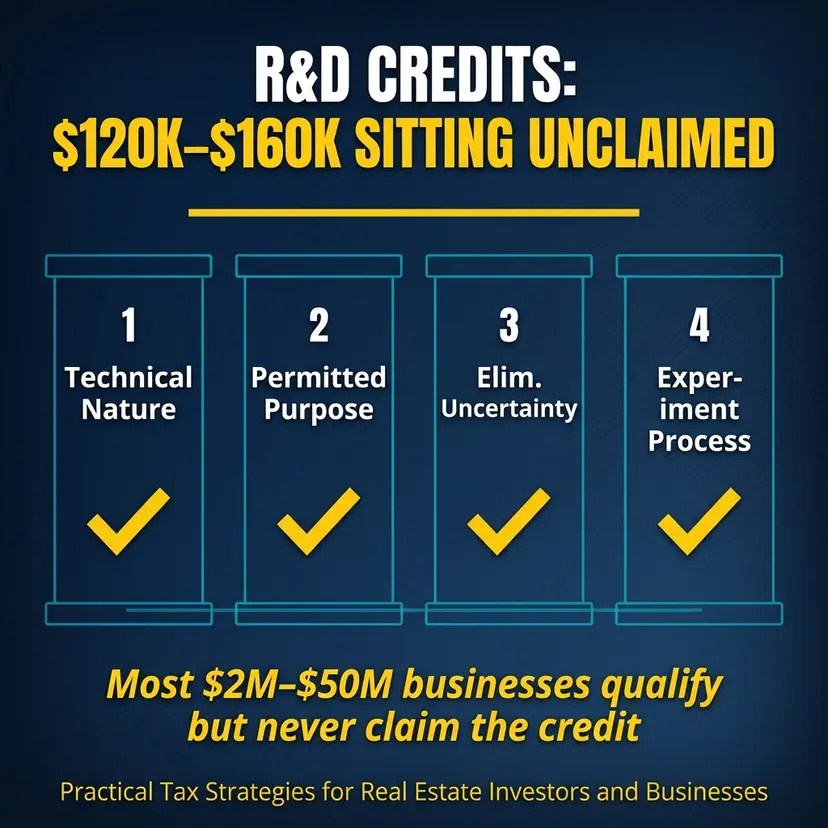
TL;DR:R&D tax credits give you a dollar-for-dollar reduction in taxes owed for technical work you're already doing. Most small businesses qualify but never claim it. Software development, manufacturing improvements, construction engineering, food formulation, and custom fabrication all count. You need proper documentation and a study to claim it, but the payoff is real.
Core answers:
-
The R&D credit is a direct tax credit, not a deduction. On $2M in qualifying expenses, you get $120K to $160K back.
-
You qualify if your work passes four tests: technological in nature, has a permitted purpose, eliminates uncertainty, and involves experimentation.
-
Qualifying costs include W-2 wages for technical work, supplies consumed in research, and 65% of contract research expenses.
-
You claim it on Form 6765. Startups under $5M revenue can apply up to $500K against payroll taxes instead of income tax.
-
You need contemporaneous documentation: who did the work, what uncertainty existed, and proof of experimentation.
Who Qualifies for the R&D Tax Credit?
The R&D tax credit was expanded decades ago to reach the businesses driving innovation in this country. Software shops writing custom code for a single client qualify. Manufacturers figuring out how to run production lines faster qualify. Construction firms engineering foundations for difficult soil qualify. Food companies reformulating recipes to extend shelf life qualify.
These businesses have qualified for years. Almost none of them claim it.
I run R&D credit studies for a living, alongside cost segregation, 179D, and bonus depreciation work. The R&D credit shows the widest gap between who qualifies on paper and who actually files. This guide explains the credit from scratch for business owners running $2M to $50M operations.
What the R&D Tax Credit Actually Is
The R&D tax credit is a direct credit against your tax liability, not a deduction.
That distinction matters more than almost anything else in this article. A deduction reduces the income you pay tax on. A credit reduces the tax itself, dollar for dollar. If your business has $2M in qualifying expenditures, you're looking at a credit of roughly 6% to 8% against what you owe.
On $2M in qualifying activity, you get $120K to $160K back. Not as a paper reduction. As a direct offset against tax owed.
The credit is available to businesses of every size. There is no revenue floor. There is no employee count threshold. A two-person software firm with $400K in qualifying wages and a Fortune 100 conglomerate run the same four-part test against the same statute.
Bottom line: This is a direct dollar-for-dollar reduction in your tax bill for technical work your team already does.
How Do You Qualify? The Four-Part Test
Every qualifying activity has to clear four hurdles. The IRS calls this the qualified research activity test under Section 41. Miss any one of them and the activity drops out. Hit all four and the wages, supplies, and contract costs tied to it become qualified research expenditures.
Test 1: Technological in Nature
The work has to rely on principles of physical science, biological science, engineering, or computer science. You're applying real technical disciplines.
Example: A custom software shop building an inventory routing algorithm is applying computer science. A graphic design studio picking a font palette is not.
Test 2: Permitted Purpose
The work has to be aimed at creating a new or improved business component. That means a product, process, software, technique, formula, or invention that will be used in the business or held for sale.
Example: A food manufacturer reformulating a sauce to reduce sodium by 30% while keeping shelf life intact is improving a product. Repackaging the same sauce in a new label is not.
Test 3: Elimination of Uncertainty
At the start of the work, the business must face technical uncertainty about whether it achieves the result, how it will achieve it, or what the design should be. If you already know the answer when you start, the activity is not research.
Example: A custom fabricator quoting a part for a new alloy does not know whether their existing tooling holds tolerance on it. That is uncertainty. Building a part they have already built a hundred times for a new customer is not.
Test 4: Process of Experimentation
The business has to work through a process of evaluating alternatives. Modeling, prototyping, systematic trial and error, simulation, testing. The hallmark is iteration: you tried something, it did not work the way you predicted, you adjusted, you tried again.
Example: A construction engineering team building three different foundation models for a difficult site, running load calculations on each, and selecting the design that holds is running a process of experimentation. Pulling a standard detail from a library is not.
All four. Every time. The good news is that genuine technical work almost always clears all four if the documentation is there. The bad news is that businesses lose qualifying activity all the time because the people doing the work never wrote down what they were trying to figure out.
Key point: Meeting all four tests simultaneously is required. Documentation is what proves you met them.
Which Industries Qualify?
This is where I see the most surprised reactions. Six industries where the credit shows up far more often than owners expect:
Software and app development. Custom work, not off-the-shelf. A SaaS company building a recommendation engine qualifies. An agency building a client-specific portal qualifies. A fintech writing reconciliation logic from scratch qualifies. Configuring an existing product does not. Writing new code to solve a problem that did not have a documented solution does.
Manufacturing process improvements. A metal stamping operation cutting a 4-second cycle down to 2.8 seconds through tooling redesign and machine programming qualifies. A plastics manufacturer dialing in a new injection mold for tighter tolerance qualifies. Process work is one of the most overlooked categories because the people doing it call it engineering or operations instead of research.
Construction engineering and design. Foundation engineering, structural systems, MEP design on complex sites. A general contractor building on a brownfield with unknown subsurface conditions and running three soil-stabilization models is doing qualifying work. Spec building is not.
Food science and formulation. Reformulating for a dietary restriction, extending shelf life, replacing a banned ingredient, scaling a small-batch recipe to production. A regional sauce company moving from a 10-gallon kettle to a 500-gallon system has months of qualifying activity in the scale-up alone.
Medical devices and biotech. This is the category owners assume is the only one that qualifies. It does, broadly: device design, biocompatibility work, regulatory testing, manufacturing process development for FDA-cleared products.
Custom fabrication. Job shops that build to print for aerospace, defense, energy, and industrial customers. Every part that pushes the shop into new alloys, new tolerances, or new processes is a candidate.
If your business looks nothing like the list above and you still solve genuine technical problems for customers, talk to a specialist before assuming you do not qualify. The industries surprise me too.
Key point: The credit is not limited to traditional R&D industries. If your team solves technical problems through experimentation, you're a candidate.
What Expenses Count as Qualified Research Expenditures?
Three categories of cost roll into the credit calculation:
Wages. The W-2 wages of employees doing qualifying work, supervising it, or directly supporting it. Engineers, developers, scientists, technicians. Their time has to be allocated. If a developer spent 60% of the year on qualifying projects and 40% on maintenance, 60% of their wages count.
Supplies. Materials consumed in the research itself. Prototypes that get destroyed, raw materials used in process trials, samples used in formulation testing. Capital equipment does not qualify here because it goes through depreciation.
Contract research. 65% of amounts paid to third parties doing qualifying work on the business's behalf. The 35% haircut is statutory. The business has to retain rights to the results and bear the financial risk of the research.
Add these up across the year, apply the credit calculation (the regular method or the alternative simplified credit method, depending on which produces the better result), and you have the federal R&D credit. Many states stack their own credit on top, sometimes worth as much as the federal piece.
Key point: Labor costs typically represent 70% to 80% of the total credit value for most businesses.
The 2025 Change: Domestic R&E Expensing Is Back
The One Big Beautiful Bill Act (OBBBA) restored immediate expensing for domestic research and experimental expenditures for taxable years beginning after December 31, 2024. From 2022 through 2024, businesses had been forced to capitalize and amortize these costs over 5 years (15 years for foreign). That created cash-flow pain across the board, especially for small businesses with heavy R&E spend and modest revenue.
Restoring immediate expensing was the headline win. For most businesses, taking the deduction in the year the expense is incurred is better than amortizing it over five years.
There is a scenario where capitalization still wins, and it deserves a model run before you default to expensing.
When Capitalization Beats Expensing
The scenario involves the interaction between three things: the R&D credit, the Section 174 deduction (the underlying expense), and the Section 163(j) business interest limitation. The mechanics in plain English:
The R&D credit is non-refundable for most businesses. It only absorbs tax you actually owe. If you expense everything in 2025 and drive taxable income to zero, you have used the deduction at full value, but the credit has nothing to absorb against. You carry it forward.
If you capitalize and amortize instead, taxable income stays higher in year one. The credit absorbs against that income. The deduction is still coming, spread across five years.
Separately, Section 163(j) limits the business interest deduction to 30% of adjusted taxable income (ATI). Expensing R&E lowers ATI, which tightens the 163(j) cap and disallows current-year interest. Capitalizing keeps ATI higher and preserves more of the interest deduction.
For most businesses with modest debt and a clean credit position, expensing wins. For businesses with significant debt service, large credit positions, or carryforwards in play, capitalizing saves more cash over the projection window than expensing does. The decision is a multi-year model, not a default election. Run it.
Key point: If you have significant debt or large credit carryforwards, model both scenarios before choosing expensing.
How to Claim the R&D Credit
The federal credit is claimed on Form 6765, filed with the business's federal return. The form lets you choose between the regular credit method (a complex base-period calculation) and the alternative simplified credit (a 14% calculation against the average QREs of the prior three years). Most small and mid-size businesses use the simplified method. The regular method's base-period reconstruction is brutal without clean historical records.
The Payroll Tax Offset for Startups
Pre-revenue and early-revenue companies elect to apply up to $500K of the federal R&D credit against the employer portion of Social Security and Medicare payroll taxes instead of income tax. The Inflation Reduction Act raised this cap from $250K. Eligibility requires gross receipts under $5M in the current year and no gross receipts more than five years prior. For a startup with $0 in income tax liability and a payroll, this election is the difference between a credit that sits and a credit that pays salaries.
Claiming Prior-Year Credits
Businesses amend up to three years of prior returns to claim the credit retroactively. I have seen owners pull six and seven figures out of returns they assumed were closed. The amendment process requires substantially the same documentation as a current-year claim, and the IRS now requires five specific pieces of information for refund claims: the business components, the research activities performed, the names of individuals who performed the research, the information each sought to discover, and the total QREs by category for each year. The bar is higher than it used to be. The opportunity is still there.
Key point: You have a three-year window to amend past returns. Many businesses recover significant credits they missed.
Documentation: The Whole Game
IRS scrutiny on R&D credits is real. Documentation is the difference between a credit that holds up under exam and a credit that gets disallowed with penalties on top.
Three things you need, contemporaneously (meaning created during the work, not reconstructed afterward):
-
Who did the work. Time tracking by project, even imperfect time tracking, by the people doing the qualifying activity. A simple weekly allocation across projects is enough if it is done consistently.
-
What uncertainty was being addressed. Project notes, design documents, RFCs, engineering memos, lab notebooks. Anything that captures the technical question at the start of the work.
-
The process of experimentation. Iteration records, test results, design alternatives evaluated, prototypes built. This is where engineering teams already have what they need: pull requests, version control history, test logs, CAD revisions, batch records.
The single biggest mistake I see is technical teams doing legitimate qualifying work and writing nothing down. When the study happens, we are reconstructing from memory and email. Reconstructed records hold up far worse under exam than contemporaneous ones. Build the habit now and the credit gets cheaper to claim every year.
This is where I work alongside your CPA. They handle the return, the elections, and the integration of the credit with the rest of your tax position. I run the study: the four-part test analysis, the QRE calculation, the documentation package that survives an exam. Most CPAs refer this out because the documentation standard is its own discipline and the study workload is its own engagement. The credit is a specialization, not a competence question.
Key point: Contemporaneous documentation created during the work is what survives IRS examination. Start documenting now.
Frequently Asked Questions
My CPA did not bring this up. Do I really qualify?
R&D credits are a specialization. General-practice CPA firms typically refer studies out because the documentation standard and the technical analysis require dedicated process. Your CPA not raising the credit usually means it is not part of their service line, not that you do not qualify. A 30-minute conversation with a specialist will tell you whether it is worth running a study.
How long does a study take?
Six to ten weeks for a typical small or mid-size business. Most of the time is technical interviews with the people doing the qualifying work and gathering the documentation. The calculation itself is fast once the activity is mapped.
What does a study cost?
Most studies are fee-based and scoped to the size of the credit. The economics only make sense if the credit substantially exceeds the study fee. A reputable provider will give you a no-cost estimate of the credit range before you commit, so you decide whether to move forward.
What happens if I get audited?
A well-documented study is built to defend the credit under exam. The documentation package, the technical narratives, and the QRE calculations are designed to answer the IRS information document requests. A specialist study provider typically supports the defense if the IRS opens an exam.
Do I take both the credit and the deduction?
Yes. The credit and the Section 174 deduction are separate. You take both, with one mechanical adjustment: the deduction is reduced by the credit amount (or you elect a reduced credit under Section 280C to avoid the deduction reduction). The election is mechanical and your tax preparer handles it.
What if my business is structured as a pass-through?
The credit flows to the owners on the K-1 and is claimed at the individual level. Same calculation, same documentation, different return.
Which states offer their own R&D credit?
Over 30 states offer their own R&D credit that stacks on top of the federal credit. California, New York, Texas, and Massachusetts have some of the largest state credits. Some states allow you to sell or transfer unused credits. Your specialist will model both federal and state credits during the study.
What is the difference between the regular method and the simplified method?
The regular credit method calculates the credit against a base period (your average QREs from years ago). The alternative simplified credit (ASC) calculates 14% of your current QREs minus 50% of the average QREs from the prior three years. Most businesses use ASC because it is simpler and does not require reconstructing old records.
Key Takeaways
-
The R&D tax credit is a dollar-for-dollar reduction in your tax bill for technical work your team already does.
-
You qualify if your work is technological, creates or improves a business component, addresses uncertainty, and involves experimentation.
-
Common qualifying industries: software development, manufacturing process improvements, construction engineering, food formulation, medical devices, and custom fabrication.
-
Qualifying costs include W-2 wages for technical employees, supplies consumed in research, and 65% of contract research expenses.
-
Startups under $5M in revenue apply up to $500K of the credit against payroll taxes instead of income tax.
-
Contemporaneous documentation (time tracking, project notes, iteration records) is what survives IRS examination.
-
You have three years to amend prior returns and claim missed credits retroactively.
Next Step
If you recognized your business in two or three of the industry examples, the next step is a 30-minute conversation. I run a no-cost analysis that estimates the credit range based on a short list of inputs: your team, your projects, your spend categories. No commitment, no study fee until you decide there is enough on the table to justify one.
The R&D credit is one of the few provisions in the tax code that rewards the work you are already doing. The businesses that claim it did not change what they were building. They changed what they wrote down.

CEO of Cashflow Strategies, Inc., Tax Strategist, Speaker, Educator
David “Mr. Cash Flow” Wiener is a nationally recognized authority on real estate tax strategy and cash flow optimization, and the host of The Tax Strategy Playbook podcast. As Founder and CEO of Cash Flow Strategies, Inc., David has spent decades helping real estate investors, business owners, and their advisory teams legally reduce taxes, unlock hidden cash flow, and put more money back into productive assets instead of into the IRS.
Over the course of his career, David has become especially known for his work with cost segregation, 179D energy-efficient commercial building deductions, and other engineering-based tax incentives that accelerate depreciation and free up capital. He has also built a long track record in cash flow and accounts receivable optimization, helping clients improve profitability and financial stability without simply “working harder” or taking on more risk.
David is a sought‑after speaker, trainer, and educator, with audiences ranging from national industry conferences to small mastermind groups and professional associations. He is known for his clear, practical teaching style and his ability to translate complex tax concepts into simple, actionable plays that investors and advisors can use right away. Whether he is speaking to CPAs, medical and dental practice owners, or real estate investors, David’s message is consistent: tax strategy is one of the most powerful—and most overlooked—wealth multipliers available.
On The Tax Strategy Playbook, David brings that same real‑world experience and teaching approach to the microphone. Each epis… Read More
Can You Deduct Leftover 2022 to 2024 Research Costs on Your 2025 Return?