The BOI Requirement Is Gone: Here's What That Actually Means for Your Entities
TL;DR: FinCEN's final rule permanently removes the beneficial ownership information (BOI) reporting requirement for U.S. companies and U.S. persons under the Corporate Transparency Act. Previously filed data will be deleted. Foreign entities still file. If you own a domestic LLC or corporation, that compliance obligation is finished.
-
U.S. companies and U.S. persons are permanently exempt from BOI reporting under the Corporate Transparency Act.
-
FinCEN will delete all previously submitted BOI data from U.S. persons from its federal database.
-
Foreign entities registered to do business in the U.S. must still report, but only for foreign beneficial owners.
-
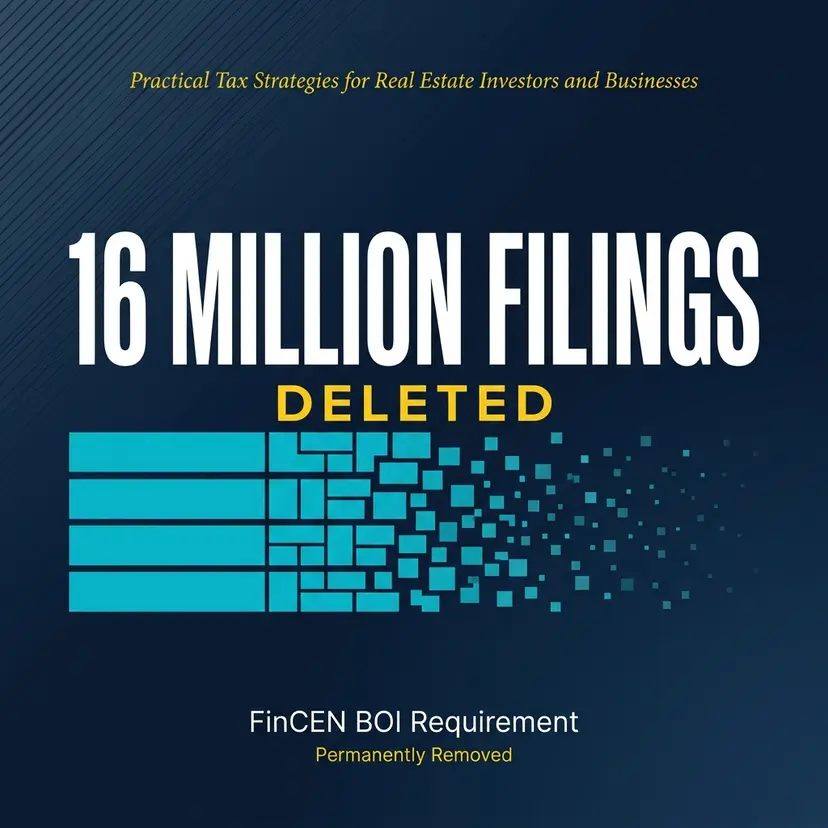
Roughly 16 million domestic entities had already filed before this reversal took effect.
-
The rule becomes effective upon publication in the Federal Register.
About 16 million domestic entities filed beneficial ownership information reports before the government reversed course. That number matters, because every one of those filings belongs to a requirement that no longer exists. FinCEN, the Treasury Department's Financial Crimes Enforcement Network, issued a final rule that permanently removes the requirement for U.S. companies and U.S. persons to report beneficial ownership information under the Corporate Transparency Act.
The rule takes effect the moment it publishes in the Federal Register. FinCEN also announced it will delete the previously reported information from U.S. persons, now exempt, from the beneficial ownership database entirely.
I've spent my career teaching business owners and real estate investors that the tax code, and the regulatory environment around it, rewards people who understand it and quietly penalizes people who assume someone else is handling it. This rule is a perfect case study in why that education matters. Let me walk you through what happened, what it means for your entity structure, and the deeper lesson worth taking from it.
What Actually Changed
The Corporate Transparency Act was set to require nearly every small LLC and corporation in the country to file a beneficial ownership report with FinCEN, with steep penalties for missing it. Then court challenges froze and unfroze the deadlines through 2024 and early 2025, an interim rule in March 2025 narrowed the scope, and today's final rule made the exemption permanent.
Where things stand now:
-
U.S. companies and U.S. persons are no longer required to report beneficial ownership information to FinCEN, permanently.
-
Foreign entities registered to do business in the U.S. remain "reporting companies." They still file, unless exempt.
-
Foreign reporting companies only report the beneficial ownership information of non-U.S. individuals. They are not required to report their U.S. beneficial owners.
-
Previously filed U.S. data will be deleted from the FinCEN database.
Treasury Secretary Scott Bessent called the original mandate "a burdensome reporting requirement for millions of law-abiding business owners." Whatever your politics, the practical reality is identical. One of the largest regulatory rollbacks affecting small businesses in recent history just became final.
Key Point: The BOI requirement for U.S. domestic entities is permanently gone, and the government is deleting what was already collected.
Why Real Estate Investors Were Most Exposed
This is the part worth sitting with, because it explains why I've been tracking this rule so closely on behalf of my clients and listeners. FinCEN originally estimated the CTA would affect over 32 million entities, falling hardest on smaller and unregulated companies. Real estate investors were particularly exposed, because developers and investors typically hold properties in single-purpose entities, and those entities did not fall within the CTA's reporting exceptions.
Consider the structure I analyze every week. An investor owns six rental properties, each held in its own LLC for liability protection. Under the original rule, that investor owed six separate federal filings, with penalties attached to each one. The structure that careful advisors recommend for asset protection became, almost by accident, a compliance minefield.
Rules written to catch bad actors tend to land first, and heaviest, on the ordinary business owner who set up an LLC because it was the responsible thing to do. That's the emerging dynamic across the regulatory landscape worth watching carefully.
Key Point: Real estate investors holding multiple single-purpose LLCs faced compounding compliance exposure. Six properties meant six separate filing obligations under the original rule.
The Original Intent Was Real, and So Were the Concerns
An honest analysis requires looking at both sides. The CTA had a legitimate purpose. Congress designed it to enhance transparency in entity structures, address money laundering and tax fraud, and stop criminals from moving money and buying assets anonymously through shell companies. The data behind that concern was striking. FinCEN found that roughly 30% of high-end, all-cash real estate purchases in six major U.S. metropolitan areas involved a company whose beneficial owner it had previously linked to suspicious activity.
The counterweight was privacy. Business groups pushing for the exemption pointed out that owners' sensitive personal information (names, addresses, passport and driver's license numbers) sat in a federal database, exposing them to ongoing cybersecurity and unauthorized disclosure risks. The decision to delete the U.S. data is the most consequential part of today's announcement. Removing a requirement helps you going forward. Destroying the data protects you retroactively.
My father taught me that tax evasion is a crime, but tax avoidance is mandatory. The same logic applies here. Transparency rules aimed at criminals deserve support in principle, and law-abiding owners deserve structures that respect their privacy in practice. Today's rule attempts to redraw that line.
Key Point: The CTA served a real anti-fraud purpose, but the privacy risks to compliant owners were significant. Deleting the collected data is the most meaningful protection this reversal delivers.
What You Should Do With This Information
💡 First, and most simply: if you formed a U.S. entity and were tracking a BOI deadline, that obligation is gone. You can close that file.
Second, if you already filed, understand that FinCEN has committed to deleting your information from the database. You submitted it in good faith under a rule that existed at the time. That was the right call then, and the deletion resolves the exposure now.
Third, and this is the teacher in me talking, treat this episode as a lesson in how fast the compliance landscape moves. This rule froze, thawed, narrowed, and then reversed inside of roughly two years. Guidance that was accurate in January 2024 became outdated several times over. The investors who navigated it well were the ones who stayed connected to a source of current information, asked their advisors specific questions, and understood the difference between a filed form and a finished obligation.
⚠️ One caution: if you're a U.S. person with ownership in a foreign entity registered to do business here, the rules still deserve a careful look. Foreign reporting companies continue to file for their foreign beneficial owners, and the details of who reports what are worth confirming with your advisor before you assume you're clear.
Key Point: Domestic entity owners can close the BOI file. Foreign entity ownership still requires a conversation with your advisor before assuming full exemption.
The Bigger Lesson Sitting Underneath This Headline
The contrarian conclusion here is worth stating directly. Owners who read today's news as a reason to pay less attention to regulation are drawing the wrong lesson from it. A rule that swung this dramatically, this quickly, is evidence that the environment around your entities is more volatile than it appears, and that the value of staying informed just increased considerably.
The same principle drives everything I teach about tax strategy. Compliance keeps you out of trouble. Strategy builds wealth. Both depend on knowing what the rules actually say right now, as opposed to what they said the last time you checked. The BOI saga proves the distance between those two things can be enormous, and it can open and close within months.
I'm optimistic about what this means for small business owners and real estate investors. A significant compliance burden lifted today, a privacy risk got resolved through data deletion, and the entities you use to protect your assets got simpler to maintain. That's real relief worth acknowledging.
Key Point: A rule that reversed this quickly is an argument for staying more connected to regulatory changes, not less. The compliance landscape rewards the informed and quietly penalizes everyone else.
Frequently Asked Questions
Do I still need to file a BOI report for my LLC?
No. If your LLC is a U.S. domestic entity, the BOI reporting requirement has been permanently removed by FinCEN's final rule. No filing is required.
What happens to the BOI report I already submitted?
FinCEN has committed to deleting previously submitted BOI data from U.S. persons who are now exempt. Your filing was compliant at the time. The deletion resolves the ongoing exposure.
Are foreign entities still required to file?
Yes. Foreign entities registered to do business in the U.S. remain "reporting companies" under the CTA, unless they qualify for a specific exemption. They report only the beneficial ownership information of non-U.S. individuals.
Does this affect my S-Corp or C-Corp?
Yes. The exemption applies to U.S. companies broadly, including LLCs, S-Corps, and C-Corps organized under U.S. law. Foreign corporations registered to operate in the U.S. are still subject to reporting.
When does the rule take effect?
The rule is effective upon publication in the Federal Register. It is already being treated as final by FinCEN.
What if I own a U.S. entity but also have ownership in a foreign entity?
The U.S. entity is exempt. The foreign entity likely still qualifies as a reporting company. Confirm the specific details with your advisor before assuming full exemption.
Why did this rule change so many times?
The CTA faced multiple court challenges from 2024 into early 2025, which produced a series of injunctions, stays, and deadline changes. The March 2025 interim rule narrowed the scope, and today's final rule made the domestic exemption permanent.
Should real estate investors holding multiple LLCs do anything differently now?
For BOI purposes, no. Each domestic LLC is now exempt from reporting. The broader takeaway is that your entity structure deserves regular review as the regulatory environment continues to evolve.
The Recap
FinCEN's final rule permanently exempts U.S. companies and U.S. persons from beneficial ownership reporting under the Corporate Transparency Act, effective upon publication in the Federal Register. Previously filed U.S. data will be deleted from the federal database. Foreign entities registered to do business in the U.S. remain reporting companies, though they only report foreign beneficial owners. Roughly 16 million domestic entities had already complied before the reversal, making this one of the largest regulatory rollbacks affecting small businesses in recent memory.
The lasting lesson sits underneath the headline. Regulations move fast, they reverse without much warning, and the people who prosper are the ones who stay educated rather than assume the rules are static. That education (patient, honest, and grounded in what the law actually says) is the most reliable wealth-protection approach available.
Key Takeaways
-
FinCEN permanently removed the BOI reporting requirement for U.S. companies and U.S. persons under the Corporate Transparency Act.
-
All previously submitted BOI data from now-exempt U.S. persons will be deleted from the federal database.
-
Foreign entities registered to do business in the U.S. still file, reporting only their foreign beneficial owners.
-
Real estate investors with multiple single-purpose LLCs were among the most exposed under the original rule. That exposure is now resolved.
-
The rule shifted dramatically across roughly two years, making real-time regulatory awareness a core part of entity management.
-
Compliance keeps you out of trouble. Strategy builds wealth. Both require knowing what the rules say today, not what they said the last time you checked.

CEO of Cashflow Strategies, Inc., Tax Strategist, Speaker, Educator
David “Mr. Cash Flow” Wiener is a nationally recognized authority on real estate tax strategy and cash flow optimization, and the host of The Tax Strategy Playbook podcast. As Founder and CEO of Cash Flow Strategies, Inc., David has spent decades helping real estate investors, business owners, and their advisory teams legally reduce taxes, unlock hidden cash flow, and put more money back into productive assets instead of into the IRS.
Over the course of his career, David has become especially known for his work with cost segregation, 179D energy-efficient commercial building deductions, and other engineering-based tax incentives that accelerate depreciation and free up capital. He has also built a long track record in cash flow and accounts receivable optimization, helping clients improve profitability and financial stability without simply “working harder” or taking on more risk.
David is a sought‑after speaker, trainer, and educator, with audiences ranging from national industry conferences to small mastermind groups and professional associations. He is known for his clear, practical teaching style and his ability to translate complex tax concepts into simple, actionable plays that investors and advisors can use right away. Whether he is speaking to CPAs, medical and dental practice owners, or real estate investors, David’s message is consistent: tax strategy is one of the most powerful—and most overlooked—wealth multipliers available.
On The Tax Strategy Playbook, David brings that same real‑world experience and teaching approach to the microphone. Each epis… Read More
What Counts as a Land Improvement, and Why Does It Depreciate Over 15 Years?