The Interest Deduction Game Just Changed, and Most Real Estate Investors Missed It
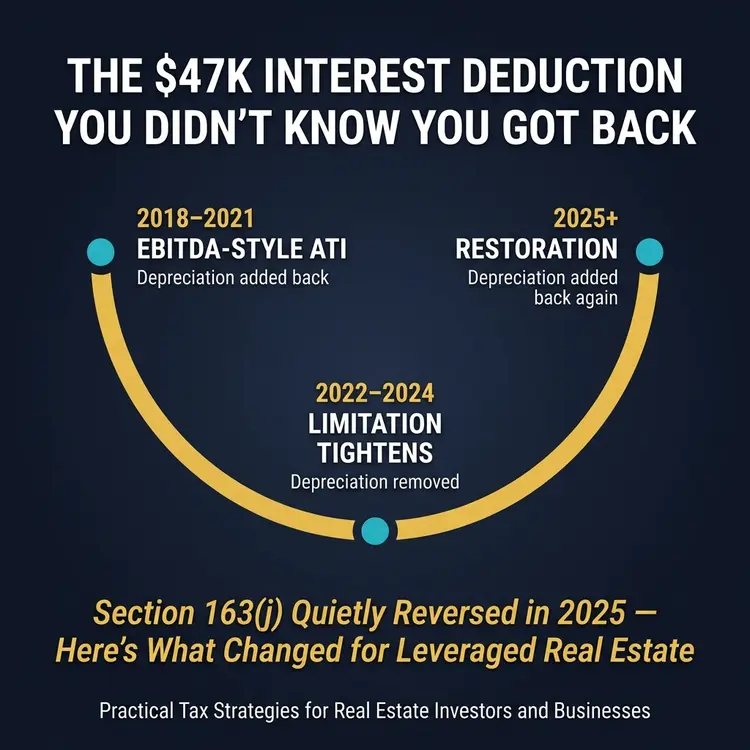
TL;DR: The One Big Beautiful Bill Act made Section 163(j) more generous for 2025 tax returns by adding depreciation back into the interest limitation calculation. This means leveraged real estate investors lose less interest deductions to the cap, cost segregation works with interest deductions instead of against them, and prior elections to opt out may no longer make sense. If you made an RPTOB election in 2022-2024, you can reverse it until October 15, 2026 or the end of the limitations period for that return, whichever comes first. If you already filed your 2025 return, you may want to review whether an amended return makes sense.
Updated September 3, 2026. The window to withdraw a Section 163(j)(7) election closes October 15, 2026, roughly six weeks out. If your election sits on a 2022 return, your own deadline may be earlier, because the assessment period for that year can close first. This update also corrects what this post originally said about capitalized interest, and adds what the statute actually says about which property the election pushed onto the slower depreciation schedule.
For 2025 tax returns, depreciation and amortization get added back when calculating your business interest expense limitation. This single change matters more than most investors realize because it means your interest deductions stop being artificially constrained by accelerated depreciation strategies. The after-tax cost of debt drops when you deduct more interest immediately instead of carrying it forward into future years.
Here's what changed and why it matters for anyone carrying debt on commercial property, whether you already filed your 2025 return or you are still on extension.
What Section 163(j) Actually Does
Section 163(j) limits how much business interest expense you deduct in a given year. The cap is based on a percentage of your Adjusted Taxable Income (ATI), which is a modified version of your taxable income that adds back certain deductions.
From 2018 through 2021, ATI was calculated like EBITDA. Depreciation and amortization were added back, which made your ATI larger and allowed more interest deductions. Then in 2022, the calculation shifted. Depreciation and amortization were no longer added back. Your ATI shrank. Your allowable interest deduction shrank with it.
For highly leveraged real estate investors, this created a problem. Interest expense that used to be fully deductible suddenly was not.
The One Big Beautiful Bill Act reversed this change. Section 70303(a) of that law struck the words "in the case of taxable years beginning before January 1, 2022" out of Section 163(j)(8)(A)(v), which restored the depreciation add-back for tax years beginning after December 31, 2024. For 2025 tax returns, ATI once again includes depreciation and amortization, which means your limitation is higher and more interest becomes deductible in the current year.
Key Point: The interest limitation loosened for 2025 returns because depreciation now adds back to your ATI, which allows more interest deductions today instead of forcing carryforwards.
Why This Change Lowers Your After-Tax Cost of Debt
When interest rates climb, interest expense becomes one of the largest line items for leveraged businesses. If your deductions are limited, the after-tax cost of borrowing rises. You're paying interest with post-tax dollars instead of pre-tax dollars.
A more generous limitation formula lowers the effective cost of borrowing by allowing larger deductions today instead of forcing you to carry them forward into future years. The after-tax cost of debt drops when you deduct more interest immediately.
This is not theoretical. If you have been carrying forward disallowed interest from 2022, 2023, or 2024, the more favorable 2025 calculation may allow you to deduct those carryforwards sooner. This reduces taxable income without new borrowing, which improves cash flow without changing your capital structure. If you already filed your 2025 return without factoring this in, it may be worth reviewing whether an amended return makes sense.
Key Point: A larger ATI means more interest deductions today, which lowers your effective borrowing cost and may put prior-year carryforwards back in play.
The 2026 Rule Change Developers Need to Know
There is a change arriving in 2026 for anyone who capitalizes interest, and it is narrower than it first appears. This section originally said the change swept in all capitalized interest. That was too broad, and the correction matters most to the readers most likely to act on it.
Here is what the statute says. The One Big Beautiful Bill Act added Section 163(j)(10), titled "Coordination with interest capitalization provisions." It provides that the limitation "shall apply to business interest without regard to whether the taxpayer would otherwise deduct such business interest or capitalize such business interest under an interest capitalization provision." Electively capitalizing interest no longer moves it outside the limitation.
The same law amended Section 163(j)(5), the provision that defines business interest, by adding one sentence: "Such term shall not include any interest which is capitalized under section 263(g) or 263A(f)." Section 263A(f) is the provision governing construction period interest on real property. That interest is carved out of the definition entirely, which means it is not business interest for this purpose and the limitation does not reach it.
For a developer, that distinction is the whole ballgame. Interest you are required to capitalize into a building under construction sits outside the calculation. Interest you chose to capitalize under some other provision is now inside it.
One more piece is worth knowing. Section 163(j)(10)(B) sets an ordering rule. Whatever interest you are allowed after the limitation gets applied first to the interest that would have been capitalized, and only the remainder goes to the interest you would have deducted. Capitalized interest gets served first out of a fixed pot, which can leave less of your current deduction intact than you expect.
The IRS has now published the form that carries this. A draft Form 8990 revised for December 2026 was posted on August 26, 2026, with a new line 2 for otherwise capitalizable business interest expense and two new lines that pull the capitalized portion back out of the current year deduction. The draft instructions are not out yet, so wait for them before relying on the mechanics.
Key Point: Electively capitalized interest falls inside the Section 163(j) calculation for tax years beginning in 2026, but interest capitalized under Section 263A(f), which covers construction period interest, is excluded from the definition of business interest and stays outside it.
Cost Segregation Now Works With Interest Deductions, Not Against Them
One of the concerns investors had when depreciation stopped being added back to ATI was that cost segregation studies might make the interest limitation worse. More depreciation means lower taxable income, which could mean a lower ATI and a tighter interest cap.
That tension is gone. With depreciation added back to ATI, cost segregation studies no longer create a conflict with interest deductions. You get the benefit of accelerated depreciation without shrinking your ability to deduct interest.
The two strategies now reinforce each other. Cost segregation reclassifies building components into shorter-lived property, which increases depreciation deductions and reduces taxable income. With 100% bonus depreciation back, those deductions hit immediately. Because depreciation is added back when calculating your interest limitation, you are not penalized for taking the accelerated write-off.
This is the planning environment cost segregation was designed for. You are not choosing between depreciation and interest deductions. You are stacking them.
Key Point: Cost segregation and interest deductions now work together because depreciation adds back to ATI, eliminating the prior conflict between the two strategies.
The Real Property Trade or Business Election Dilemma
Real estate investors have the option to elect out of the Section 163(j) limitation entirely if they operate a Real Property Trade or Business (RPTOB). The election allows unlimited interest deductions, which sounds appealing if you are carrying significant debt.
The election comes with a cost. Once you opt out, you are required to depreciate certain property using the Alternative Depreciation System (ADS), which uses longer recovery periods. Qualified Improvement Property (QIP), for example, loses eligibility for bonus depreciation under an RPTOB election.
This trade-off made sense for some investors when the interest limitation was tight and depreciation was not adding back to ATI. With the more generous calculation in place, the election may no longer be worth the cost. The cost of losing accelerated depreciation often exceeds the benefit of unlimited interest deductions, especially when bonus depreciation is available at 100%.
The election is generally irrevocable. You make it once and you live with it, which is a problem when the rules move as fast as they have the past few years. The IRS has since opened a narrow window to undo elections made in 2022 through 2024, covered further down.
The election did not kill cost segregation. It killed one specific piece of it.
This is where most owners got the wrong idea. When people hear their building went onto the slower ADS schedule, they assume a cost segregation study became pointless. It did not, and the statute is unusually clear about it.
Section 168(g)(8) says the property forced onto ADS "shall consist of any nonresidential real property, residential rental property, and qualified improvement property held by an electing real property trade or business." That is the whole list. The 5 year, 7 year, and 15 year components a study identifies, the carpet and the cabinetry, the specialty electrical, the parking lot and the landscaping, were never on that list. They stayed on the normal schedule and they stayed eligible for bonus depreciation the entire time.
So the damage was narrower than its reputation, and it was concentrated in one place. Here is the whole trade-off:
| Asset | Normal MACRS life | ADS life under the election | Bonus depreciation eligible? |
|---|---|---|---|
| Residential rental building | 27.5 years | 30 years | No, the recovery period is too long either way |
| Nonresidential building | 39 years | 40 years | No, either way |
| Qualified improvement property | 15 years | 20 years | Yes normally, and the election is what took it away |
| 5, 7 and 15 year personal property and land improvements | unchanged | not covered by Section 168(g)(8) | Yes, the whole time |
Read down that table and the real cost shows up. On the shell it is small, two and a half years on residential rental and one year on nonresidential. The expensive part was qualified improvement property, which falls from 15 year property eligible for bonus depreciation to 20 year straight line with none. If you own a commercial building and you have been renovating interiors, that is where the election has been costing you.
There is a version of this that should make you uncomfortable. If you made the election and then skipped a cost segregation study because someone told you it would not help, you have been leaving the largest part of the benefit on the table for three or four years. That is worth fixing whether or not you withdraw the election.
Key Point: The RPTOB election may no longer make sense with the more generous interest limitation, and the ADS penalty it carries hits the building shell and qualified improvement property, not the shorter-lived property a cost segregation study identifies.
The Rare IRS Do-Over You Need to Know About
Here is where things get interesting. The IRS released Revenue Procedure 2026-17, which gives taxpayers a limited-time opportunity to unwind certain Section 163(j) elections made in prior years.
If you elected out of the limitation in 2022, 2023, or 2024, when the calculation was less favorable and the trade-off seemed worth the cost, you now have the option to retroactively withdraw that election. The revenue procedure says a taxpayer who withdraws "will be treated as if the election had never been made." The deadline is October 15, 2026 or the end of the limitations period for the return the election was made on, whichever comes first. If you made the election on a 2022 return, that limitations period may close before October 2026 does.
The mechanics are not complicated, but they are not light either. You withdraw by filing an amended return, an amended Form 1065, or an administrative adjustment request for the year the election was made, with "FILED PURSUANT TO REV. PROC. 2026-17" written across the top and a signed withdrawal statement attached. You also amend every affected later year by that same date, with depreciation recomputed and basis adjusted in each one. Partnerships issue amended Schedules K-1, and the partners who receive them file their own amended returns. If you are under examination for one of those years, you hand a copy to the revenue agent coordinating the exam.
Read that list again and notice how much of it sits on other people's calendars rather than yours. Somebody who calls their CPA in the second week of October is not going to make it. If this applies to you, the useful move this month is a conversation, not a decision.
One more piece is easy to miss. The same revenue procedure lets a taxpayer who is withdrawing the election also make a late election under Section 168(k)(7), which is the election not to take bonus depreciation on a class of property. That sounds backwards until you remember that withdrawing puts bonus back on the table for years you have already filed, and there are situations where you would rather not take it.
This is not common. The IRS rarely offers do-overs on irrevocable elections. The legislative changes were significant enough that the IRS recognized taxpayers might be locked into positions that no longer serve them.
Key Point: The IRS is allowing revocation of certain Section 163(j) elections made in 2022-2024, until October 15, 2026 or the end of the limitations period for that return, whichever comes first, and the filing is a multi-year job rather than a single form.
The Strategic Planning Window for 2025 vs. 2026
The shift in how interest capitalization is treated starting in 2026 created a planning question for 2025, though a narrower one than it first appeared. If you were electively capitalizing interest, moving that into 2025 kept it outside the Section 163(j) calculation, and that option is gone for later years. Construction period interest capitalized under Section 263A(f) is a different story, because it sits outside the definition of business interest and never depended on that timing.
For 2026 planning, once elective capitalization stops helping with the limitation, depreciation becomes more valuable in the ATI calculation because depreciation gets added back. The timing matters if you are planning capital expenditures that will generate depreciation.
The strategy depends on your specific situation. The point is this: the rules were different in 2025 than they are in 2026, and that difference created a timing window that has now closed for elective capitalization.
Key Point: 2025 was the last year elective interest capitalization helped avoid the limitation, and construction period interest under Section 263A(f) was never inside it to begin with.
The Small Business Exemption Most Investors Miss
Not everyone is subject to the Section 163(j) limitation. If your business meets the gross receipts test under Section 448(c), you are exempt.
For 2025 returns, businesses with average annual gross receipts of $31 million or less over the prior three years are not subject to the limitation at all. You deduct all your business interest without worrying about ATI calculations or carryforwards.
This exemption often gets overlooked because the conversation around Section 163(j) focuses on large, leveraged businesses. If you are operating below the threshold, the limitation does not apply to you, and that is worth confirming with your tax advisor.
Key Point: Businesses with average annual gross receipts under $31 million are exempt from Section 163(j) entirely.
What This Means for Your 2025 Strategy
The return of the more generous ATI calculation for 2025 does not mean Section 163(j) stops mattering. The limitation is less restrictive, which changes how you think about leverage, depreciation, and timing.
If you have been carrying forward disallowed interest, the new rules applied to 2025 returns may free up those deductions sooner. If you made an RPTOB election in the past three years, you can still revoke it. The deadline is October 15, 2026 or the end of the limitations period for that return, whichever comes first. If you filed your 2025 return and missed opportunities related to these changes, an amended return might be worth reviewing with your tax advisor.
If you are a developer who was electively capitalizing interest in 2025, that was the last year the strategy helped with the limitation. Starting with 2026 tax returns, the rules changed, and you will need a different approach.
This is not the kind of shift that announces itself. Your CPA may have applied the new rules to your 2025 return without flagging the implications. The implications are real, and they affect how much tax you pay, how much cash flow you keep, and whether prior elections still make sense. If you are still on extension for 2025, this is worth addressing before you file.
Frequently Asked Questions
What is Section 163(j) and why does the limitation exist?
Section 163(j) limits business interest expense deductions to prevent companies from overleveraging and creating excessive tax deductions through debt financing. The cap is based on a percentage of your Adjusted Taxable Income (ATI).
How did the One Big Beautiful Bill Act change the interest limitation?
The Act restored the pre-2022 calculation method by adding depreciation and amortization back to ATI for 2025 tax returns. This makes your ATI larger, which increases the amount of interest you deduct in the current year.
Should I revoke my RPTOB election if I made one in 2022 or 2023?
The answer depends on your specific situation. With the more generous limitation now in place, the trade-off of losing accelerated depreciation may no longer be worth unlimited interest deductions. Review the math with your tax advisor well before the deadline, which is October 15, 2026 or the end of the limitations period for that return, whichever comes first.
Did making the RPTOB election mean cost segregation was a waste of money?
No. The election moved nonresidential real property, residential rental property, and qualified improvement property onto the slower ADS schedule. It did not touch the 5 year, 7 year, and 15 year personal property and land improvements that make up the bulk of what a study finds, and those stayed eligible for bonus depreciation. If you skipped a study because of the election, the study was probably still worth doing, and it still is.
Does cost segregation still make sense with Section 163(j)?
Yes. With depreciation now added back to ATI, cost segregation no longer conflicts with interest deductions. The two strategies reinforce each other instead of competing.
What happens to my disallowed interest carryforwards from prior years?
Carryforwards from 2022-2024 may now be deductible sooner under the more generous ATI calculation applied to 2025 returns. These carryforwards reduce taxable income without requiring new borrowing. If you already filed your 2025 return, review whether you maximized the use of these carryforwards.
What changes in 2026 for developers capitalizing interest?
Starting with 2026 tax returns, Section 163(j)(10) applies the limitation whether you would deduct the interest or capitalize it, so electively capitalizing no longer moves interest outside the calculation. There is an important exception. Section 163(j)(5) excludes interest capitalized under Section 263(g) or Section 263A(f) from the definition of business interest, and Section 263A(f) is the provision covering construction period interest on real property. That interest stays outside the limitation.
Who is exempt from Section 163(j)?
Businesses with average annual gross receipts of $31 million or less over the prior three years are exempt from the limitation entirely.
When is the deadline to revoke a Section 163(j) election?
Revenue Procedure 2026-17 sets it at October 15, 2026 or the end of the limitations period for the return the election was made on, whichever comes first. It applies to certain elections made in 2022, 2023, or 2024. Because the limitations period can be the binding date, confirm which one governs your specific return before you count on October.
Key Takeaways
-
For 2025 tax returns, depreciation and amortization get added back to ATI, which loosens the Section 163(j) interest limitation and lowers the after-tax cost of debt.
-
Cost segregation studies now work with interest deductions instead of against them because depreciation adds back to the limitation calculation.
-
The RPTOB election to opt out of Section 163(j) may no longer make sense with the more generous limitation, and revocations are allowed through October 15, 2026 or the end of the limitations period for that return, whichever comes first.
-
The RPTOB election pushed only nonresidential real property, residential rental property, and qualified improvement property onto ADS. The 5, 7 and 15 year property a cost segregation study identifies was never affected and stayed eligible for bonus depreciation.
-
Starting with 2026 tax returns, electively capitalized interest falls inside the Section 163(j) limitation, but interest capitalized under Section 263A(f), which covers construction period interest, is excluded from the definition of business interest and stays outside it.
-
Businesses with average annual gross receipts under $31 million are exempt from Section 163(j) entirely.
-
Disallowed interest carryforwards from 2022-2024 may now become deductible sooner under the new calculation applied to 2025 returns.
Where to Start
If you made this election in 2022, 2023, or 2024, the question worth answering this month is whether withdrawing it actually puts back more than the amended returns cost to prepare. That is an arithmetic question, and it has an answer before you commit to anything.
I offer a no-cost analysis, delivered through my relationship with CSSI. No obligation and no pitch, and if a study will not pay for itself on your property, I will tell you that. Do not gather documents first. A conversation is enough to start.
- Book a time: calendly.com/david-wiener/cs
- Or call 770-224-8504, option two
Whatever you decide, decide it with your own tax advisor. This is education, not advice about your return.

CEO of Cashflow Strategies, Inc., Tax Strategist, Speaker, Educator
David “Mr. Cash Flow” Wiener is a nationally recognized authority on real estate tax strategy and cash flow optimization, and the host of The Tax Strategy Playbook podcast. As Founder and CEO of Cash Flow Strategies, Inc., David has spent decades helping real estate investors, business owners, and their advisory teams legally reduce taxes, unlock hidden cash flow, and put more money back into productive assets instead of into the IRS.
Over the course of his career, David has become especially known for his work with cost segregation, 179D energy-efficient commercial building deductions, and other engineering-based tax incentives that accelerate depreciation and free up capital. He has also built a long track record in cash flow and accounts receivable optimization, helping clients improve profitability and financial stability without simply “working harder” or taking on more risk.
David is a sought‑after speaker, trainer, and educator, with audiences ranging from national industry conferences to small mastermind groups and professional associations. He is known for his clear, practical teaching style and his ability to translate complex tax concepts into simple, actionable plays that investors and advisors can use right away. Whether he is speaking to CPAs, medical and dental practice owners, or real estate investors, David’s message is consistent: tax strategy is one of the most powerful—and most overlooked—wealth multipliers available.
On The Tax Strategy Playbook, David brings that same real‑world experience and teaching approach to the microphone. Each epis… Read More

What Counts as a Land Improvement, and Why Does It Depreciate Over 15 Years?