The Math Behind Cost Segregation: How Breaking Down Your Building Accelerates Depreciation
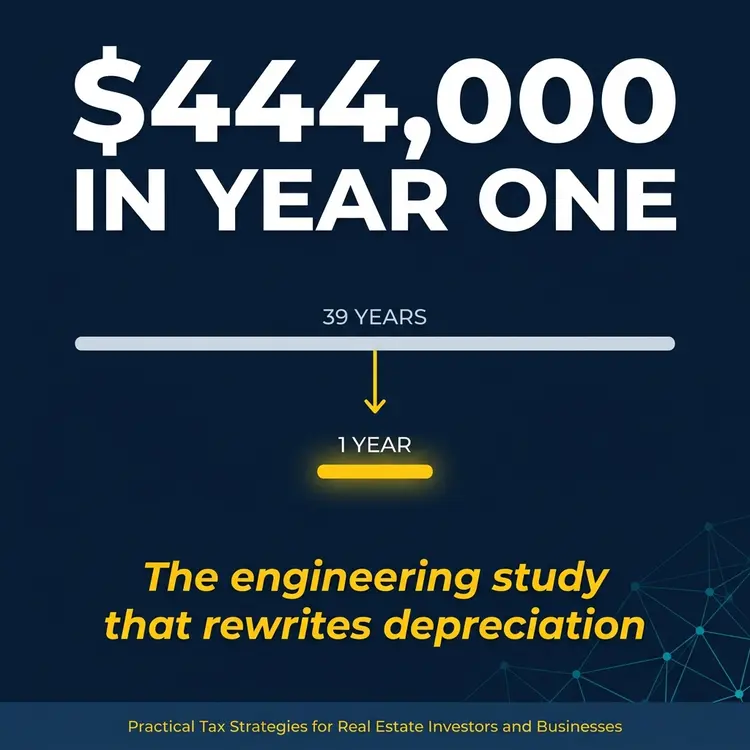
TL;DR: Cost segregation studies reclassify property components into faster depreciation schedules (5, 7, or 15 years instead of 39 years). Residential generally runs 20% to 40% and varies by building. Commercial depends on property type and asset class. For a $3 million building, this turns a $77,000 annual deduction into about $1.25 million in year one. The strategy works for properties you already own through look-back studies. Engineering-based analysis ensures IRS compliance.
Core Facts:
-
Standard commercial depreciation: 39 years at ~$77,000/year for a $3M property
-
With cost segregation: about $1.25 million first-year deduction (100% bonus depreciation restored in 2025)
-
Study cost depends on the building; about $2,000 is the very low end for CSSI
-
Works on existing properties through Form 3115 catch-up deduction
-
Engineering-based studies give you component-level documentation to hand over if your return is examined
Most commercial property owners think they know depreciation. You own a building with $3 million in depreciable basis, land excluded. The IRS tells you to depreciate over 39 years. You deduct roughly $77,000 each year. Simple math.
The problem is this approach treats your entire property as one asset. The tax code lets you separate components and depreciate them at different rates.
Engineering-based cost segregation studies identify which parts of your building qualify for 5-year, 7-year, or 15-year depreciation schedules. This acceleration shifts deductions to year one and compounds over the first five years of ownership.
Here's how the math works.
What Gets Reclassified: The Components That Accelerate
Engineers performing a cost segregation study conduct component-level analysis of your property. They measure, photograph, and document specific building elements the IRS lets you depreciate faster than the structure.
Five-year property includes non-structural interior components like carpeting, cabinets, countertops, wall coverings, wall treatments, window treatments, decorative finishes, and specialty electrical or plumbing systems dedicated to specific equipment.
Fifteen-year property captures land improvements such as parking lots, sidewalks, landscaping, fencing, and exterior lighting.
On residential property, reclassification generally runs 20% to 40%, and it varies with the building. On commercial it depends entirely on the property type and asset class, so there's no general range to quote. For the $3 million building in this example, assume the study identifies $1.2 million eligible for faster depreciation.
Depreciating $1.2 million over 5 to 15 years versus 39 years creates the cash flow impact.
What This Means: Reclassifying building components shifts tax deductions from future decades into the present. This frees up capital when you need it most.
How Cost Segregation Changes Year One Cash Flow
Here are the numbers on a $3 million commercial property purchase.
Standard depreciation gives you $77,000 annually for 39 years. Steady, predictable, spread thin across four decades.
A cost segregation study identifying $1.2 million in accelerated components changes the math. The permanent restoration of 100% bonus depreciation under the One Big Beautiful Bill Act (signed July 4, 2025) lets you deduct the full $1.2 million in year one.
First-year depreciation jumps from $77,000 to about $1.25 million.
At a 37% federal tax rate, you're pulling $444,000 in tax savings forward into year one instead of spreading them across decades. You're not creating new deductions. You're compressing the timeline.
The Calculation: Front-loading depreciation converts future tax benefits into immediate cash flow you control today.
Why Front-Loading Depreciation Matters
Cost segregation's value isn't total deductions over time. The value is when you receive them.
A dollar of tax savings today is worth more than a dollar 30 years from now. Front-loading deductions frees up capital to reinvest in acquisitions, fund renovations, reduce debt, or cover operations.
For every $100,000 in accelerated depreciation, a taxpayer in the 37% federal bracket saves approximately $37,000 in first-year federal taxes. Without acceleration, that same $100,000 spread over 39 years produces a deduction of about $2,564 a year, worth roughly $949 in annual tax savings at the same rate.
The difference is immediate liquidity versus theoretical future benefit.
Time Value Insight: Tax deductions generate more value when taken earlier because capital compounds through reinvestment.
What Happens Over Five Years
Cost segregation doesn't only change year one. The strategy reshapes cash flow trajectory for the first five years of ownership.
On the $3 million building in this example, the five-year picture looks like this. Standard depreciation produces about $385,000 in deductions over those five years, worth roughly $142,000 in federal tax savings at 37%. With the study, year one alone carries about $1.25 million in deductions, and the five-year total comes to roughly $529,000 in tax savings. Nothing about the total deduction over the life of the property changed. What changed is the year you get the money.
This isn't hypothetical. This is cash staying in your business instead of going to the IRS.
Take a $2 million apartment complex with $1.6 million in depreciable basis. On that specific property, a study identifies $560,000 in accelerated first-year depreciation. At a 37% rate that produces $207,200 in first-year tax savings. Standard 27.5-year straight-line depreciation on the same basis gives a $58,182 deduction, worth about $21,500 in tax savings that year.
The difference is roughly $186,000 in cash flow that shows up now instead of over the next two decades.
Five-Year Reality: Accelerated depreciation compounds across multiple years. This creates sustained cash flow advantages beyond the first-year benefit.
Can You Do This on Properties You Already Own?
You don't need to buy a new property to benefit from cost segregation. The IRS lets you perform a look-back study on properties you've owned for years. You catch up on missed depreciation.
You file Form 3115, a change in accounting method. You don't amend prior-year returns. The entire catch-up deduction gets taken in the current tax year.
Properties owned for less than 15 years still have value in reclassifying components. The math works because you're compressing future deductions into the present.
Look-Back Advantage: Existing properties qualify for cost segregation through Form 3115, allowing catch-up depreciation without amending previous tax returns.
What Does a Cost Segregation Study Cost?
Study cost can't be quoted without details on the specific building. About $2,000 is the very low end for CSSI, and it rises with the type of study, the type of building, and complexity.
The study fee for your building depends on its size, systems, and records. The free estimate quotes it before you commit.
Cost vs. Benefit: Study fees are quoted per building, and the free estimate shows the fee and the projected benefit side by side.
Why Engineering-Based Studies Are Required
The IRS blessed cost segregation methodology in its Cost Segregation Audit Techniques Guide. They specify engineering-based studies performed by qualified personnel provide necessary substantiation.
Cheaper alternatives exist in the market. Database-type studies, rule-of-thumb studies, and do-it-yourself options cost less upfront. They leave you with thinner documentation and often miss opportunities to accelerate more depreciation.
Engineering-based studies involve in-person site visits where trained professionals take photographs and measurements inside and outside the building. They capture details engineers need to maximize reclassification opportunities. Virtual studies rely on photos the owner takes. These often miss critical components.
CSSI has produced over 65,000 engineering-based studies. If a client is audited for any reason, we defend the study at no charge for as long as needed.
This separates legitimate tax planning from cutting corners.
Documentation Standard: Engineering-based studies with in-person site visits provide IRS-compliant substantiation. They give you a component-by-component record to hand over.
When Cost Segregation Doesn't Work
Cost segregation isn't right for every property or every investor. I turn down clients when the math doesn't work in their favor.
A study might not be appropriate if:
-
The cost basis, not counting land, is under $150,000
-
You plan to sell without doing a 1031 exchange within the next 3 or 4 years
-
You don't pay enough tax to warrant accelerating the depreciation
-
You're a high-income earner with limited passive income and the deductions will only apply to passive income you don't have
When a study won't benefit a client, I refer them back to their tax preparer with a free estimate so they make an informed decision together.
The free estimate includes the actual study cost and estimated tax benefit based on minimal information. This gives you a way to determine if the strategy makes sense before committing.
Screening Criteria: At a cost basis of $150,000 and up, not counting land, a free estimate tells you whether a study pays. Below that, or without income to absorb the deductions, it usually doesn't.
What Your CPA Might Not Know
Many tax preparers aren't familiar with cost segregation studies or how to apply them to a tax return. Some don't know short-term rental income gets treated as non-passive if you meet material participation rules. Others don't want to handle the complexity.
This doesn't mean cost segregation isn't valuable. Your CPA might not have the expertise or bandwidth to implement it.
We help CPAs apply the study to their client's tax return. The strategy is sound. The IRS approves it. The math works. The issue is usually education and execution support, which we provide.
CPA Limitation: Cost segregation requires engineering analysis CPAs don't perform, but they apply the results once the study is complete.
Common Misconceptions About Cost Segregation
Common misconceptions prevent property owners from exploring cost segregation:
Misconception 1: My CPA will handle it for me
CPAs don't perform cost segregation. The strategy requires engineering analysis. They apply the results, but they don't conduct the study.
Misconception 2: It's too expensive
You can't know the fee without details on the building. About $2,000 is the very low end for CSSI, and a free estimate gives you the number before you decide.
Misconception 3: It only works for commercial properties
The strategy works for residential rental properties, including single-family homes, duplexes, and apartment complexes.
Misconception 4: I've owned the property too long
Properties owned for less than 15 years still generate value through look-back studies.
Education Gap: Most property owners underestimate cost segregation applicability because their advisors lack familiarity with the strategy.
The Math Changes Cash Flow
Cost segregation isn't a loophole. It's a legitimate IRS-approved strategy allowing you to depreciate your property based on the actual components.
The math is straightforward. The engineering is rigorous. The results are measurable.
If you own commercial or residential rental property with a cost basis of $150,000 or more, not including land, it's worth a free estimate rather than treating your building as a single 39-year asset.
The strategy works. The question is whether you're going to access it before you lose years of compounding benefit.
If you're ready to see what a cost segregation study does for your property, call me at 770-224-8504 x 2. I'll provide a free estimate showing the actual study cost and projected tax benefit. No commitment required. We'll run the numbers and determine if this makes sense for you.
Frequently Asked Questions
How long does a cost segregation study take to complete?
Engineering-based studies typically take 4 to 8 weeks from site visit to final report delivery. Timeline depends on property complexity and documentation availability.
Do I need to own the property for a full year before doing a study?
No. You perform the study in the year you acquire or place the property in service. The sooner you complete it, the sooner you access tax benefits.
What happens if I sell the property after doing cost segregation?
Accelerated depreciation gets recaptured as ordinary income (up to 25% rate) when you sell. If you do a 1031 exchange, recapture gets deferred along with capital gains.
Will cost segregation trigger an IRS audit?
Engineering-based studies performed according to IRS guidelines are a documented application of existing rules. Proper documentation and qualified personnel give you a record you can stand behind. CSSI has produced over 65,000 engineering-based studies.
Does cost segregation work for residential rental properties?
Yes. Single-family homes, duplexes, and apartment buildings qualify. Residential properties use 27.5-year standard depreciation instead of 39 years, but component reclassification still creates acceleration.
What if my property is older or fully renovated?
Renovations and improvements qualify for cost segregation. The study identifies components based on when improvements were placed in service, not when the building was originally constructed.
Can I do cost segregation myself or use software?
DIY and software-based studies lack the engineering documentation the IRS expects to see behind a component classification. They often miss reclassification opportunities. They leave the classifications thinly supported.
How much documentation do I need to provide?
You'll need purchase agreements, settlement statements, construction invoices (if applicable), prior depreciation schedules, and property access for the site visit. We guide you through the documentation process.
Key Takeaways
-
Cost segregation reclassifies building components into 5, 7, or 15-year depreciation schedules instead of 39 years. Residential generally runs 20% to 40% and varies by building. Commercial depends on property type and asset class.
-
A $3 million building typically shifts from $77,000 annual deductions to about $1.25 million in year one with 100% bonus depreciation (restored in 2025).
-
The strategy works on existing properties through Form 3115 look-back studies, allowing catch-up depreciation without amending prior returns.
-
Engineering-based studies with in-person site visits provide IRS-compliant substantiation and give you documentation that holds up under examination.
-
Study cost depends on the specific building, with about $2,000 as the very low end for CSSI, rising with study type, building type, and complexity.
-
A cost basis of $150,000 or more, not including land, is worth a free estimate; below that, or without taxable income to absorb the deductions, a study often doesn't pay.
-
CPAs apply cost segregation results but don't perform the engineering analysis required for the study itself.

CEO of Cashflow Strategies, Inc., Tax Strategist, Speaker, Educator
David “Mr. Cash Flow” Wiener is a nationally recognized authority on real estate tax strategy and cash flow optimization, and the host of The Tax Strategy Playbook podcast. As Founder and CEO of Cash Flow Strategies, Inc., David has spent decades helping real estate investors, business owners, and their advisory teams legally reduce taxes, unlock hidden cash flow, and put more money back into productive assets instead of into the IRS.
Over the course of his career, David has become especially known for his work with cost segregation, 179D energy-efficient commercial building deductions, and other engineering-based tax incentives that accelerate depreciation and free up capital. He has also built a long track record in cash flow and accounts receivable optimization, helping clients improve profitability and financial stability without simply “working harder” or taking on more risk.
David is a sought‑after speaker, trainer, and educator, with audiences ranging from national industry conferences to small mastermind groups and professional associations. He is known for his clear, practical teaching style and his ability to translate complex tax concepts into simple, actionable plays that investors and advisors can use right away. Whether he is speaking to CPAs, medical and dental practice owners, or real estate investors, David’s message is consistent: tax strategy is one of the most powerful—and most overlooked—wealth multipliers available.
On The Tax Strategy Playbook, David brings that same real‑world experience and teaching approach to the microphone. Each epis… Read More

Section 280C Election: Take the Full R&D Credit, or Keep the Full Deduction?