How Fractional Family Offices Work: Costs, Benefits, and Who Should Use Them
How Fractional Family Offices Work: Costs, Benefits, and Who Should Use Them
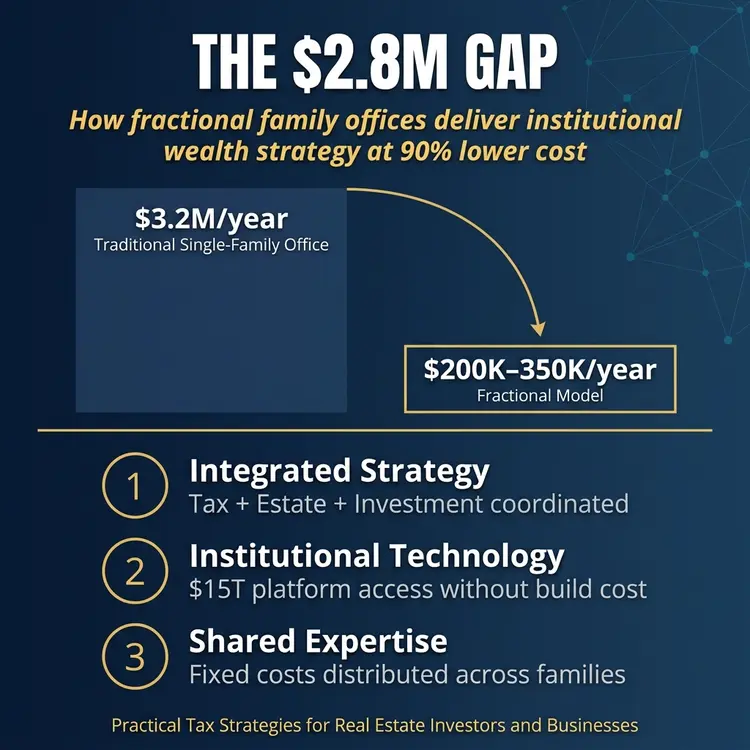
Quick Summary: Fractional family offices share specialized wealth management teams across multiple families, cutting costs from $3.2 million to $100,000-$625,000 annually while delivering institutional-grade services. Families with $25-100 million benefit most because they get coordinated tax strategy, estate planning, and investment management without building infrastructure.
Core answer:
-
Traditional single-family offices cost $1-2 million minimum per year, with $3.2 million average
-
Fractional models charge 0.20%-1.25% of assets (typically 0.40%-0.70%), saving 60-80% in fees
-
Best for families with $25-100 million who need sophisticated planning but lack scale for a dedicated office
-
Key advantage is coordination - all advisors work from one plan instead of operating in silos
-
Technology platforms, AI reporting, and institutional-grade tools come standard without implementation costs
What Is a Fractional Family Office?
A fractional family office delivers comprehensive services identical to a traditional single-family office but shares the team and infrastructure across multiple families. You get investment management, tax strategy, estate planning, and governance coordination under one system.
The cost difference is significant. According to a family office accounting software provider, operating a standalone family office requires between $1 million and $2 million annually at minimum, with average costs hitting $3.2 million per year before you generate a single dollar of investment returns.
The math tells the story. A family with $100 million in assets pays 3.2% annually in operating costs alone. Those economics work when you're managing far more capital. Most experts recommend $100 million minimum, with many suggesting $250 million or more before a traditional single-family office makes financial sense.
Key Point: Fractional offices solve the cost problem by sharing expenses, making institutional-grade wealth management accessible at 1/5th to 1/10th the price of building your own team.
Why Do Traditional Family Offices Cost So Much?
The cost structure scales poorly at smaller asset levels. That same provider's figures put families with less than $500 million in assets under management at 105 basis points (1.05% of total assets) on average. Offices managing over $1 billion pay 36 basis points (0.36%). A threefold efficiency gap.
The problem is fixed costs. One family office technology firm puts staff costs at 67% of total operating expenses. When you hire specialized professionals in tax strategy, investment management, estate planning, and governance, those costs exist regardless of portfolio size. A $50 million portfolio and a $200 million portfolio both need a qualified CIO, CFO, and tax director.
Fractional models share those fixed costs across multiple families. Multi-family offices typically charge between 0.20% and 1.25% of assets under management annually, with most falling in the 0.40% to 0.70% range. For a family with $50 million, fees run $100,000 to $625,000 per year. Compare this to the $1-2 million minimum for a dedicated office.
Key Point: You're accessing the same specialists and systems billion-dollar families use, but sharing the cost structure instead of absorbing everything individually.
What Does Integration Mean in Practice?
The value isn't lower costs alone. The bigger shift is coordination.
When tax planning and investment management get handled by separate advisors who don't communicate, families still build wealth. But they pay more in taxes, miss timing opportunities, and end up with conflicting strategies. The disconnection forces you to play project manager between your CPA, wealth advisor, and estate attorney. Nobody coordinates the overall strategy because nobody owns the full picture.
The industry is recognizing this gap. Wealth management platforms increasingly pitch the family office experience as the thing you have to offer to stay competitive, with estate and tax planning treated as table stakes rather than add-ons. Tax planning and estate planning are no longer separate services you buy independently. They're parts of managing wealth effectively.
The fractional model delivers this integration without requiring you to build infrastructure. Coordinated oversight, proactive tax planning, estate structure, and investment management all work from the same playbook under one system.
Key Point: Integration means your tax strategy informs investment decisions, estate structure shapes entity setup, and governance aligns with succession planning because one team sees the complete picture.
How Technology Platforms Create an Advantage
Fractional models bring another edge: modern technology systems most traditional family offices haven't adopted.
By that same firm's count, 65% of family offices still rely on spreadsheets for core operations. Meanwhile, 63% want AI-powered reporting tools but only 29% use them. This technology gap creates opportunity for modern fractional models offering institutional-grade platforms without requiring you to build them yourself.
Major wealth management platforms now serve advisors managing trillions in combined assets. They bring institutional-grade estate and tax planning tools to a broader market. The largest private banks, national brokerage firms, and independent wealth advisors leverage these platforms to deliver sophisticated planning at scale.
Families accessing fractional family office services get this institutional-grade technology without implementation costs or learning curves. Consolidated reporting (seeing all wealth in one place), enhanced oversight capabilities, and integrated planning tools become available immediately. No years of development. No millions in technology investment.
Key Point: Modern fractional offices give you the same reporting dashboards, AI document processing, and portfolio analytics billion-dollar families use, included in your fee structure.
Why Is This Model Growing Now?
The fractional family office model isn't emerging in isolation. Several market forces are converging.
Total estimated wealth for families with family offices has surged from $3.3 trillion in 2019 to $5.5 trillion today. A 67% increase in five years. This wealth is projected to reach $9.5 trillion by 2030, representing a 189% rise from 2019.
North America is expected to see the greatest increase, with a projected average rise of 258% between 2019 and 2030. This growth links directly to rapid wealth creation in technology, real estate, and entrepreneurship, combined with the urgency of transferring wealth to the next generation.
More families are accumulating significant wealth quickly. The need for structured governance, succession planning, and long-term preservation strategies becomes urgent. Most of these families don't have enough assets to justify a traditional single-family office. This is where fractional models fit.
Key Point: Wealth creation is outpacing the traditional family office model's economics, creating a gap fractional offices are designed to fill.
Who Benefits Most from Fractional Family Offices?
The sweet spot typically includes families with $25-100 million in net worth. This demographic has outgrown basic wealth management (working with a single financial advisor) but hasn't reached the scale where a dedicated single-family office makes financial sense.
These families face complexity. Concentrated wealth from selling a business or real estate portfolio. Planning for multiple generations. Tax optimization across several LLCs or entities. Governance structures need formalization without unnecessary bureaucracy.
The fractional model provides the sophistication these situations require without overhead eating into returns. You get access to specialists in tax strategy, estate planning, investment management, and family governance. You're sharing those resources with other families in similar situations, making the economics work.
Key Point: If you have $25-100 million, need institutional-grade planning, but the $3.2 million average family office cost destroys your economics, fractional models were designed for this exact scenario.
The Hidden Value of Advisor Coordination
The most overlooked benefit is what happens when all advisors work together from the beginning instead of being assembled after decisions are made.
Tax strategy informs investment decisions. Estate structure shapes how you set up entities. Governance frameworks align with succession planning. Risk management integrates with insurance coverage and asset protection. These aren't separate projects with occasional overlap. They're interconnected systems creating compounding value when coordinated properly.
Most families don't realize how much value disconnected advisors leave on the table. Your CPA prepares tax returns but doesn't proactively model tax scenarios. Your wealth advisor manages investments but doesn't coordinate with your estate attorney. Your insurance agent sells policies without understanding your risk profile or asset protection strategy.
The fractional family office model fixes this by creating a single point of accountability with visibility across all areas. Strategy gets executed because someone is responsible for making sure the estate attorney, CPA, and wealth advisor work from the same plan.
Key Point: Coordination turns separate services into an integrated system where each decision strengthens the others instead of creating conflicts.
Why Traditional Family Office Costs Keep Rising
Cost pressure on traditional family offices is increasing. Family office operating costs have risen 23% since 2020, outpacing both inflation and growth in assets under management.
This creates compounding pressure on families trying to maintain traditional structures. As costs rise and the efficiency gap between small and large family offices widens, alternative models become more attractive.
The fractional model addresses this by sharing cost inflation across multiple families instead of forcing each family to absorb everything individually. When technology expenses increase or specialized talent becomes more expensive, the impact distributes across the client base instead of concentrating on one family.
Key Point: Traditional family office costs are rising 23% while fractional models spread those increases across multiple families, maintaining better economics.
What This Means for Your Wealth Preservation Strategy
The emergence of fractional family offices represents more than a cost-saving alternative. This is recognition of something deeper. Effective wealth preservation extends beyond investment performance to structural planning and decision-making frameworks.
Governance matters. Succession planning matters. Tax optimization matters. Estate structure matters. They all matter more when coordinated instead of handled by separate advisors who don't communicate.
Families recognizing this early are positioning themselves to preserve wealth across generations without paying the premium previously required for this level of sophistication. The institutional-grade strategies once reserved for families with $500 million or more are now accessible to those willing to prioritize integrated planning.
The fractional family office model isn't replacing traditional single-family offices. The model expands access to the same principles and practices for families who previously couldn't justify the cost. This democratization of sophisticated wealth management changes who gets to benefit from strategies with proven results.
For families with significant wealth but not unlimited resources, the question isn't whether you need family office-level coordination. The question is whether you're getting coordination through disconnected advisors or an integrated system designed to work together.
Frequently Asked Questions
How much does a fractional family office cost compared to a traditional family office?
Traditional single-family offices cost $1-2 million minimum annually, with average costs of $3.2 million. Fractional family offices charge 0.20%-1.25% of assets under management (typically 0.40%-0.70%). For a family with $50 million, fractional fees run $100,000-$625,000 per year, saving 60-80% compared to a dedicated office.
What is the minimum net worth needed for a fractional family office?
Most fractional family offices work best for families with $25-100 million in net worth. This range has outgrown basic wealth management but lacks the scale ($250 million+) where traditional single-family offices make economic sense. Below $25 million, traditional wealth advisors typically provide sufficient service.
What services do fractional family offices provide?
Fractional family offices deliver investment management, tax strategy and planning, estate planning and structure, business governance, succession planning, risk management, consolidated reporting, and family governance frameworks. All services work from one coordinated plan.
How is a fractional family office different from a multi-family office?
These terms often describe the same model. Both share specialized teams across multiple families to reduce costs while delivering institutional-grade services. The key distinction from traditional wealth management is coordination. All advisors work together under one system instead of providing separate services.
Do fractional family offices use the same technology as traditional family offices?
Modern fractional offices often use better technology. While 65% of traditional family offices still rely on spreadsheets, fractional models provide institutional-grade platforms with AI-powered reporting, consolidated dashboards, and integrated planning tools as part of standard service.
Can a fractional family office help with tax strategy?
Yes. Tax strategy is one of the core services. Because fractional offices coordinate all advisors, tax planning integrates with investment decisions, estate structure, and entity setup. Your tax professional works with your investment team and estate attorney from the same plan, identifying opportunities disconnected advisors miss.
What happens if my family outgrows a fractional family office?
As assets grow beyond $250-500 million, some families transition to dedicated single-family offices when the cost-to-asset ratio makes economic sense. Many families with $500 million+ continue using fractional models because the coordination, technology, and service quality meet their needs without the overhead of building a team.
How do I know if my family needs a fractional family office?
Consider a fractional office if you have $25-100 million in assets, work with multiple advisors who don't coordinate, face complexity from business sales or real estate holdings, need multi-generational planning, or want institutional-grade services without $3 million annual costs. If you're playing project manager between your CPA, wealth advisor, and attorney, you're experiencing the problem fractional offices solve.
Key Takeaways
-
Fractional family offices cut costs from $3.2 million annually to $100,000-$625,000 by sharing specialized teams across multiple families while delivering institutional-grade services
-
Families with $25-100 million benefit most because they need sophisticated planning but lack the scale where traditional single-family offices ($250 million+) make economic sense
-
The primary advantage is coordination. All advisors work from one plan, allowing tax strategy to inform investments, estate structure to shape entity setup, and governance to align with succession planning
-
Modern fractional offices provide better technology than 65% of traditional family offices still using spreadsheets, including AI-powered reporting, consolidated dashboards, and integrated planning tools
-
Traditional family office costs rose 23% since 2020 while fractional models spread those increases across multiple families, maintaining superior economics
-
The model expands access to institutional-grade wealth management strategies previously reserved for families with $500 million or more in assets
-
Integration creates compounding value because coordinated advisors identify opportunities disconnected specialists miss, in tax optimization, timing decisions, and structural planning

CEO of Cashflow Strategies, Inc., Tax Strategist, Speaker, Educator
David “Mr. Cash Flow” Wiener is a nationally recognized authority on real estate tax strategy and cash flow optimization, and the host of The Tax Strategy Playbook podcast. As Founder and CEO of Cash Flow Strategies, Inc., David has spent decades helping real estate investors, business owners, and their advisory teams legally reduce taxes, unlock hidden cash flow, and put more money back into productive assets instead of into the IRS.
Over the course of his career, David has become especially known for his work with cost segregation, 179D energy-efficient commercial building deductions, and other engineering-based tax incentives that accelerate depreciation and free up capital. He has also built a long track record in cash flow and accounts receivable optimization, helping clients improve profitability and financial stability without simply “working harder” or taking on more risk.
David is a sought‑after speaker, trainer, and educator, with audiences ranging from national industry conferences to small mastermind groups and professional associations. He is known for his clear, practical teaching style and his ability to translate complex tax concepts into simple, actionable plays that investors and advisors can use right away. Whether he is speaking to CPAs, medical and dental practice owners, or real estate investors, David’s message is consistent: tax strategy is one of the most powerful—and most overlooked—wealth multipliers available.
On The Tax Strategy Playbook, David brings that same real‑world experience and teaching approach to the microphone. Each epis… Read More

What Counts as a Land Improvement, and Why Does It Depreciate Over 15 Years?