Bonus Depreciation vs. Section 179: Which Accelerates Real Estate Tax Savings
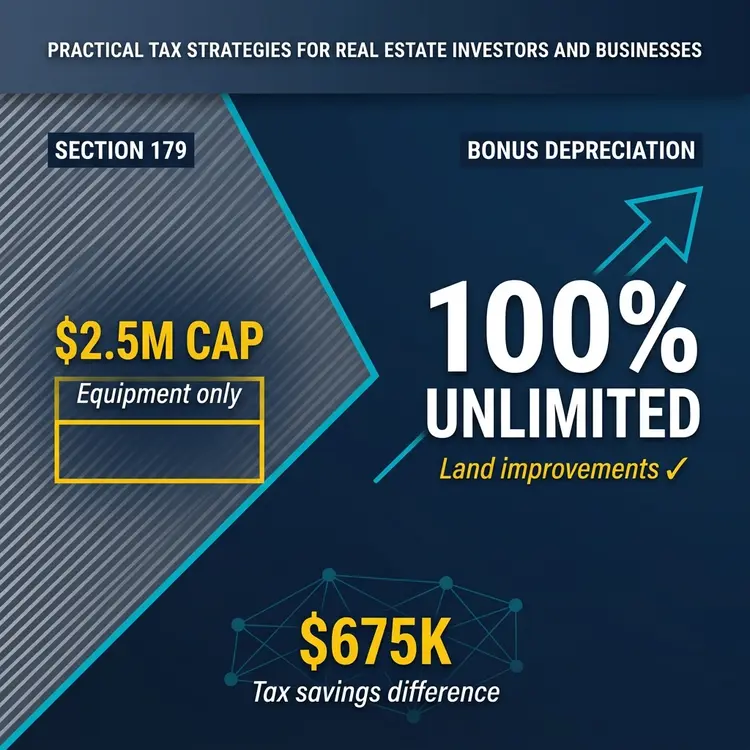
TL;DR: Bonus depreciation typically delivers larger first-year tax deductions for real estate investors compared to Section 179 because of no dollar caps, broader asset eligibility (including land improvements), and fewer income restrictions. The One Big Beautiful Bill Act reinstated 100% bonus depreciation for property placed in service after January 19, 2025, making this tool more valuable for properties analyzed through cost segregation studies.
Core Answer:
-
Bonus depreciation offers 100% deduction with no dollar limit. Section 179 caps at $2.5 million (2025) and phases out at $4 million in total purchases.
-
Bonus depreciation covers land improvements (parking lots, landscaping, fencing). Section 179 typically excludes these assets.
-
Section 179 has taxable income limitations. Bonus depreciation does not add this layer of restriction.
-
Cost segregation studies identify property value eligible for accelerated depreciation, typically yielding better results with bonus depreciation. Residential generally runs 20% to 40% and varies by building. Commercial depends on property type and asset class.
-
Section 179 works best for specific business equipment. Bonus depreciation works better for real estate property components.
Two tax strategies. One decision determines whether you keep an extra $100,000 in year-one cash flow or spread those deductions across three decades.
Property investors face this question repeatedly: Should I use bonus depreciation or Section 179 to accelerate my tax deductions? The choice matters because selecting the wrong tool leaves five-figure to six-figure deductions on the table each year.
Most investors assume these tools work the same way. They don't. Each follows different rules, covers different asset types, and produces different results when applied to investment property.
How Section 179 and Bonus Depreciation Work
Section 179 allows full deduction of qualifying equipment and certain improvements in the year you place them in service. For 2025, the deduction limit is $2.5 million. The deduction phases out when total qualifying purchases reach $4 million.
Bonus depreciation operates on a percentage basis, not a dollar cap. The One Big Beautiful Bill Act provides 100% bonus depreciation for property placed in service after January 19, 2025. You spend $10 million or $50 million, the percentage stays at 100%.
The dollar cap difference becomes critical for large commercial or multifamily properties. A cost segregation study identifying $2 million in accelerated components fits within Section 179 limits. When the study identifies $4 million or $8 million in eligible components, Section 179 hits its ceiling.
Bonus depreciation has no ceiling.
Key Point: Bonus depreciation's lack of dollar limits makes it more suitable for large property acquisitions where cost segregation studies identify millions in accelerated components.
Why Asset Eligibility Matters More Than You Think
Section 179 restricts which assets qualify as property. Land improvements like parking lots, fencing, landscaping, and exterior lighting typically fall outside the definition.
Bonus depreciation includes these land improvements in eligible property.
Cost segregation studies reclassify part of a property's purchase price into 5-year, 7-year, and 15-year recovery periods. On residential that generally runs 20% to 40%, and it varies with the building. On commercial it depends on the property type and asset class. Land improvements and site work represent a substantial portion of that reclassification.
Relying on Section 179 means leaving whole categories of assets out of the calculation. Land improvements are the clearest example. Parking lots, site lighting, landscaping, and drainage are 15-year property, they qualify for bonus depreciation, and Section 179 generally does not reach them. On a property with a large improvement basis, that gap is the difference between a first-year deduction and a 39-year one.
Running those same land improvements through Section 179 produces minimal results because most assets don't meet the eligibility criteria.
Key Point: Bonus depreciation's broader asset eligibility captures land improvements that Section 179 excludes, and how much of the total accelerated deduction they represent depends on the property type and asset class.
Income Limitations Create Hidden Restrictions
Section 179 includes a taxable income limitation. The deduction cannot create or increase a net operating loss for your business.
This restriction affects W-2 employees who invest in real estate. Accelerated depreciation generates paper losses. Using those losses to offset salary income requires meeting real estate professional status or material participation tests.
Bonus depreciation doesn't layer this income restriction into the deduction mechanism. Passive loss rules apply to both tools, but Section 179 adds an extra limitation that reduces its effectiveness for investors with substantial W-2 income.
Key Point: Section 179's taxable income limitation adds complexity for W-2 earners investing in real estate, while bonus depreciation avoids this additional restriction.
Calculate Your Potential Savings Before Talking to Anyone
Get a rough estimate before contacting a cost segregation firm or scheduling a CPA meeting.
A cost segregation calculator estimates year-one deductions based on purchase price, property type, and land value. This estimate tells you whether a full study makes financial sense before spending money on the analysis.
Calculators at costsegregation.info show how cost segregation pairs with bonus depreciation. Walking into a tax advisor meeting with projected numbers beats guessing about potential benefits.
Key Point: Free online calculators provide ballpark estimates that help determine whether a full cost segregation study is worth pursuing for your property.
When Section 179 Makes Strategic Sense
Section 179 works well for specific scenarios. Office furniture, computers, and vehicles used in property management businesses fit the tool's design.
For real estate property components, bonus depreciation typically provides broader asset coverage, no dollar caps, and simpler income treatment. The optimal choice depends on your property type, tax position, and which assets need accelerated depreciation.
The permanent extension of 100% bonus depreciation under the One Big Beautiful Bill Act eliminates the phase-down uncertainty. Previous schedules dropped the rate to 80%, then 60%, then 40%.
The rate stays at 100% going forward.
Key Point: Section 179 remains useful for specific business equipment purchases, while bonus depreciation generally serves real estate investors better for property components.
Real Estate Professional Status Determines Deduction Usability
Accelerated depreciation generates value when you use the losses it creates.
Investors without real estate professional status face passive loss restrictions. Rental losses offset rental income. Offsetting W-2 salary requires meeting specific qualification tests.
Real estate professional status requires spending more than 50% of work time in real property trades or businesses and performing at least 750 hours annually in those activities. Meeting these tests converts rental losses from passive to non-passive, which means they offset W-2 income, business income, and other active sources.
This status distinction converts paper losses into tangible tax savings.
Key Point: Real estate professional status, or material participation in a short-term rental, is what lets accelerated losses offset W-2 income. Without one of the two, the deductions sit and wait for passive income to show up.
Cost Segregation Finds What Section 179 Misses
Both bonus depreciation and Section 179 accelerate deductions. Neither tool reaches full effectiveness without a cost segregation study identifying which components qualify for shorter recovery periods.
Buildings depreciate over 27.5 years for residential property and 39 years for commercial property. Cost segregation studies break buildings into individual components (flooring, electrical, plumbing, site work) and assign each component to its correct recovery period.
The outcome: decades of depreciation compressed into year one.
Take a residential rental with $500,000 in structure basis. Standard depreciation gives roughly $17,425 in year one. After a cost segregation study reclassifies the qualifying components, that first-year figure goes over $95,000 on that specific property. Nothing about the total deduction changed. The year you claim it did.
The difference isn't marginal. The difference changes your entire tax outcome.
Key Point: Cost segregation studies identify property components eligible for 5, 7, or 15-year depreciation schedules. That moves a large share of the deduction into year one instead of spreading it across 27.5 or 39 years.
What 100% Bonus Depreciation Means for 2025 Property Purchases
The return of 100% bonus depreciation reshapes property purchase economics. Investors buying during the phase-down years (80%, 60%, 40% rates) still captured value. The reinstatement of full expensing makes the strategy substantially more effective.
Middle-market investors gain the ability to immediately deduct the full cost of eligible components. This changes capital planning, tax strategy, and long-term investment decision modeling.
You're creating immediate cash flow through tax savings. That cash flow compounds when reinvested into additional properties or business growth.
Key Point: The permanent 100% bonus depreciation rate creates predictable tax planning opportunities and eliminates concerns about phasedown schedules reducing future benefits.
Strategic Timing Beats Maximum Year-One Deductions
A common mistake: assuming maximum year-one deductions always produce optimal results.
Sometimes front-loading makes sense. High-income investors often get better outcomes staggering bonus depreciation across multiple years instead of taking everything immediately. Strategic timing generates six-figure and seven-figure tax savings when you model how accelerated depreciation interacts with other tax code provisions.
Bring your tax professional in at this stage. These are powerful tools, but they only work when someone is looking at your whole return, not the property transaction in isolation.
Key Point: High-income investors should model multi-year depreciation timing strategies rather than automatically taking maximum year-one deductions.
Steps to Take Before Closing on Your Property
Most investors address tax strategy after purchase. This sequence wastes opportunities.
Before closing, complete these steps:
-
Run cost segregation calculator estimates for the target property
-
Determine your passive loss rule status and restrictions
-
Consult your CPA about real estate professional qualification
-
Evaluate if short-term rental material participation applies
-
Model how accelerated depreciation affects your total tax picture
This pre-closing analysis determines which properties make financial sense and how to structure the purchase transaction for optimal tax treatment.
Key Point: Pre-closing tax planning identifies opportunities and structures transactions correctly, while post-closing planning limits you to working within existing constraints.
Frequently Asked Questions
What's the main difference between bonus depreciation and Section 179 for real estate?
Bonus depreciation has no dollar limit and covers land improvements. Section 179 caps at $2.5 million (2025) and excludes most land improvements, making bonus depreciation more effective for real estate investors.
Does the One Big Beautiful Bill Act change bonus depreciation permanently?
Yes. The Act restored 100% bonus depreciation for property placed in service after January 19, 2025, and made this rate permanent rather than subject to phasedown schedules.
When should I choose Section 179 over bonus depreciation?
Section 179 works better for business equipment purchases (furniture, computers, vehicles) and situations where the taxable income limitation aligns with your tax strategy. For property components identified through cost segregation, bonus depreciation typically delivers better results.
Do I need real estate professional status to benefit from accelerated depreciation?
No, but your ability to offset W-2 income with rental losses depends on meeting real estate professional status or material participation tests. Without qualifying, you use losses against rental income only.
How much does a cost segregation study cost?
Pricing depends on the specific building, so it cannot be quoted sight unseen. Engineering-based studies start at about $2,000 at the very low end, and the fee rises with study type, building type, and complexity.
What assets does bonus depreciation cover that Section 179 doesn't?
Bonus depreciation covers land improvements (parking lots, landscaping, fencing, exterior lighting), site utilities, and other 15-year property that Section 179 typically excludes from eligible property definitions.
Should I always take maximum depreciation in year one?
Not always. High-income investors should model multi-year depreciation strategies because staggering deductions across several years sometimes produces larger total tax savings than taking everything immediately.
How do I calculate potential savings before hiring a cost segregation firm?
Use online calculators at costsegregation.info that estimate year-one deductions based on purchase price, property type, and land percentage. These estimates help determine if a full study makes financial sense.
Key Takeaways
-
Bonus depreciation provides 100% deduction with no dollar cap, while Section 179 limits deductions to $2.5 million (2025) and phases out at $4 million in total purchases.
-
Land improvements (parking lots, landscaping, fencing) qualify for bonus depreciation but typically fall outside Section 179 eligibility, creating a significant advantage for real estate investors.
-
Cost segregation studies identify property value eligible for accelerated depreciation, moving deductions into year one rather than spreading them across the full recovery period. Residential generally runs 20% to 40% and varies by building. Commercial depends on property type and asset class.
-
Section 179 includes taxable income limitations that restrict its use for investors with W-2 income, while bonus depreciation avoids this additional restriction layer.
-
Real estate professional status or material participation in short-term rentals determines whether you offset W-2 income with rental losses from accelerated depreciation.
-
The One Big Beautiful Bill Act's permanent 100% bonus depreciation rate creates predictable tax planning without concerns about future phasedown schedules.
-
Pre-closing tax planning and cost segregation estimates determine which properties are worth pursuing and how to structure transactions for optimal tax treatment.

CEO of Cashflow Strategies, Inc., Tax Strategist, Speaker, Educator
David “Mr. Cash Flow” Wiener is a nationally recognized authority on real estate tax strategy and cash flow optimization, and the host of The Tax Strategy Playbook podcast. As Founder and CEO of Cash Flow Strategies, Inc., David has spent decades helping real estate investors, business owners, and their advisory teams legally reduce taxes, unlock hidden cash flow, and put more money back into productive assets instead of into the IRS.
Over the course of his career, David has become especially known for his work with cost segregation, 179D energy-efficient commercial building deductions, and other engineering-based tax incentives that accelerate depreciation and free up capital. He has also built a long track record in cash flow and accounts receivable optimization, helping clients improve profitability and financial stability without simply “working harder” or taking on more risk.
David is a sought‑after speaker, trainer, and educator, with audiences ranging from national industry conferences to small mastermind groups and professional associations. He is known for his clear, practical teaching style and his ability to translate complex tax concepts into simple, actionable plays that investors and advisors can use right away. Whether he is speaking to CPAs, medical and dental practice owners, or real estate investors, David’s message is consistent: tax strategy is one of the most powerful—and most overlooked—wealth multipliers available.
On The Tax Strategy Playbook, David brings that same real‑world experience and teaching approach to the microphone. Each epis… Read More
What Counts as a Land Improvement, and Why Does It Depreciate Over 15 Years?