How to Qualify as an IRS Real Estate Professional: The Complete Documentation Strategy
TL;DR: The IRS Real Estate Professional designation lets property investors deduct rental losses against W-2 income and business profits. You need 750+ hours in real estate activities and more than 50% of your work time in real estate. Miss the documentation standards, and the IRS disallows your claim during audit.
Core Requirements:
-
Work 750+ hours annually in real property trades or businesses where you materially participate
-
Spend more than 50% of your total work time in real estate activities
-
Make the Section 469 grouping election if you own multiple properties
-
Maintain contemporaneous time logs with specific activity descriptions
-
Re-qualify every single tax year
The IRS Real Estate Professional designation unlocks one of the most effective tax strategies for property investors. When you qualify, rental losses that normally sit trapped as passive losses become deductible against your W-2 income, business profits, and capital gains.
The IRS scrutinizes these claims more aggressively than almost any other tax position. Tax Court has a long line of decisions that turn on nothing more than whether the taxpayer kept a credible time log.
Run the arithmetic on a real portfolio. An investor with 15 properties and $80,000 of suspended rental losses who qualifies gets to deduct all $80,000 against ordinary income. At a 35% marginal rate, that is $28,000 of federal tax. Your own rate and your state's treatment will move that number. Without the designation, those losses sit on the return as carryforwards and do nothing for you this year.
The difference between qualifying and not qualifying isn't paperwork. It's the difference between accessing strategies the wealthy have always used and leaving tens of thousands of dollars on the table every year.
What Are the Two Core Requirements?
The IRS establishes qualification through two distinct tests under IRC Section 469(c)(7). You need to satisfy both tests, and they're evaluated annually for each individual taxpayer.
The 750-Hour Test: You perform more than 750 hours of services during the tax year in real property trades or businesses in which you materially participate. These hours involve real estate activities, not investment analysis or property acquisition research.
The 50% Test: More than half of your total personal services during the year occur in real property trades or businesses. This creates an immediate challenge for anyone with a full-time job outside real estate.
If you work 40 hours per week at a W-2 job, you're logging approximately 2,081 hours annually in non-real estate work. Meeting the 50% threshold becomes nearly impossible because you would need to exceed 2,081 hours in real estate activities to hit the halfway mark.
So a single filer holding down a full-time job outside real estate almost never qualifies. The hours aren't there.
Key Point: The 50% test eliminates most W-2 employees from qualifying unless their spouse meets both requirements independently.
What Activities Count Toward the 750 Hours?
The IRS draws clear boundaries around what qualifies as real property trade or business activity. Understanding these distinctions prevents the most frequent documentation failures.
Activities that count:
-
Property management and tenant communication
-
Maintenance coordination and on-site repairs
-
Lease preparation and rental marketing
-
Showing properties to prospective tenants
-
Bookkeeping specific to property operations
-
Vendor management and contractor oversight
Activities that don't count:
-
Reviewing financial statements or investment performance
-
Property acquisition research and due diligence
-
Financing discussions with lenders
-
General investment planning
-
Time spent learning about real estate investing
The distinction matters because investors often inflate their qualifying hours by including investment activities that the IRS explicitly excludes. When an audit arrives, those inflated hours collapse, and the entire Real Estate Professional claim fails.
Key Point: Only operational activities count. Investment and acquisition work doesn't qualify, no matter how time-intensive.
How Does Material Participation Work?
Meeting the hour thresholds doesn't automatically qualify you. The IRS also requires material participation in your real estate activities, which means active, ongoing involvement in operations.
The IRS provides seven tests for material participation. Three dominate real estate applications:
Test 1: You participate more than 500 hours during the year in the activity.
Test 2: Your participation constitutes substantially all of the participation in the activity by all individuals, including non-owners.
Test 5: You participate more than 100 hours during the year, and your participation is not less than any other individual's participation.
For investors with multiple properties, Test 1 becomes the most practical path. The strategy intersects with compliance here because you don't apply the 500-hour test across all your properties unless you make a specific election.
Key Point: Material participation requires active involvement, not passive oversight. The 500-hour test works best for multi-property investors who make the grouping election.
Why Is the Section 469 Grouping Election Critical?
Without the grouping election, each rental property stands as a separate activity. That means you would need to materially participate in each individual property to claim losses against ordinary income.
The Section 469 grouping election allows you to treat all rental real estate activities as a single activity. This aggregation lets you combine hours across your entire portfolio to meet the material participation threshold.
You make the election by attaching a statement to your original tax return. This isn't optional strategy. It's mandatory mechanics for anyone with multiple properties.
What makes this election particularly unforgiving is that you don't add it later during an audit. If you forget to make the election on your original return, you've disqualified yourself from Real Estate Professional benefits for that tax year, regardless of how many hours you worked.
Key Point: The grouping election must appear on your original return. Missing it means losing all benefits for that year with no second chance.
What Documentation Standards Survive IRS Audits?
The IRS doesn't accept estimates, approximations, or year-end reconstructions. They want contemporaneous records, meaning documentation created at or near the time you performed the work.
Contemporaneous records carry weight because they're harder to fabricate. When you log hours in real time, the details are specific, consistent, and verifiable. When you reconstruct hours months later, patterns emerge that auditors recognize immediately.
The IRS Passive Activity Loss Audit Technique Guide documents exactly how agents challenge Real Estate Professional claims. They look for inconsistencies between reported hours and calendar availability. They compare activity descriptions across months to identify copy-paste patterns. They cross-reference your logs against third-party records like maintenance invoices and tenant communications.
Effective documentation includes:
-
Date and duration of each activity
-
Specific description of work performed
-
Property address or identifier
-
Names of people involved when applicable
-
Supporting evidence like emails, invoices, or photos
A simple spreadsheet or logbook works, but the entries need to be detailed enough to prove the work happened. "Property management, 3 hours" doesn't survive scrutiny. "Coordinated HVAC repair at 123 Main St, met contractor on-site, reviewed invoice, updated tenant on timeline, 3 hours" does.
Key Point: Create your time logs when you do the work, not months later. Specific details prove authenticity during audits.
How Does the Spouse Strategy Work for W-2 Employees?
For married couples where one spouse maintains full-time employment outside real estate, the non-working or part-time working spouse qualifies as a Real Estate Professional.
Each spouse needs to independently meet both the 750-hour and 50% tests. Hours don't combine between spouses to reach the thresholds. But if one spouse qualifies, the tax benefits apply to the joint return.
This creates a practical path for households where one person focuses on property management while the other maintains traditional employment. The qualifying spouse needs to genuinely perform the work and maintain proper documentation.
The IRS will examine whether the qualifying spouse had the time available to perform the claimed hours. If someone claims 1,000 hours of real estate work while also working part-time and managing household responsibilities, the timeline needs to make sense.
Key Point: The spouse strategy works when one partner has legitimate time available and performs real operational work, not when hours are artificially shifted on paper.
What Are the Most Common Qualification Failures?
Most Real Estate Professional claims that fail audits collapse for predictable reasons:
Inadequate time logs. Investors who don't produce contemporaneous records lose their claims even when they genuinely worked the hours. The IRS standard is clear. If you don't prove it, the work didn't happen.
Missing grouping election. Forgetting to attach the Section 469 statement to the original return creates an irreversible disqualification for that tax year.
Counting non-qualifying activities. Including investment research, property acquisition time, or financial review hours inflates the count artificially and triggers disallowance during audit.
Implausible hour claims. Reporting 2,000 hours of real estate work while maintaining full-time employment raises immediate red flags because the math doesn't work.
Inconsistent documentation. Time logs that show identical entries across multiple months or lack specific activity details signal reconstruction rather than contemporaneous recording.
Key Point: Audits fail when documentation looks manufactured. Real-time logs with specific details survive scrutiny.
What Is the Tax Impact of Qualification?
Without Real Estate Professional status, passive loss rules cap your rental loss deductions at $25,000 annually. That cap phases out completely once your adjusted gross income reaches $150,000. Confirm the current thresholds with your tax professional before planning around them.
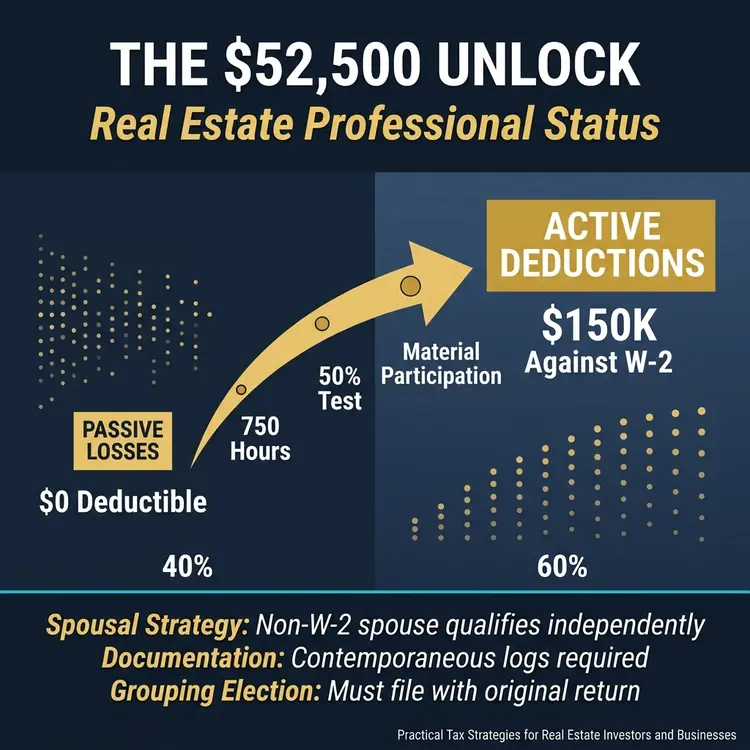
For an investor with $150,000 in rental losses and $200,000 in W-2 income, the difference is stark. Without Real Estate Professional status, you have $0 in deductible losses. With proper qualification, you have $150,000 in deductible losses.
At a 35% combined federal and state tax rate, that's $52,500 in tax savings in a single year. Multiply that across a decade of active investing, and the cumulative impact reaches into six figures.
This advantage compounds when paired with cost segregation studies and bonus depreciation. Accelerated depreciation creates substantial paper losses in the early years of property ownership. Real Estate Professional status converts those losses into immediate tax savings rather than passive loss carryforwards that you might never use.
Key Point: The tax savings compound over time. A single year of qualification produces tens of thousands in benefits, and a decade produces hundreds of thousands.
How Do You Maintain Qualification Year After Year?
Real Estate Professional status isn't permanent. You re-qualify every single tax year by meeting both tests again.
This annual requirement means your documentation discipline doesn't slip. A strong year of record-keeping doesn't carry forward to protect a weak year. Each January resets the clock, and you build your case from scratch.
For investors planning long-term wealth building through real estate, this creates a compliance rhythm. Time tracking becomes part of your regular operational routine, not a year-end scramble.
The investors who succeed with Real Estate Professional status treat documentation like they treat tenant screening or property maintenance. It's not optional, it's not something you get to when convenient. It's a fundamental requirement of the strategy.
Key Point: Annual re-qualification means documentation becomes a habit, not a project. Build your time logs throughout the year.
When Does Professional Guidance Matter?
Real Estate Professional status sits at the intersection of substantial tax savings and intense IRS scrutiny. The rules are specific, the documentation standards are strict, and the consequences of getting things wrong extend beyond losing the deduction.
If the IRS disallows your claim during an audit, you face back taxes on the income that should have been offset by rental losses. You also face potential penalties and interest on the underpayment. The financial reversal exceeds the original tax savings.
This is where working with advisors who specialize in real estate tax strategy becomes valuable. They understand the documentation the IRS expects, they know how to structure the grouping election properly, and they identify qualification issues before they become audit problems.
Tax strategy isn't about finding loopholes or pushing boundaries. It's about understanding the rules completely and executing them correctly. Real Estate Professional status is a legitimate, effective tool when used properly. Proper use requires precision.
Key Point: The cost of getting this wrong exceeds the cost of professional guidance. Specialist advisors prevent expensive qualification failures.
Frequently Asked Questions
Who qualifies as an IRS Real Estate Professional?
You qualify if you spend more than 750 hours per year in real property trades or businesses where you materially participate, and more than 50% of your total work time is in real estate. Full-time W-2 employees rarely qualify unless their spouse meets both tests independently.
What happens if I don't make the Section 469 grouping election?
Without the grouping election, each property is treated as a separate activity. You would need to materially participate in each individual property to claim losses, which is nearly impossible for investors with multiple properties. The election must be made on your original tax return and can't be added later.
Does property acquisition time count toward the 750 hours?
No. Investment activities like property research, due diligence, financing discussions, and acquisition work don't count. Only operational activities like property management, maintenance coordination, tenant communication, and lease preparation qualify.
If my spouse qualifies as a Real Estate Professional, do the tax benefits apply to our joint return?
Yes. When filing jointly, if one spouse qualifies as a Real Estate Professional and you make the proper elections, the rental loss deductions apply to your combined income. Each spouse must independently meet the 750-hour and 50% tests.
What type of time log does the IRS accept during an audit?
The IRS requires contemporaneous records created at or near the time you performed the work. Your logs need to include the date, duration, specific activity description, property address, and supporting evidence like emails or invoices. Generic entries or year-end reconstructions typically fail during audits.
How often do I need to re-qualify for Real Estate Professional status?
You re-qualify every single tax year. There's no carryforward or permanent status. Each year you need to meet the 750-hour test, the 50% test, and maintain proper documentation from January through December.
What is material participation and why does it matter?
Material participation means active, ongoing involvement in your real estate operations, not passive oversight. The IRS uses seven tests to determine material participation. The most practical test for property investors is working more than 500 hours in the activity. Without material participation, you don't qualify even if you meet the hour thresholds.
What tax savings can Real Estate Professional status provide?
The savings depend on your rental losses and tax rate. An investor with $100,000 in rental losses and a 35% combined tax rate saves $35,000 annually when qualified. Without the status, those losses remain trapped as passive losses and provide no immediate tax benefit.
Key Takeaways
-
Real Estate Professional status transforms rental losses from passive limitations into active deductions against ordinary income. The tax savings reach tens of thousands of dollars annually for investors with substantial portfolios.
-
Qualification requires meeting two distinct tests: more than 750 hours in real property trades or businesses, and more than 50% of total personal services in those activities. Both tests apply annually to each individual taxpayer.
-
The Section 469 grouping election is mandatory for investors with multiple properties. Without it, you materially participate in each property separately, which makes qualification nearly impossible for most investors.
-
Documentation standards are strict and unforgiving. The IRS requires contemporaneous records created at or near the time you performed the work. Year-end reconstruction weakens your case and often leads to disallowance during audits.
-
For married couples where one spouse works full-time outside real estate, the other spouse qualifies independently. This creates a practical path for households to access Real Estate Professional benefits while maintaining traditional employment income.
-
The difference between qualifying correctly and claiming incorrectly isn't the loss of a deduction. It's the exposure to back taxes, penalties, and interest that exceed the original tax savings. Precision matters because the stakes are high and the IRS watches these claims closely.

CEO of Cashflow Strategies, Inc., Tax Strategist, Speaker, Educator
David “Mr. Cash Flow” Wiener is a nationally recognized authority on real estate tax strategy and cash flow optimization, and the host of The Tax Strategy Playbook podcast. As Founder and CEO of Cash Flow Strategies, Inc., David has spent decades helping real estate investors, business owners, and their advisory teams legally reduce taxes, unlock hidden cash flow, and put more money back into productive assets instead of into the IRS.
Over the course of his career, David has become especially known for his work with cost segregation, 179D energy-efficient commercial building deductions, and other engineering-based tax incentives that accelerate depreciation and free up capital. He has also built a long track record in cash flow and accounts receivable optimization, helping clients improve profitability and financial stability without simply “working harder” or taking on more risk.
David is a sought‑after speaker, trainer, and educator, with audiences ranging from national industry conferences to small mastermind groups and professional associations. He is known for his clear, practical teaching style and his ability to translate complex tax concepts into simple, actionable plays that investors and advisors can use right away. Whether he is speaking to CPAs, medical and dental practice owners, or real estate investors, David’s message is consistent: tax strategy is one of the most powerful—and most overlooked—wealth multipliers available.
On The Tax Strategy Playbook, David brings that same real‑world experience and teaching approach to the microphone. Each epis… Read More

What Counts as a Land Improvement, and Why Does It Depreciate Over 15 Years?