IRS Safe Harbor Elections: 3 Tax Deductions CPAs Miss
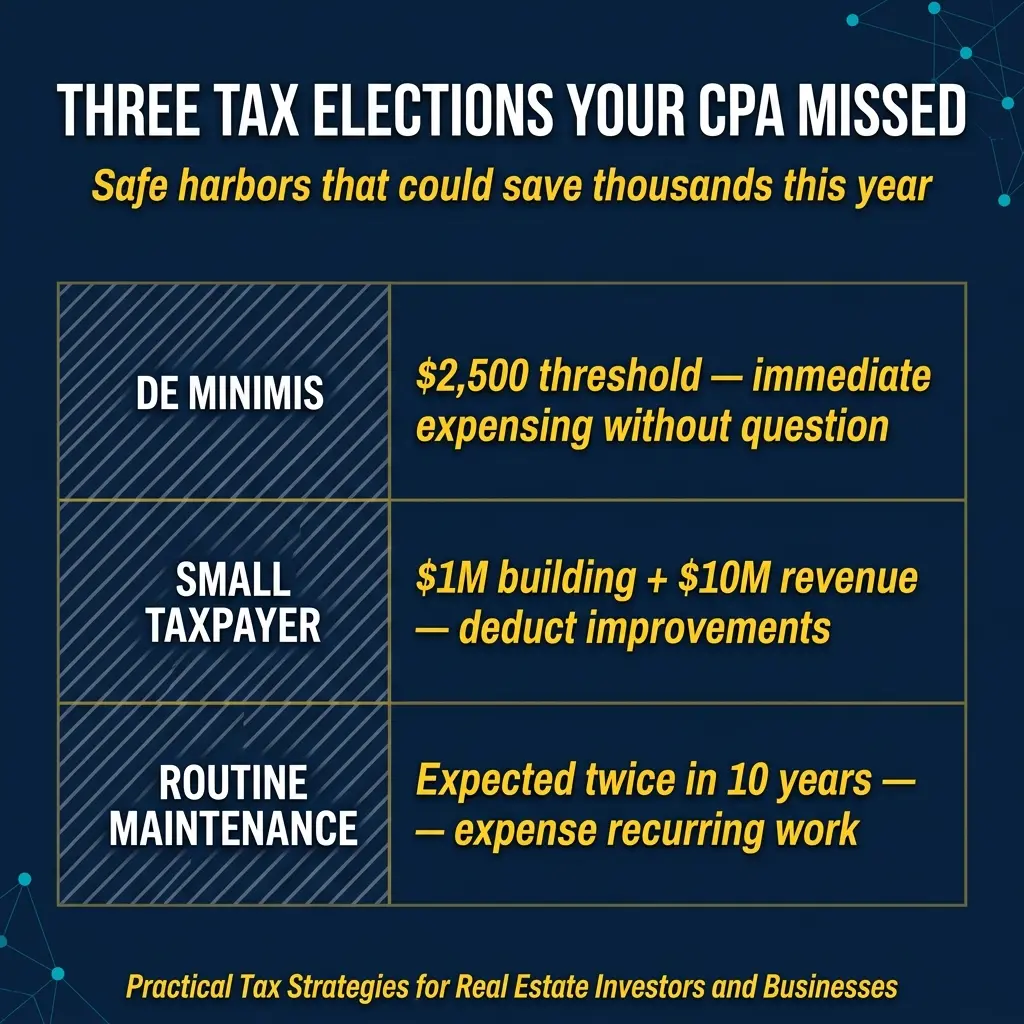
TL;DR: Three IRS safe harbor elections let you immediately expense repairs and equipment that most CPAs are capitalizing. The de minimis safe harbor ($2,500 threshold), small taxpayer safe harbor (improvements under $10,000), and routine maintenance safe harbor save money and paperwork. But you need to make formal elections, and most tax preparers don't.
The de minimis safe harbor lets you expense items up to $2,500 per invoice without capitalizing them. Most businesses qualify, but you need written accounting procedures and a formal election attached to your tax return.
The small taxpayer safe harbor lets rental property owners with buildings under $1 million in basis deduct up to $10,000 in annual improvements if they meet specific criteria. This turns capitalized improvements into immediate deductions.
The routine maintenance safe harbor allows you to expense recurring repairs like HVAC work or roof maintenance if you expect to perform them more than once during the property's life. No formal election required, but documentation matters.
What Are IRS Safe Harbor Elections?
Before September 2013, business owners made capitalization decisions based on decades of conflicting case law. The IRS issued final tangible property regulations in 2013 that combined all that case law into one unified framework. The regulations created clear safe harbors with specific thresholds and requirements giving you automatic approval to expense certain costs.
The problem is straightforward. Most business owners still have no idea these safe harbors exist. Small businesses miss the de minimis safe harbor election and unnecessarily complicate their bookkeeping while delaying deductions they're entitled to take immediately.
I've watched this pattern repeat for years. Business owners assume their CPA is optimizing their tax position when the CPA is only handling compliance. The gap between what's possible and what's happening is where money gets left behind.
Bottom line: Safe harbors exist to simplify your taxes and reduce IRS disputes, but they only work if your tax preparer uses them.
How the De Minimis Safe Harbor Works
The de minimis safe harbor lets you immediately expense items below a specific dollar threshold. For taxpayers without applicable financial statements, the threshold is $2,500 per invoice or item.
When the regulations were first finalized, the threshold started at $500. Business owners and tax advisors complained immediately. Even ten years ago, normal business equipment like computers, tablets, and cell phones easily exceeded $500. The IRS listened and increased the threshold to $2,500 for taxable years beginning on or after January 1, 2016.
Requirements for the De Minimis Election
You need to make the election. You need to attach a specific statement to your timely filed return, including extensions. Miss the election deadline and the opportunity disappears permanently for the tax year.
There's another requirement catching people off guard. You need written accounting procedures in place at year start treating amounts below the threshold as expenses. Making the election without procedures will not survive IRS scrutiny.
Real-World Example
Jennifer owns three rental properties and spent $47,000 on improvements in 2024. Her accountant capitalized everything for 27.5 years of depreciation.
A new CPA reviewed her return and found $22,000 qualified as deductible repairs under safe harbor provisions. Jennifer saved $7,040 in year-one taxes.
Same property. Same expenses. Different tax outcome. The only variable was knowledge and execution.
What this means: The de minimis election turns capitalized assets into immediate deductions, but only if you make the election and document your procedures.
Who Qualifies for the Small Taxpayer Safe Harbor
This election is valuable for owners of lower-cost rental properties. The small taxpayer safe harbor lets you deduct costs that would normally be capitalized as improvements if you meet three requirements:
-
Average annual gross receipts of $10 million or less
-
Building property with an unadjusted basis of $1 million or less
-
Total annual amounts not exceeding the lesser of $10,000 or 2% of the unadjusted basis
This safe harbor is most valuable for owners of lower-cost rental properties with buildings under $500,000 basis who spend a moderate amount on maintenance and occasional upgrades each year. If your typical annual spending is under $8,000 to $10,000 in combined repairs and improvements, this election saves hours of classification work and potentially thousands in accelerated deductions.
You're not required to capitalize costs as improvements if you qualify. You expense them immediately. You need to make the election.
Bottom line: If you own rental properties under $1 million in basis, this election turns improvements into immediate deductions within the threshold limits.
Understanding the Routine Maintenance Safe Harbor
The routine maintenance safe harbor lets you deduct recurring activities keeping property in ordinarily efficient condition, even if the work might otherwise qualify as an improvement.
For buildings, activities performed more than once during 10 years qualify. The repair doesn't need to be performed more than once. The expectation at the time of the repair needs to be substantiated showing the repair would occur more than once during the life of the asset.
HVAC maintenance, roof repairs, parking lot resurfacing all qualify as recurring needs. If you document your expectation to perform the activity more than once over 10 years, you expense it under the routine maintenance safe harbor.
This safe harbor doesn't require a formal election like the others. You still need documentation supporting your position.
Key insight: Documentation of your expectation matters more than the actual frequency of past repairs.
Why Safe Harbors Matter More in 2025 and Beyond
Bonus depreciation is phasing out. It dropped to 60% in 2024, falls to 40% in 2025, and is scheduled for elimination by the end of 2026. The impact of capitalizing an expense becomes greater when you lose bonus depreciation on it.
If amounts are below the de minimis threshold, you only need documentation substantiating the amount paid. Your adviser and preparer will not need to spend time analyzing the support for, or nature of, the expenses. There will never be an issue of recapture.
The window for easy acceleration is closing. The safe harbors remain.
What you need to know: As bonus depreciation phases out, safe harbor elections become more valuable because they create immediate deductions without depreciation schedules.
Steps to Take With Your Tax Advisor
Ask if your CPA is making the de minimis safe harbor election. Ask if you qualify for the small taxpayer safe harbor. Ask how they're documenting routine maintenance expectations.
These are not aggressive strategies. They're explicit provisions the IRS created to simplify compliance and reduce disputes.
The difference between a tax preparer and a tax strategist is knowing these elections exist and implementing them consistently. I've seen this pattern across hundreds of returns. Business owners assume their CPA is optimizing strategy when the CPA is handling compliance.
The gap is where your money goes.
Want to learn more tax strategies like this? I break down practical, actionable tax planning techniques every week on the Tax Strategy Playbook podcast. Subscribe wherever you listen to podcasts and get strategies you can use immediately to keep more of what you earn.
Frequently Asked Questions
What happens if I miss the de minimis safe harbor election deadline?
If you miss the election deadline for a tax year, the opportunity disappears permanently for the year. You need to attach the election statement to your timely filed return, including extensions. There's no retroactive fix.
Do I need an accountant to set up written accounting procedures for the de minimis safe harbor?
You need written procedures in place at the beginning of the tax year, but they need not be complex. A simple written policy stating your business expenses items under $2,500 rather than capitalizing them is sufficient. Your CPA should help you draft this.
Can I use the small taxpayer safe harbor if I own multiple rental properties?
Yes, but the election applies per building, and each building needs an unadjusted basis of $1 million or less. You also need average annual gross receipts of $10 million or less across all your activities.
Does the routine maintenance safe harbor work for new properties where I haven't done repairs before?
Yes. The requirement is expecting to perform the activity more than once during the property's life. You document your expectation based on the nature of the repair and industry standards, not on your personal history with the specific property.
What's the difference between a repair and an improvement under these safe harbors?
Repairs maintain property in ordinarily efficient condition. Improvements better the property, restore it to like-new condition, or adapt it to a new use. The safe harbors let you expense certain costs otherwise classified as improvements if you meet specific criteria.
Are these safe harbor elections aggressive tax positions?
No. These are explicit provisions the IRS created to simplify compliance and reduce disputes. They're conservative, well-established elections the IRS expects qualified taxpayers to use.
Will using these safe harbors increase my audit risk?
Properly documented safe harbor elections do not increase audit risk. They reduce it because you're following explicit IRS guidance rather than navigating gray areas in capitalization decisions.
Can I make these elections myself, or do I need my CPA to do it?
The elections need to be attached to your tax return with specific language and documentation. Your CPA should handle this as part of tax preparation. If your current CPA is not making these elections, have the conversation.
Key Takeaways
-
Three IRS safe harbors (de minimis, small taxpayer, and routine maintenance) let you expense costs that would otherwise be capitalized, but most tax preparers don't use them.
-
The de minimis safe harbor allows immediate expensing of items up to $2,500 per invoice if you make a formal election and maintain written accounting procedures.
-
The small taxpayer safe harbor lets rental property owners with buildings under $1 million in basis deduct up to $10,000 in annual improvements if they meet specific requirements.
-
The routine maintenance safe harbor expenses recurring repairs based on your documented expectation of frequency, not on past performance.
-
With bonus depreciation phasing out (60% in 2024, 40% in 2025, eliminated by 2027), safe harbor elections become more valuable because they create immediate deductions.
-
Missing election deadlines means permanently losing the deduction for that tax year, because these elections need to be attached to your timely filed return.
-
The gap between tax preparation and tax strategy is knowing these elections exist and implementing them consistently.

CEO of Cashflow Strategies, Inc., Tax Strategist, Speaker, Educator
David “Mr. Cash Flow” Wiener is a nationally recognized authority on real estate tax strategy and cash flow optimization, and the host of The Tax Strategy Playbook podcast. As Founder and CEO of Cash Flow Strategies, Inc., David has spent decades helping real estate investors, business owners, and their advisory teams legally reduce taxes, unlock hidden cash flow, and put more money back into productive assets instead of into the IRS.
Over the course of his career, David has become especially known for his work with cost segregation, 179D energy-efficient commercial building deductions, and other engineering-based tax incentives that accelerate depreciation and free up capital. He has also built a long track record in cash flow and accounts receivable optimization, helping clients improve profitability and financial stability without simply “working harder” or taking on more risk.
David is a sought‑after speaker, trainer, and educator, with audiences ranging from national industry conferences to small mastermind groups and professional associations. He is known for his clear, practical teaching style and his ability to translate complex tax concepts into simple, actionable plays that investors and advisors can use right away. Whether he is speaking to CPAs, medical and dental practice owners, or real estate investors, David’s message is consistent: tax strategy is one of the most powerful—and most overlooked—wealth multipliers available.
On The Tax Strategy Playbook, David brings that same real‑world experience and teaching approach to the microphone. Each epis… Read More

What Counts as a Land Improvement, and Why Does It Depreciate Over 15 Years?