Can You Deduct Leftover 2022 to 2024 Research Costs on Your 2025 Return?
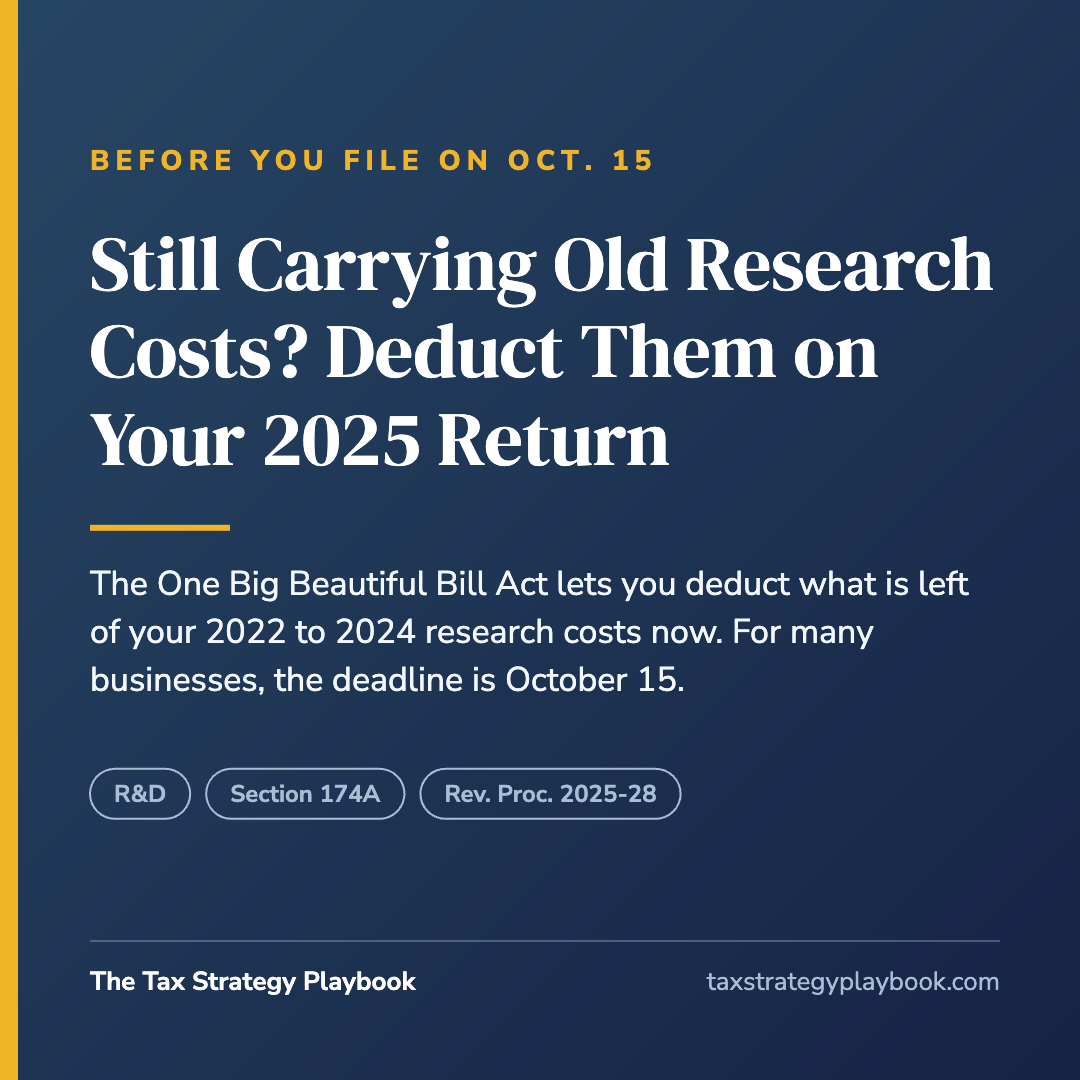
TL;DR: Yes, if your business still has research costs from 2022, 2023, or 2024 sitting on an amortization schedule, you can deduct everything that is left on your 2025 return, or split it across 2025 and 2026. The One Big Beautiful Bill Act created that choice, and IRS Revenue Procedure 2025-28 lets you make it with a statement attached to the return. For calendar-year C corporations and sole proprietors, the practical deadline is October 15, 2026. For calendar-year partnerships and S corporations, the window closed on September 15. This is a timing benefit, not a new deduction, so whether to take it depends on what your 2025 income looks like.
Key Takeaways
- From 2022 through 2024, domestic research costs could not be deducted when paid. They were spread over five years, starting at the midpoint of the year, so only 10 percent came off in the first year.
- The One Big Beautiful Bill Act restored the immediate deduction for domestic research starting with tax years that begin after December 31, 2024, and it lets you pull forward whatever is left from 2022 through 2024.
- You can deduct the remaining balance in full on your 2025 return, or ratably over 2025 and 2026. If you do nothing, the old schedule keeps running into 2029.
- The election is made with a statement on the return, not a Form 3115, under Revenue Procedure 2025-28.
- Calendar-year C corporations and sole proprietors have until October 15, 2026. Calendar-year partnerships and S corporations are already past their deadline.
What happened to research costs from 2022 to 2024?
For decades, a business could deduct its research and development costs in the year it paid them. The Tax Cuts and Jobs Act changed that for tax years beginning after 2021. Starting in 2022, Section 174 required domestic research costs to be amortized over five years, beginning at the midpoint of the year the money was spent. The midpoint rule meant the first year allowed only a half year of amortization: 10 percent of the cost.
Research costs include more than lab work. Software development, engineering iteration, prototype work, and the wages of the people doing it all landed in this bucket. For a company spending heavily on development, the change turned real cash outlays into deductions trickling out over six tax years.
What did the One Big Beautiful Bill Act change?
The One Big Beautiful Bill Act added Section 174A, which lets businesses deduct domestic research and experimental expenditures in the year they are paid or incurred, for tax years beginning after December 31, 2024. Research performed outside the United States did not get the same fix; it still amortizes over 15 years.
The law also dealt with the costs already stuck on the books from 2022 through 2024. It gave every business with a remaining unamortized balance of domestic research costs a choice: keep amortizing on the old schedule, or recover the rest faster.
There was a separate, broader election for smaller businesses, those with average annual gross receipts of $31 million or less, that let them go back and amend 2022 through 2024 returns to deduct those costs as if the old rule had never applied. That election had a July 6, 2026 deadline, and it has passed. We covered it in Your Business May Qualify for a Six-Figure Tax Refund. The catch-up election in this article is different, and it is still open for some businesses.
How does the catch-up election work?
Under the election, you take whatever domestic research cost from 2022, 2023, and 2024 has not yet been amortized and do one of two things:
- Deduct all of it in your first tax year beginning after December 31, 2024. For a calendar-year business, that is the 2025 return.
- Deduct it ratably over two years, half in 2025 and half in 2026.
The IRS treats this as an automatic change in accounting method. Revenue Procedure 2025-28 waives the usual Form 3115 and allows a statement filed with the return in its place. It applies on a cut-off basis, so there is no Section 481(a) adjustment to calculate.
What is it worth in dollars?
Take a company that spent $100,000 a year on domestic research in 2022, 2023, and 2024. Here is what remained unamortized when 2025 began:
- 2022 costs: 10 percent in 2022, then 20 percent in each of 2023 and 2024. $50,000 left.
- 2023 costs: 10 percent in 2023, 20 percent in 2024. $70,000 left.
- 2024 costs: 10 percent in 2024. $90,000 left.
That is $210,000 still waiting to be deducted. On the old schedule, only $60,000 of it would come off in 2025, with the rest dribbling out through 2029. With the election, all $210,000 comes off in 2025, or $105,000 in each of 2025 and 2026.
For a C corporation at the 21 percent federal rate, pulling the extra $150,000 into 2025 lowers that year's federal tax by $31,500. Be clear about what that is: the same total deduction, taken sooner. You are not creating new write-offs. You are collecting the old ones years early, which is worth the most to a business that needs the cash now.
Who can still make the election, and by when?
The election goes on the return for your first tax year beginning after December 31, 2024. That makes the deadline depend on what kind of return you file and whether you have already filed it.
Calendar-year C corporations and sole proprietors that have not filed yet. If you are on extension, the 2025 return is due October 15, 2026. The statement goes on that return.
The same businesses if they already filed on time without the statement. The IRS's general procedure for automatic accounting method changes, Revenue Procedure 2015-13, section 6.03(4)(a), gives a taxpayer that timely filed its return an automatic six months from the original due date, not counting extensions, to make the change on an amended return. For a calendar-year return originally due April 15, that window also ends October 15, 2026. Revenue Procedure 2025-28 builds on that general procedure, but it does not walk through this exact situation, so confirm it with your tax professional before relying on it.
Calendar-year partnerships and S corporations. Accounting method choices for a partnership or S corporation are made by the business, not by the owners individually. Their extended 2025 returns were due September 15, 2026, and the six-month window measured from their March 15 due date ended the same day. For most calendar-year pass-throughs, this election is no longer available.
Fiscal-year businesses. The first tax year beginning after December 31, 2024 ends later, so the deadlines are later. Work them out from your own year end.
Should every business take the full deduction in 2025?
No, and this is where a tax professional earns the fee. Pulling $150,000 of deductions into one year is valuable when that year has income to absorb it at a high rate. It is less valuable, or even counterproductive, when:
- The business already shows a loss for 2025. Extra deductions add to a net operating loss, and a loss carried forward generally offsets only 80 percent of taxable income in a later year.
- 2025 was a low-income year and 2026 looks stronger. The two-year option exists for exactly that case.
- Your state does not follow the federal rules. States decide separately whether to adopt federal research expensing, so the federal and state answers can differ.
Doing nothing is also a choice. The old schedule still delivers every dollar, just slowly.
Does this change my R&D credit?
Not directly. The deduction and the credit are separate benefits under separate sections of the code. The deduction reduces taxable income; the credit reduces tax dollar for dollar, and it has its own look-back rules through amended returns. If your business did qualifying work in 2022 through 2024 and never claimed the credit, that is a separate conversation worth having. Our complete guide to R&D tax credits for small business walks through how the credit is calculated and documented, and startups without an income tax bill should read how the credit can offset payroll taxes.
Frequently Asked Questions
Can I deduct my remaining 2022 to 2024 research costs on my 2025 return? Yes, if they are domestic research costs still being amortized. The One Big Beautiful Bill Act lets you deduct the remaining balance in full in your first tax year beginning after December 31, 2024, or ratably over that year and the next.
What is the deadline for the research cost catch-up election? It is made on the return for your first tax year beginning after December 31, 2024. For calendar-year C corporations and sole proprietors on extension, that return is due October 15, 2026. Calendar-year partnerships and S corporations were due September 15, 2026.
Do I need to file Form 3115 for the research cost catch-up? No. Revenue Procedure 2025-28 waives Form 3115 for this change and allows a statement filed with the return instead.
Does the catch-up election apply to foreign research costs? No. Research performed outside the United States still amortizes over 15 years, and the catch-up applies only to domestic research costs.
Is the catch-up election a new deduction? No. It is the same total deduction taken sooner. Without the election, the remaining 2022 to 2024 costs keep amortizing on the original schedule, into 2029 for costs paid in 2024.
Know what you are leaving on the schedule
If your business spent money developing software, products, or processes in the last few years, there is a good chance part of that spending is still sitting on an amortization schedule, and it is easy to miss that the rules changed. Whether to pull it forward is a judgment call about your income, and the window for making it closes in about two weeks for some businesses and already closed for others.
I offer a no-cost analysis, delivered through my relationship with CSSI (Cost Segregation Services, Inc.). No obligation and no pitch. I will look at what you spent, what qualifies, and what the numbers say, and if a study would not pay for itself, I will tell you that. Details on the R&D side are at davidhwiener.com.
Grab a time on Calendly at calendly.com/david-wiener/cs or call 770-224-8504, option two.
This article is educational and is not tax, legal, or accounting advice. Every situation is different; work with a qualified tax professional before acting on any strategy described here.

CEO of Cashflow Strategies, Inc., Tax Strategist, Speaker, Educator
David “Mr. Cash Flow” Wiener is a nationally recognized authority on real estate tax strategy and cash flow optimization, and the host of The Tax Strategy Playbook podcast. As Founder and CEO of Cash Flow Strategies, Inc., David has spent decades helping real estate investors, business owners, and their advisory teams legally reduce taxes, unlock hidden cash flow, and put more money back into productive assets instead of into the IRS.
Over the course of his career, David has become especially known for his work with cost segregation, 179D energy-efficient commercial building deductions, and other engineering-based tax incentives that accelerate depreciation and free up capital. He has also built a long track record in cash flow and accounts receivable optimization, helping clients improve profitability and financial stability without simply “working harder” or taking on more risk.
David is a sought‑after speaker, trainer, and educator, with audiences ranging from national industry conferences to small mastermind groups and professional associations. He is known for his clear, practical teaching style and his ability to translate complex tax concepts into simple, actionable plays that investors and advisors can use right away. Whether he is speaking to CPAs, medical and dental practice owners, or real estate investors, David’s message is consistent: tax strategy is one of the most powerful—and most overlooked—wealth multipliers available.
On The Tax Strategy Playbook, David brings that same real‑world experience and teaching approach to the microphone. Each epis… Read More
The Excess Business Loss Limitation in 2026: Why the Threshold Dropped to $256,000