Superseding Returns: The Tax Correction Tool Most Filers Never Hear About
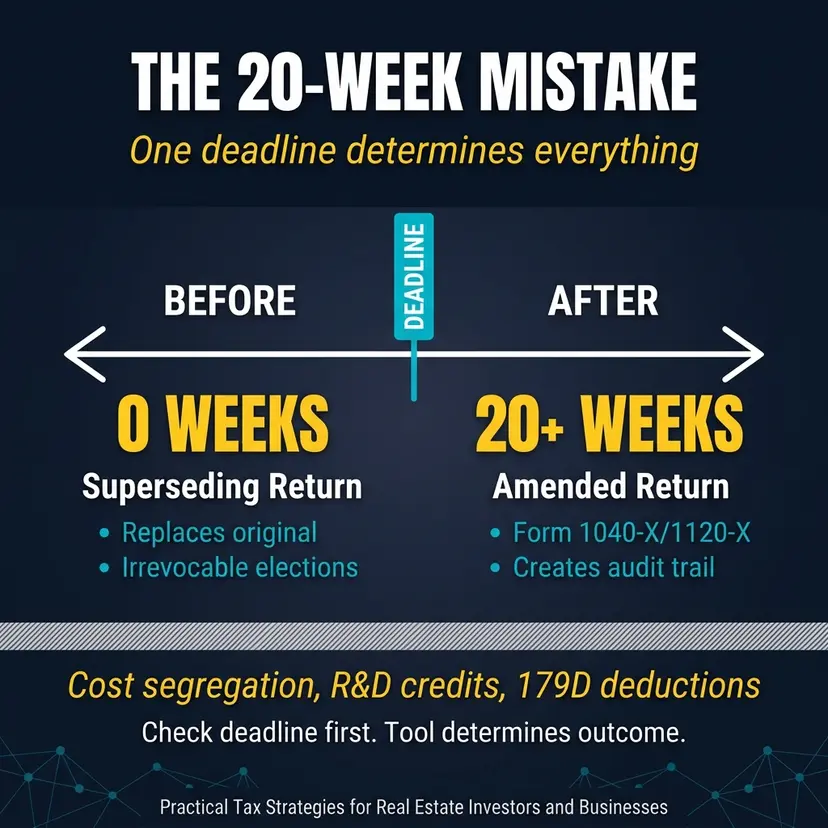
There are two ways to fix a tax return, and the one you can use depends entirely on timing. A superseding return, filed before the deadline, replaces the original completely. An amended return, filed after the deadline, adjusts specific items and creates a paper trail. For strategies like cost segregation, R&D credits, and Section 179D, using the wrong tool, or either one when Form 3115 is what's actually needed, creates real problems.
-
A superseding return replaces the original filing completely and is only available before the extended deadline.
-
An amended return adjusts specific line items after the deadline and creates a change record for IRS review.
-
Timing is the deciding factor, not complexity, not filing history.
-
Certain irrevocable elections (bonus depreciation, cost segregation) can't be changed on an amended return, which makes the superseding window critical.
-
Form 3115 is often the right tool for look-back cost segregation studies, not an amendment.
Amended returns filed on Form 1040-X often take 20 weeks or more to process. That alone is why timing matters more than most filers realize.
Most filers know one way to fix a return: file an amended return. There's a second option called a superseding return, and it's one of the most overlooked tools in tax strategy. For anyone working with cost segregation studies, R&D credits, or Section 179D deductions, knowing which tool applies can make a big financial difference.
What Is a Superseding Return vs. an Amended Return?
A superseding return is filed after the original but before the filing deadline, including any extensions. The IRS treats it as the true original return. The National Taxpayer Advocate confirms that the changes relate back to the original filing date. It replaces the first return entirely, with no amendment trail and no layered record.
An amended return works differently. Filed on Form 1040-X for individuals or Form 1120-X for corporations, it changes specific line items after the deadline has passed. The original return stays on file, and the amendment creates a change record the IRS can review.
Superseding returns give you a cleaner fix. Amended returns create a documented adjustment. The dividing line between them is your extended filing deadline.
Step 1: Understand What Each Return Actually Does
A superseding return replaces everything. Because the IRS treats it as the original, it has to be complete, every number, every election, every attachment. Filing only the changed items creates an incomplete record. The corrected return has to stand on its own.
An amended return adds a documented change on top of the original filing, and the quality of that documentation matters. Strategies like cost segregation and R&D credits face growing IRS scrutiny, and the underlying analysis needs to clearly support every adjustment made.
Step 2: Check Your Deadline Before Anything Else
Timing is the whole decision. If the filing deadline, including any extension, hasn't passed yet, the superseding return is still available. Once that date passes, an amended return is the only option.
This window matters most when irrevocable elections are involved. Some elections made on an original return can't be changed on an amended return. For bonus depreciation and cost segregation elections, that difference determines whether a correction is even possible.
Step 3: File the Right Way
For a superseding return, use the same form as the original and clearly note that it supersedes the earlier filing. Include everything: every number, election, and attachment. Partial filings create incomplete records.
For an amended return, use the right amendment form for your return type, explain what changed and why, and make sure the supporting documentation is thorough. The IRS is focusing on complex returns where the potential recovery is highest, so thin documentation on engineering-based claims is a real risk.
Step 4: Know When Neither Return Is the Answer
Many investors assume a missed cost segregation study means reopening old returns. It doesn't. For look-back studies on existing properties, the IRS specifies that taxpayers can't make accounting method changes by amending prior returns. Form 3115 is the right tool, and it captures years of missed depreciation in a single current-year adjustment.
The results are often significant. In one documented case, a property owner with a $960,000 building basis captured a $176,123 catch-up deduction in one year through a Section 481(a) adjustment, with no amendments to prior returns.
Step 5: Get the Documentation Right
For R&D credit corrections, documentation created after the fact is the most common reason a claim gets reduced during an exam. An error in one part of a complex claim can also raise questions about the entire return, which leads to broader IRS review.
Getting a correction right the first time protects everything else on the return. Working with your CPA and a specialty firm together makes sure the adjustment is just as solid as the original analysis.
The Recap
A superseding return replaces the original and is only available before your deadline, extensions included. An amended return adjusts the record after the deadline and needs strong documentation to hold up. Irrevocable elections make the superseding window especially important, and Form 3115 handles look-back cost segregation without touching prior returns.
If you're not sure whether a superseding return is still available for a recent filing, the fastest way to find out is to ask while the window is still open. Send an email to david.wiener@cashflowstrategies.us and I'll help you figure out where you stand.
Frequently Asked Questions
What's the main difference between a superseding return and an amended return?
Timing. A superseding return is filed before the extended deadline and fully replaces the original. An amended return is filed after the deadline and adjusts specific line items, leaving the original on file.
Can I change a bonus depreciation election on an amended return?
Generally, no. Bonus depreciation and some cost segregation elections are locked in once the deadline passes. The superseding return window is the only way to change them.
Does a missed cost segregation study always require amending prior returns?
No. For look-back studies on existing properties, Form 3115 is the right tool. It picks up missed depreciation as a current-year adjustment without reopening prior returns.
How does the IRS treat a superseding return?
As the original return. The National Taxpayer Advocate confirms the changes go back to the original filing date, so there's no amendment trail and no layered record of changes.
What happens if documentation on an amended R&D credit claim is weak?
Weak documentation is the most common reason R&D credit claims get cut during an exam. It can also draw IRS attention to the rest of the return, well beyond the original correction.
Who should I contact if I'm unsure which correction tool applies?
Reach out at david.wiener@cashflowstrategies.us. The first step is confirming whether the superseding window is still open before assuming an amendment is the only option.
Is Form 3115 available for all property types?
Form 3115 covers accounting method changes, including cost segregation on existing properties. Whether it applies to a specific situation depends on the property type and how it was treated before. A specialty firm can confirm quickly.
Can filing the wrong correction method create IRS problems?
Yes. Using an amended return when the superseding window was still open gives up a cleaner option and may lock in irrevocable elections. Using an amendment for a look-back cost segregation study, when Form 3115 is the right method, creates a compliance problem instead of fixing one.
Key Takeaways
-
A superseding return replaces the original filing and is only available before the extended filing deadline.
-
An amended return adjusts specific line items after the deadline and creates a change record for IRS review.
-
Timing is the only factor that determines which tool is available, not complexity or filing history.
-
Irrevocable elections for bonus depreciation and cost segregation can't be changed on an amended return, which makes the superseding window critical for anyone who catches an error early.
-
Form 3115, not an amendment, is the right tool for look-back cost segregation studies on existing properties.
-
Documentation quality on complex corrections determines how well a claim holds up if the IRS takes a closer look.
-
Using the right correction method from the start protects the entire return, not just the adjusted line items.

CEO of Cashflow Strategies, Inc., Tax Strategist, Speaker, Educator
David “Mr. Cash Flow” Wiener is a nationally recognized authority on real estate tax strategy and cash flow optimization, and the host of The Tax Strategy Playbook podcast. As Founder and CEO of Cash Flow Strategies, Inc., David has spent decades helping real estate investors, business owners, and their advisory teams legally reduce taxes, unlock hidden cash flow, and put more money back into productive assets instead of into the IRS.
Over the course of his career, David has become especially known for his work with cost segregation, 179D energy-efficient commercial building deductions, and other engineering-based tax incentives that accelerate depreciation and free up capital. He has also built a long track record in cash flow and accounts receivable optimization, helping clients improve profitability and financial stability without simply “working harder” or taking on more risk.
David is a sought‑after speaker, trainer, and educator, with audiences ranging from national industry conferences to small mastermind groups and professional associations. He is known for his clear, practical teaching style and his ability to translate complex tax concepts into simple, actionable plays that investors and advisors can use right away. Whether he is speaking to CPAs, medical and dental practice owners, or real estate investors, David’s message is consistent: tax strategy is one of the most powerful—and most overlooked—wealth multipliers available.
On The Tax Strategy Playbook, David brings that same real‑world experience and teaching approach to the microphone. Each epis… Read More

What Counts as a Land Improvement, and Why Does It Depreciate Over 15 Years?