The Carwash Tax Advantage Is Real. The Deal Still Has to Work.
TL;DR: The One Big Beautiful Bill Act permanently restored 100% bonus depreciation in 2025, and carwash properties are built to take full advantage of it. These assets regularly qualify for large first-year tax deductions through cost segregation. A tax break doesn't fix a bad investment, though. Oversaturated markets, high membership cancellation rates, future tax bills at sale, and aging equipment are real risks no tax law addresses.
Who this is for: Real estate investors evaluating express tunnel carwash purchases, tax professionals advising capital-heavy operating businesses, and business owners weighing bonus depreciation in their investment strategy.
-
100% bonus depreciation is now permanent, with no expiration date, for qualifying property placed in service after January 19, 2025.
-
Carwash properties are a standout case in cost segregation, with much of their depreciable value sitting in equipment and site improvements that carry five-year and 15-year write-off periods.
-
Bonus depreciation delays your tax bill, it doesn't erase it. When you sell the property, the IRS recaptures those deductions and taxes them at ordinary income rates.
-
Too many carwashes competing in the same area is now the top concern in the industry, ranking above customer sign-ups and membership growth.
-
Smart buyers evaluate the business first, check the physical condition of the property second, and factor in tax strategy third.
Why Carwash Investors Are Paying Close Attention Right Now
The U.S. carwash market brought in roughly $20.7 billion in revenue in 2025. Purchase multiples that once ran 10 to 12 times annual earnings have settled into a steadier seven to nine range. Buyers are pricing operations now, not momentum.
The One Big Beautiful Bill Act, signed on July 4, 2025, permanently restored 100% bonus depreciation for qualifying property acquired and placed in service after January 19, 2025. No expiration date, no scheduled phase-down. For an express tunnel carwash with high equipment costs, that single provision reshapes the first-year tax picture of an acquisition or new build.
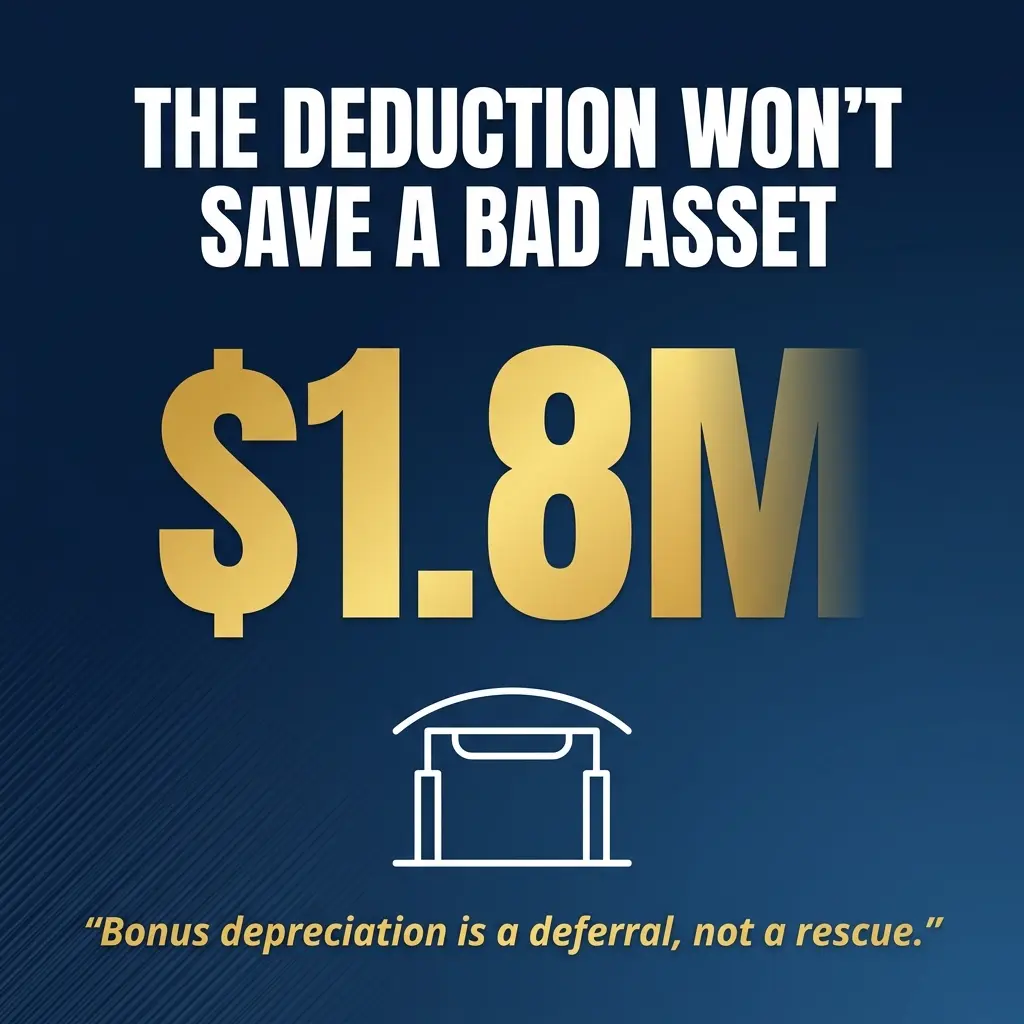
Investors are falling in love with the deduction before they've verified the business underneath it. The tax benefit follows the asset. It won't save a deal that doesn't work on its own.
Key Point: Calmer purchase prices reflect a more disciplined market. That discipline needs to extend to how investors weigh tax benefits against actual operating performance.
Why Carwashes Are a Cost Segregation Outlier
How Carwash Depreciation Works
A standard commercial building is written off for tax purposes over 39 years. A modern express tunnel works differently. The building is a protective cover for specialized equipment, and the tax code treats that equipment on a much faster timeline.
A cost segregation study breaks a property into its components and assigns each one the correct depreciation timeline. Land is excluded.
Nearly every major cost in the facility qualifies for faster depreciation:
-
Tunnel conveyors, high-pressure pump stations, and water reclamation systems
-
Vacuum stations, payment kiosks, electrical systems, and automated wash arches
-
Site lighting, canopies, paving, and drainage systems
What the Numbers Look Like in Practice
On a $5 million express tunnel with $4 million in depreciable value, a study that reclassifies 45% for that specific property produces $1.8 million in deductions in year one. What any given carwash reclassifies depends on what the study finds in that building. That deduction flows to investors as a paper loss, offsetting other passive income and reducing federal tax liability.
💡 The quality of the cost segregation study determines how much qualifies and how well it holds up under IRS review.
Key Point: A carwash carries an unusually large share of its cost in equipment and site improvements, which is why cost segregation tends to matter more here than on a standard commercial building. Only the study determines the actual split.
The Saturation Problem Nobody Prices In
What the Industry Data Shows
A tax deduction shields income. It does nothing when three or four competing carwashes open in the same trade area. That scenario is now common in smaller cities and suburban markets.
Market saturation and site density became the top concern among operators in Q1 2026, ranking above customer acquisition and membership growth for the first time. Operators expect revenue growth to slow through 2026 as competition intensifies and subscription growth flattens.
The Membership Churn Problem
Monthly memberships convert weather-dependent revenue into recurring income. Lenders and buyers find that attractive. The cancellation data complicates the picture. Monthly membership cancellations for carwashes run 7.6% per month, more than double the cross-industry average of roughly 3.4%.
A financial model that assumes flat memberships and stable pricing in a crowded market will produce projections that real conditions won't honor. Lenders evaluate earnings coverage, typically two to four times lease obligations. When memberships erode and revenue drops, that coverage breaks. No upfront tax deduction repairs it.
ZIPS Car Wash filed for Chapter 11 in February 2025 after carrying roughly $654 million in total funded debt. The restructuring plan was designed to cut that load by approximately $279 million. It's a direct illustration of what happens when expansion outpaces unit economics.
Key Point: Monthly cancellations at 7.6% in an oversaturated market aren't a marketing problem. They signal that the investment was underwritten on assumptions the market refused to honor.
Recapture, State Conformity, and the Appraisal Gap
Depreciation Recapture at Exit
Bonus depreciation delays the tax bill. It doesn't eliminate it.
At sale, the IRS applies depreciation recapture to the accelerated portions of the write-off, taxed at ordinary income rates. That takes a real bite out of net proceeds. A 1031 exchange defers that liability by rolling proceeds into a new qualifying property, which is why so many operators end up in a continuous reinvestment cycle. Plan for that cycle before closing, because it shapes the entire hold strategy.
State Conformity and the Appraisal Gap
Many states don't follow federal bonus depreciation rules. That means a 100% federal deduction won't produce the same deduction at the state level. Investors in those states maintain two separate depreciation schedules and carry a state tax bill that quietly shrinks the first-year benefit. A local tax advisor who knows the state's conformity rules belongs in due diligence, not as an afterthought.
⚠️ Carwash appraisals frequently come in below the agreed purchase price. Lenders size loans strictly off appraised property value. If the appraisal falls short, the buyer covers the gap in cash at closing, regardless of any tax benefit factored into the acquisition model.
Buyers who overpay to hit a calendar deadline find that plugging the cash gap erodes long-term returns. Deadline pressure is real. The math still has to win.
Key Point: Year-one deductions become a recapture liability at exit. State non-conformity and appraisal shortfalls can reduce the net benefit further. Factor all three in before closing.
The Equipment Keeps Aging After the Deduction Clears
Writing off tunnel equipment in year one changes the tax return. It changes nothing about the physical condition of the equipment.
High-pressure pumps, water filtration systems, payment kiosks, and conveyor chains run under constant chemical exposure, moisture, and mechanical stress. These systems require regular maintenance and eventual full replacement on predictable cycles. A facility requiring major equipment replacement within three years of purchase will face capital costs that overwhelm operating cash flow.
Disciplined buyers inspect the actual equipment, verify remaining useful life, and build a dedicated capital reserve fund directly into the operating budget. That reserve exists independent of any tax benefit. It's what separates a durable investment from a fragile one.
Key Point: First-year deductions accelerate tax savings. They don't slow equipment degradation. A funded capital reserve is the only real hedge against operational failure.
How Disciplined Buyers Sequence the Decision
Successful carwash investors follow the same sequence.
-
Underwrite the operating business first. Traffic volume, site access, competitive density, realistic cancellation rates, honest pricing assumptions. Run the numbers with zero tax benefit included. The deal clears that bar or it doesn't.
-
Verify the physical asset second. Equipment age, maintenance records, a funded reserve for future capital spending.
-
Layer in the tax strategy third. Commission a quality cost segregation study, review state conformity, and build a recapture plan tied to the intended hold period and exit.
In that sequence, bonus depreciation becomes exactly what it was designed to be: an accelerant for a sound investment. The current environment rewards that discipline more than any period in the past decade.
Key Point: Tax strategy is the third layer. Investors who put it first tend to find out why that order matters.
The Bottom Line
Permanent 100% bonus depreciation gives carwash investors a strong first-year tool, amplified by cost segregation rates few asset classes can match. The same market carries saturation risk, elevated membership cancellations, recapture obligations at exit, state conformity complications, and appraisal gaps that demand cash at closing. Durable wealth in this sector comes from disciplined asset selection, honest underwriting, funded equipment reserves, and tax strategy applied as the final layer of a sound decision.
Frequently Asked Questions
What is 100% bonus depreciation and how does it apply to carwashes?
100% bonus depreciation lets investors deduct the full cost of qualifying short-life property in the year it's placed in service. For carwash buyers, a cost segregation study identifies which components qualify. How much qualifies depends on the specific property, and a carwash tends to carry more of its cost in equipment than a standard commercial building does.
Is bonus depreciation a permanent tax benefit?
Under the One Big Beautiful Bill Act, 100% bonus depreciation is now permanent for property placed in service after January 19, 2025. The deduction itself is a deferral. When the property sells, the IRS taxes the accelerated deductions at ordinary income rates.
Why do carwashes qualify for such high cost segregation reclassification rates?
A carwash building is a protective shell around specialized equipment. The tax code assigns that equipment five-year and 15-year depreciation timelines instead of the standard 39-year schedule. Because so much of a carwash's total value sits in equipment and site improvements rather than the structure, a much larger portion qualifies for faster write-offs than almost any other commercial property type.
What is the risk of ignoring market saturation when underwriting a carwash?
A financial model built on optimistic membership retention in a saturated market will produce projections real conditions won't deliver. Lenders evaluate earnings coverage, typically two to four times lease obligations. When memberships fall and revenue follows, that coverage breaks. The tax structure offers no protection at that point.
How does membership churn affect a carwash investment?
Monthly cancellations for carwash memberships run approximately 7.6%, more than double the cross-industry average of roughly 3.4%. In competitive markets, the cost of acquiring new members is also rising. Together, those dynamics compress the recurring revenue model lenders and buyers rely on.
What happens in states that don't conform to federal bonus depreciation rules?
Investors in non-conforming states maintain separate state and federal depreciation records. The federal deduction won't reduce state taxable income by the same amount. That produces a higher state tax bill and a smaller effective first-year benefit. A local tax advisor who knows the state's rules belongs in due diligence, not after closing.
What is the appraisal gap and how does it affect carwash buyers?
Carwash appraisals sometimes come in below the agreed purchase price. Lenders base loan amounts strictly on appraised property value. If the appraisal falls short, the buyer covers the difference at closing, in cash.
Should I prioritize the tax benefit when evaluating a carwash acquisition?
The tax benefit makes a solid investment better. It doesn't make a weak one worth doing. Disciplined buyers underwrite the business with no tax benefit factored in, verify equipment condition and remaining useful life, and apply tax strategy as the final layer.
Key Takeaways
-
The One Big Beautiful Bill Act permanently restored 100% bonus depreciation for qualifying property placed in service after January 19, 2025, with no expiration date.
-
Carwash properties carry an unusually large share of their cost in equipment and site improvements, which is what makes cost segregation worth doing here. The percentage that reclassifies depends on the specific property.
-
Bonus depreciation delays the tax bill, it doesn't erase it. Recaptured depreciation is taxed at ordinary income rates at sale, and many states don't follow federal bonus depreciation rules.
-
Too much local competition is now the top concern among carwash operators. Monthly membership cancellations run 7.6%, more than double the cross-industry average.
-
Appraisal shortfalls are common with specialized properties. Any gap between appraised value and purchase price lands on the buyer in cash at closing.
-
Equipment degrades regardless of year-one deductions. A funded capital reserve built into the operating budget, separate from any tax benefit, is non-negotiable.
-
Carwash investment follows a specific sequence: underwrite the operating business first, verify the physical asset second, apply tax strategy third.

CEO of Cashflow Strategies, Inc., Tax Strategist, Speaker, Educator
David “Mr. Cash Flow” Wiener is a nationally recognized authority on real estate tax strategy and cash flow optimization, and the host of The Tax Strategy Playbook podcast. As Founder and CEO of Cash Flow Strategies, Inc., David has spent decades helping real estate investors, business owners, and their advisory teams legally reduce taxes, unlock hidden cash flow, and put more money back into productive assets instead of into the IRS.
Over the course of his career, David has become especially known for his work with cost segregation, 179D energy-efficient commercial building deductions, and other engineering-based tax incentives that accelerate depreciation and free up capital. He has also built a long track record in cash flow and accounts receivable optimization, helping clients improve profitability and financial stability without simply “working harder” or taking on more risk.
David is a sought‑after speaker, trainer, and educator, with audiences ranging from national industry conferences to small mastermind groups and professional associations. He is known for his clear, practical teaching style and his ability to translate complex tax concepts into simple, actionable plays that investors and advisors can use right away. Whether he is speaking to CPAs, medical and dental practice owners, or real estate investors, David’s message is consistent: tax strategy is one of the most powerful—and most overlooked—wealth multipliers available.
On The Tax Strategy Playbook, David brings that same real‑world experience and teaching approach to the microphone. Each epis… Read More
What Counts as a Land Improvement, and Why Does It Depreciate Over 15 Years?