The Short-Term Rental Strategy Most High Earners Miss
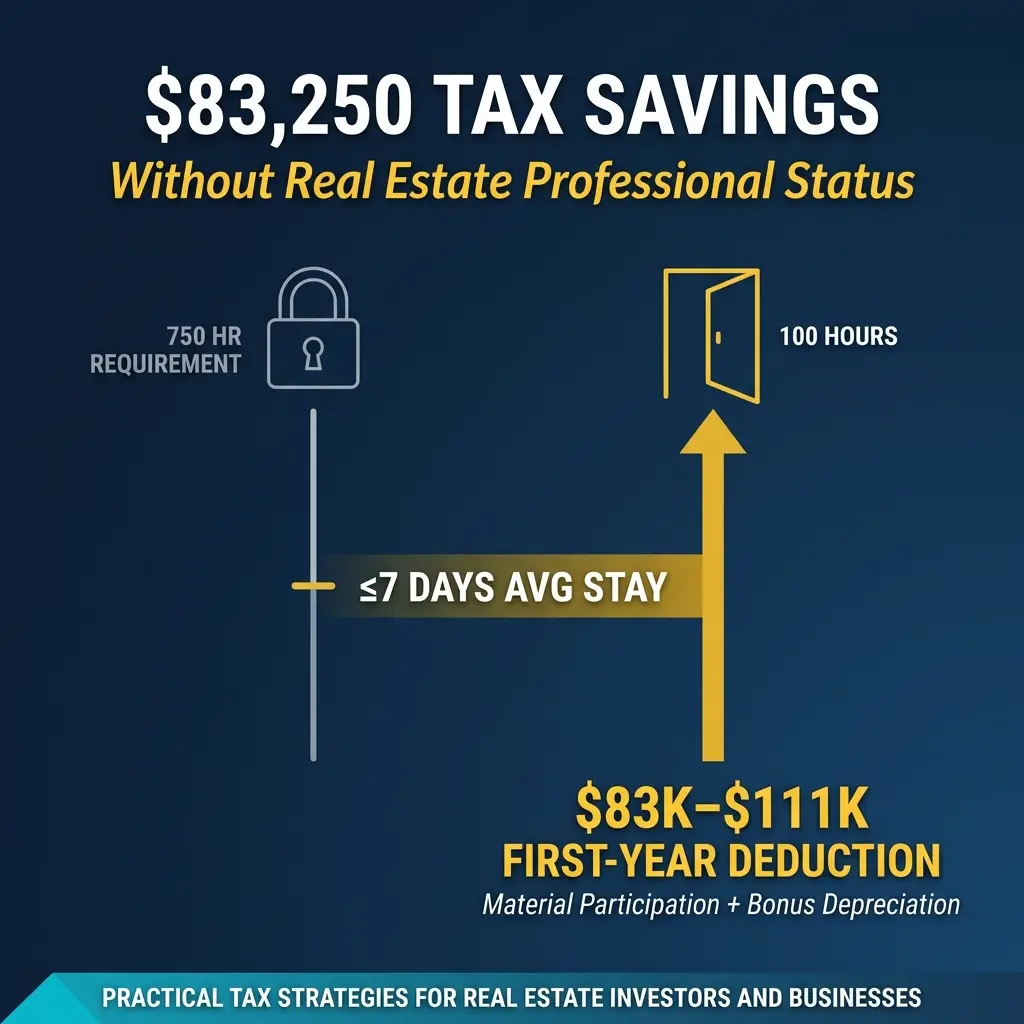
TL;DR: High-earning W-2 employees don't need real estate professional status to offset active income with short-term rental losses. They use the Short-Term Rental Loophole. The material participation test (500 hours per year, or 100 hours if nobody participates more) creates a separate pathway. Combined with restored 100% bonus depreciation for properties placed in service after January 19, 2025, the 2026 tax year offers outsized first-year deductions.
W-2 earners making $200,000, $300,000, or more per year have been using short-term rental losses to shelter active income for years without qualifying as real estate professionals. The path exists through material participation rules, which are distinct from real estate professional status requirements.
When you meet specific hour thresholds in managing your short-term rental, the IRS treats your losses as non-passive. Those losses offset W-2 income directly. The 2026 tax year creates a particularly strong window because of restored 100% bonus depreciation for properties placed in service after January 19, 2025. When combined with a cost segregation study, first-year deductions multiply.
What Is Real Estate Professional Status (And Why You Don't Need It)
When people talk about using rental losses to offset W-2 income, real estate professional status dominates the conversation. The requirements are strict. You need more than 750 hours per year in real estate trades or businesses, and more than half of your personal service time must be in real estate. For W-2 employees with demanding jobs, those thresholds are functionally impossible. You'd need to make real estate your primary occupation.
The conventional wisdom becomes: if you earn a high W-2 salary, rental losses stay passive. They offset other passive income, not the salary generating your largest tax bill. This framing is accurate for long-term rentals. Short-term rentals follow different rules. The tax code creates a separate classification when you meet material participation standards.
Key Point: Real estate professional status requires 750+ hours and making real estate your primary work. Short-term rentals bypass this through material participation tests.
How Material Participation Works for Short-Term Rentals
The IRS defines short-term rentals as properties where the average guest stay is seven days or less. When your property qualifies and you materially participate, income and losses become non-passive. They offset active W-2 income without needing real estate professional status. Material participation uses seven tests outlined in the tax code. Most short-term rental owners focus on these four:
Test 1: You participate more than 500 hours during the tax year in the activity.
Test 4: You participate more than 100 hours during the tax year, and your participation is at least as much as any other individual (including non-owners).
Test 5: You participated in the activity for any five of the prior ten years.
Test 6: The activity is a personal service activity, and you participated for any three prior years.
Test 1 provides the clearest path for most STR owners. When you document more than 500 hours of participation in managing, maintaining, and operating your short-term rental during the tax year, your losses offset W-2 income. No real estate professional status required.
Test 4 offers a path for owners who don't hit 500 hours individually. If you participate more than 100 hours and nobody else (spouse, partner, property manager, employee) participates more than you, you meet material participation. This test evaluates your hours against everyone else involved, including contractors and employees. Spousal hours count separately when determining who participated most, unless you file jointly and combine hours for the test.
These approaches have been tested and validated in tax court. The framework is well-established.
Key Point: Material participation (500+ hours/year, or 100+ hours if you participate more than anyone else) allows STR losses to offset active W-2 income without real estate professional status.
What Activities Count Toward the Hour Tests
Meeting the hour requirements (whether 500 or 100) requires active involvement. If you hire a property management company to handle operations, reviewing monthly statements won't get you there. The IRS requires participation to be regular, continuous, and substantial. Qualifying activities include:
Guest Communication: Responding to inquiries, managing reservations, coordinating check-ins and check-outs
Property Maintenance: Cleaning, landscaping, addressing maintenance issues, coordinating with contractors
Marketing and Pricing: Updating listings, managing pricing strategies, responding to reviews
Financial Management: Bookkeeping, tracking expenses, managing payments
Quality Control: Physically inspecting the property, ensuring standards between guests
Time spent as an investor does not count. Reviewing financial reports or making high-level decisions about the property qualifies as investor activity, not participation. The distinction determines whether your losses are passive or non-passive. Documentation matters. Track hours with contemporaneous logs that include specific task descriptions, dates, and time spent. Reconstructed estimates built at year-end when your CPA asks for proof won't hold up under audit.
Key Point: Active management tasks count toward hour tests. Investor-level oversight does not. Documentation must be contemporaneous and specific.
Why the 2026 Tax Year Creates Maximum Opportunity
Material participation has existed for years. The restoration of 100% bonus depreciation creates outsized value for 2026 specifically. The Tax Cuts and Jobs Act originally allowed 100% bonus depreciation. You deducted the full cost of qualifying property in year one instead of depreciating over time. That provision phased down to 60% by 2024. Recent legislation restored 100% bonus depreciation for property placed in service after January 19, 2025.
For short-term rental owners, this creates significant first-year deductions. A cost segregation study reclassifies portions of your property into shorter depreciation schedules. Combined with 100% bonus depreciation, first-year deductions multiply. In some cases, deductions exceed the purchase price. When you meet material participation, those losses are non-passive. They flow directly against W-2 income. For high earners in top tax brackets, this creates immediate tax liability reduction. You fund additional investments, pay down debt, or accelerate wealth-building strategies.
Timing is critical. You must place the property in service during 2025 or 2026 to access 100% bonus depreciation. You must meet material participation within the same tax year you claim the loss. Close on a property in November without hitting the hour threshold by December 31st, and the loss stays passive. It won't offset W-2 income that year.
Key Point: Properties placed in service after January 19, 2025 qualify for 100% bonus depreciation. Combined with material participation, first-year W-2 offset potential maximizes.
Three Verification Questions Before You Commit
Strategy becomes execution at the verification step. People hear about material participation, get excited about tax savings, and assume buying a short-term rental delivers the benefit automatically. You have to meet the test. You have to prove it. Answer three questions before structuring your finances around this strategy:
1. Does Your Property Qualify as a Short-Term Rental?
If your average guest stay exceeds seven days, the framework collapses. Look at booking data, not intentions or listing descriptions. The IRS measures actual guest stays.
2. Will You Realistically Accumulate 500 Hours in the Tax Year?
Demanding W-2 jobs, frequent travel, or remote management with minimal hands-on involvement make hitting the hour thresholds difficult. Be honest about capacity and willingness to do the work. If you're splitting responsibilities with a spouse or partner, the 100-hour test (Test 4) might be more realistic than the 500-hour test.
3. Are You Prepared to Document Participation for an Audit?
Contemporaneous logs with specific task descriptions, dates, and time spent are required. Participation must be regular, continuous, and substantial. Sporadic or investor-level oversight won't qualify.
If you answer no to any question, this strategy won't work for your situation. Other tax optimization approaches exist without material participation requirements. Know the answer before buying the property, not after structuring expectations around a deduction you won't legally claim.
Key Point: Verify average guest stays, realistic hour capacity, and documentation readiness before committing capital to this strategy.
The Gap Between Tax Preparation and Tax Strategy
Material participation rules for short-term rentals are well-documented and regularly applied. Most CPAs don't proactively raise this strategy because tax preparation and tax strategy operate as separate disciplines. Your CPA focuses on compliance. Filing accurate returns based on information you provide, meeting deadlines, minimizing audit risk. This work is valuable and reactive. Strategic tax planning identifies opportunities like STR material participation and structures investments to maximize them. This requires a different approach.
If your advisor hasn't mentioned material participation while you explore short-term rentals, ask why. Either they're unfamiliar with the strategy, or they're making assumptions about your capacity without asking qualifying questions. The conversation with your tax advisor should sound like this: I'm considering a short-term rental. If I meet the material participation test, losses offset my W-2 income. Help me evaluate whether this makes sense for my situation and what documentation standards I need to meet.
If the conversation won't lead to substantive discussion about hour tracking, cost segregation studies, and the interplay between bonus depreciation and passive loss rules, you're getting compliance support, not strategic advice. For high earners making investment decisions involving significant capital, that gap is costly.
Key Point: Most tax advisors focus on compliance, not proactive strategy identification. Ask directly about material participation when exploring STR investments.
Real Numbers: What This Strategy Looks Like
You're a W-2 earner making $300,000 per year. You purchase a short-term rental property for $500,000. You commission a cost segregation study identifying $200,000 in components eligible for accelerated depreciation. With 100% bonus depreciation restored, you deduct $200,000 in year one. When you meet material participation, that $200,000 loss offsets active income. At a 35% effective tax rate, you save $70,000 in taxes during the first year. You reinvest that $70,000 into another property, pay down high-interest debt, or fund additional tax-advantaged strategies. All compound over time.
When you don't meet material participation, that $200,000 loss is suspended. It carries forward for use against future passive income. It won't touch W-2 income. You still pay $105,000 in taxes on your $300,000 salary. The deduction you expected to create immediate cash flow is locked behind passive loss limitations. The difference isn't $70,000 in year one. The opportunity cost of what $70,000 generates over the next decade matters. That's the distinction between tax planning and tax preparation.
Key Point: A $200,000 first-year deduction creates $70,000 in tax savings at 35% rates when material participation is met. Without it, the deduction suspends.
Frequently Asked Questions
Do I need to be a real estate professional to offset W-2 income with STR losses?
No. Real estate professional status requires 750+ hours and making real estate more than half your work time. Material participation for short-term rentals requires 500+ hours managing the specific property. The tests are separate.
What defines a short-term rental for IRS purposes?
A property where the average guest stay is seven days or less. The IRS measures actual booking data, not your listing settings or intentions.
What happens if I meet 500 hours in year two but not year one?
Losses are passive in year one and suspend. They carry forward. In year two, when you meet material participation, new losses offset W-2 income and you release suspended losses from prior years.
Does hiring a property manager disqualify me from material participation?
No, but it makes meeting 500 hours harder. You need to perform substantive tasks yourself. Reviewing manager reports counts as investor activity, not participation.
What documentation does the IRS require for material participation?
Contemporaneous logs showing dates, specific tasks performed, and time spent. Logs must demonstrate regular, continuous, and substantial participation. Reconstructed year-end estimates won't satisfy audit standards.
Will 100% bonus depreciation continue past 2026?
Current legislation applies to property placed in service after January 19, 2025. Future changes require new legislation. The 2026 tax year offers certainty for planning.
What is a cost segregation study and do I need one?
A cost segregation study reclassifies building components into shorter depreciation schedules. Combined with bonus depreciation, it maximizes first-year deductions. A property with a cost basis as low as $150,000, not including land, is worth a free estimate to see whether a study produces benefit.
What if my STR has some guests staying longer than seven days?
The IRS uses average guest stay. If your average is seven days or less across all bookings during the year, the property qualifies. Track booking data to verify.
When does the 100-hour test (Test 4) make sense versus the 500-hour test?
The 100-hour test applies when you participate at least 100 hours and nobody else participates more than you (including contractors, managers, and employees). This test works when you are the most active participant but don't hit 500 hours individually. If you own multiple short-term rentals, you may make a grouping election under IRS Regulation 1.469-4 to combine properties as a single activity for material participation purposes. This election requires attaching a statement to your tax return and follows specific IRS requirements for grouping based on similar operations, common control, and geographic proximity. Consult your tax advisor before making this election, as it affects how suspended losses are released when you sell properties.
Key Takeaways
High-earning W-2 employees offset active income with short-term rental losses through material participation (500+ hours/year, or 100+ hours if nobody participates more), not real estate professional status.
Properties placed in service after January 19, 2025 qualify for 100% bonus depreciation, maximizing first-year deductions when combined with cost segregation studies.
Material participation requires regular, continuous, substantial involvement in property management. Investor-level oversight doesn't count. Documentation must be contemporaneous and specific.
Average guest stays must be seven days or less. The IRS measures actual booking data, not listing descriptions or intentions.
Verify you'll meet the 500-hour threshold before purchasing. Closing late in the year without time to accumulate hours leaves losses passive for that tax year.
Most tax advisors focus on compliance, not proactive strategy. Ask directly about material participation when exploring short-term rental investments.
Meeting material participation in year one with maximized bonus depreciation creates immediate W-2 offset and compounds wealth-building capacity through tax savings reinvestment.

CEO of Cashflow Strategies, Inc., Tax Strategist, Speaker, Educator
David “Mr. Cash Flow” Wiener is a nationally recognized authority on real estate tax strategy and cash flow optimization, and the host of The Tax Strategy Playbook podcast. As Founder and CEO of Cash Flow Strategies, Inc., David has spent decades helping real estate investors, business owners, and their advisory teams legally reduce taxes, unlock hidden cash flow, and put more money back into productive assets instead of into the IRS.
Over the course of his career, David has become especially known for his work with cost segregation, 179D energy-efficient commercial building deductions, and other engineering-based tax incentives that accelerate depreciation and free up capital. He has also built a long track record in cash flow and accounts receivable optimization, helping clients improve profitability and financial stability without simply “working harder” or taking on more risk.
David is a sought‑after speaker, trainer, and educator, with audiences ranging from national industry conferences to small mastermind groups and professional associations. He is known for his clear, practical teaching style and his ability to translate complex tax concepts into simple, actionable plays that investors and advisors can use right away. Whether he is speaking to CPAs, medical and dental practice owners, or real estate investors, David’s message is consistent: tax strategy is one of the most powerful—and most overlooked—wealth multipliers available.
On The Tax Strategy Playbook, David brings that same real‑world experience and teaching approach to the microphone. Each epis… Read More
Can You Deduct Leftover 2022 to 2024 Research Costs on Your 2025 Return?