
 YouTube

 Apple Podcasts

 Spotify

 iHeartRadio

 Pandora

 Deezer

 Amazon Music

 Podchaser

 PocketCasts
Form 6765 Changed for 2026: R&D Credit Records to Build Now

Key Takeaways
- The IRS does not examine the R&D tax credit as one lump sum; it evaluates eligibility project by project based on specific technical uncertainties, trials, and contributions.
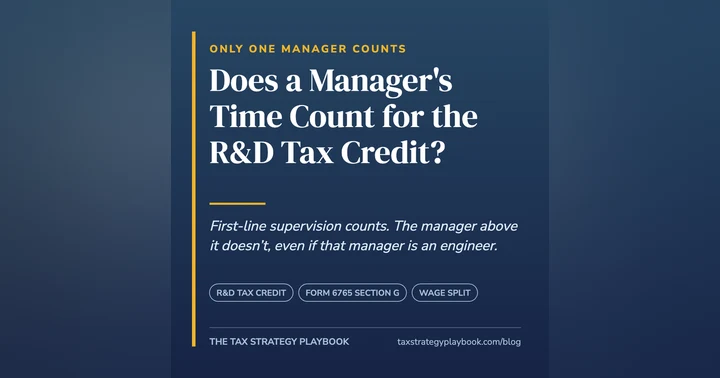
- Form 6765 Section G becomes mandatory for tax years beginning after 2025, requiring companies to itemize project details, wage splits, and expenses directly on the return unless exempt.
- Businesses can claim an exemption from Form 6765 Section G if they are qualified small businesses using the payroll offset, or if they meet specific thresholds including $1.5 million or less in qualified research spending across a controlled group and $50 million or less in average gross receipts.
- Even if a company is exempt from Section G reporting, it is not exempt from maintaining usable records, such as project descriptions, evidence of trial and error, and time tracking.
- Before December 31, business owners should build five core records: a stable project list, a one-paragraph description of technical uncertainties per project, existing trial evidence, a three-way wage split (research, supervision, support), and tied expense records.
Form 6765 changed for 2026, and the change reaches past the form and into your shop. When the IRS examines an R&D tax credit, it doesn't look at one big number. It goes project by project: what you didn't know at the start, what you tried, who did the work, and how much of their time went to it. Starting with 2026 returns, Section G of Form 6765 asks a version of those same questions at filing. In this episode I walk through what the IRS asks for in an R&D credit exam, the refund claim rules for amended returns, who's exempt from Section G and the condition that trips people up, the three-way wage split, and the five records to build before December 31 while your people still remember what they tried.
This is part three of a four-part solo series on the research and development tax credit. It's for owners who've claimed the credit or plan to on a 2026 return, for whoever runs engineering, operations or product (you hold the answers accounting can't produce), and for tax professionals, who'll get the Section G request first.
CHAPTERS
0:00 What does the IRS ask in an R&D tax credit audit?
2:01 What is a business component for the R&D credit?
4:07 What records does the IRS want in an R&D credit exam?
7:10 R&D credit refund claim requirements on an amended return
10:38 Can the IRS question an R&D credit carryforward?
12:45 What is Form 6765 Section G and when is it required?
14:19 Who is exempt from Form 6765 Section G?
16:43 What Section G asks for: project list and wage split
21:29 R&D credit records to build before December 31
32:19 R&D tax credit playbook: six steps before year end
Nothing in this episode is tax advice. Your situation needs a professional who knows your facts. Tax evasion is a crime, but tax avoidance is mandatory.
Your host: David Wiener, "Mr. Cash Flow"
Website: https://davidhwiener.com
No-cost analysis for cost segregation, 179D and R&D tax credits. No obligation, no pitch, and I'll tell you if a study won't pay for itself: https://calendly.com/david-wiener/cs or 770-224-8504 x2
Email: david@davidhwiener.com
Free newsletter and 2026 tax planning guide: https://www.taxstrategyplaybook.com/newsletter/
YouTube: https://www.youtube.com/@TaxStrategyPlaybookPodcast/?sub_confirmation=1
#Form6765 #RDTaxCredit #TaxStrategy
Frequently Asked Questions
What is Form 6765 Section G and when is it required?
Section G is a portion of Form 6765 that requires taxpayers to itemize their R&D tax credits project by project. It is mandatory for tax years beginning after December 31, 2025, unless the business qualifies for a specific exemption.
Who is exempt from filing Section G on Form 6765?
You are exempt if you are a qualified small business taking the payroll offset, or if you meet three criteria on an original return: $1.5 million or less in total qualified research expenses across your controlled group, a three-year average gross receipts of $50 million or less, and filing an original timely return.
What records does the IRS require during an R&D tax credit audit?
The IRS looks for records that substantiate your claims project by project, including what technical uncertainties existed at the start, what alternatives were tried, who performed the work, and how much time and money were spent.
Does every 2026 tax return claiming the R&D credit need a written research narrative?
As the instructions currently read, a written narrative is not strictly required on a timely filed original return, though it is mandatory for amended returns that add or increase a credit, and highly recommended for audit defense.
David Wiener: Which projects did you claim? For each one, what didn't you know when you started? What did you try? Who did the work? And how much time went to it? Those are the questions the IRS opens with when they look at an R&D credit. The first ones aren't about how much you spent, they're about which projects one at a time. Now Try answering them for a project that wrapped up two years ago. The engineer who ran it left last spring. Her test results lived on her laptop. The two designs that failed never made it into any file because back then everybody knew. That's how a real credit on real work turns into a hard conversation. The research happened, the proof walked out the door with her. So here's today's argument. Your R&D credit doesn't get defended in the audit. It gets defended this year by the people doing the work in records nobody can build later. And for twenty twenty six, you've got about six weeks left. I'm David Wiener. This is the Tax Strategy Playbook, and today's the third stop in a four part solo run on the R&D tax credit. We started with the payroll offset for startups. Three weeks ago it was research a client paid for. Today is the one owners tend to worry about without saying so out loud. What happens to your credit when the IRS takes a look? Plus a new rule on your 2026 return that asks for the credit project by project before anybody's been picked for a review. Brian Broussard covered what qualifies back in episode 9, so start there if the four-part test is new to you. Today picks up at the question owners ask me a year or two after their first claim. If the IRS ever looks at this, what are they going to want? Before the IRS part, one idea that changes how you'll hear the rest of this. Your research and development credit isn't one number. It's a stack of smaller ones. The tax code calls each piece a business component. That's a fancy name for the specific thing you were trying to build or improve: a product, a process, a piece of software, a technique, a formula, or an invention. A new fixture design is a business component. A reformulated sauce is one. A scheduling engine is one. The law tests every one of them separately. The four questions Brian walked through in episode nine get asked about each project on its own. Were you trying to make something work better, last longer, perform better, or hold up better? Was it grounded in engineering or the hard sciences? Did you start out not knowing whether you could do it or how you could do it? And did you work through it by trying alternatives? Four questions every project. The statute says it in plain words. The tests are applied separately to each business component. Here's why that matters to an owner. It cuts both ways. The good news, one weak project doesn't sink the strong ones. If you claimed six projects and one turns out to be routine work, the other five still stand on their own. The bad news is you can't defend the credit as a whole. We spend a lot on engineering, so about this much must qualify. isn't an answer to any one of the four questions. A percentage of payroll has no projects in it. So when I say the credit lives at the project, the IRS will look for it there. And the records that hold up are the ones that are built there. For the tax professionals, one line. When a whole component doesn't pass, the regulations shrink the test back to the most significant subset of it, a subsystem or part, and test that. Which only works if the records are kept at a level somebody can actually shrink back to. So let's go to what happens when the letter shows up and what the IRS asks for in order. First, the thing owners worry about the very most. Being selected for a look at your R&D credit doesn't mean you did something wrong. The credit is technical. It's claimed a lot and it involves judgment calls. That draws attention on its own. Selection isn't an accusation. What matters is whether you can show your work. And here's the frame I'd use. In review the burdens on you, the regulations say a company claiming the credit has to keep records in. And I'm quoting sufficiently usable form and detail to substantiate that the expenditures claimed are eligible for the credit. Usable form and detail, not a summary, not a memory, records that tie the dollars to the work. So what do they ask for? Well, it follows the shape of the law. Which projects did you claim? For each project, what was the technical question at the start? The thing you didn't know? What did you try? Who did the work? And how much of their time went into it? And what did you spend on supplies and outside contractors for that project? Think about what each of those questions needs. The technical question needs somebody to have written it down near the start before the answer was known. What you tried needs test results, design revisions, a log, an email thread, a ticket history. Who did the work needs time by project, not time by department. And the spending needs to be tied to the same projects. Every one of those is easy to capture in the month it happens and it's hard to rebuild two years later. Here's why the timing matters so much. A record made during the research shows what your people tried before anyone knew the answer. A record made afterward shows what they remember. And memory edits out the dead ends. Two years later, everybody remembers the design that worked. Nobody remembers the two that failed. But the two that failed are the proof that you were uncertain in the first place. They're the evidence that the R&D credit is built on. And people leave. The engineer who ran the project takes a job across town. The shop manager retires. The contractor's gone. When the person who knew is gone, the record is all that's left to speak for the work. So what tends not to hold up? A percentage of engineering payroll with nothing behind it. A list of job titles. One paragraph describing the whole company's R&D in general terms. Interviews done two years later with the people who weren't there. None of those answers the four questions for the specific project. And what tends to hold up is boring, dated notes, test results, design files, and time tied to projects. Now a lot of companies don't claim the credit the year they earn it. They find out about it later and they go back on amended returns. Brian covered that in episode nine. If that's you, there's a specific set of rules worth knowing because the IRS has tightened exactly that door. For a research credit claimed on an amended return as a refund claim, the IRS says that the claim needs five things to be valid. One the business components the claim relates to. Two the research activities for each one. Three The names of the people who did each activity, four, what each of them was trying to find out, and five the totals for wages, supplies, and contract research. Then in June of 2024, the IRS eased up. It waived two of those five items for filing purposes, the names of the people and what each person was trying to find out. Plenty of people heard the IRS dropped the documentation requirement. That is not what happened. The same IRS page says the waived information may be requested if the refund claim is selected for examination. Filing got easier, proving the credit didn't get easier. So if anyone ever tells you we don't need names anymore, the accurate version is you don't need them to file the claim. You may very well need them to keep the claim. Small favor before we get to the deadline part, if this is landing for you, tap follow in whatever app you're using. This is how the show reaches people who've never heard of it. There's a grace window on incomplete claims that has an end date on it. Right now, if the IRS decides a research credit refund claim is missing one of the required items, it'll send a letter naming what's missing and it gives you forty-five days to fix it. That's what the IRS calls perfecting the claim. That transition period, as the IRS describes it today, runs through January 10th, 2027. It's been extended before, so check where it stands when you're when you're filing. Here's why that window matters. If a claim's rejected because it was missing required information, the IRS says the appeals process isn't available for it. Appeals is the independent office inside the IRS where you'd normally take a disagreement. For a claim rejected as incomplete, that door is closed. So if you've got an amended R&D claim in the works or you're thinking about one, ask your tax professional this month. what the claim includes and what happens if it's filed after that date. None of this means don't amend. Brian made the case in episode 9 that open prior years can be worth real money, and it's still true. It means the claim has to arrive complete, with projects already named, because the IRS has stopped accepting a total and a promise. Tax professionals, two notes for you here. The letter the IRS sends during the transition period is letter 6426C. Or letter 6428, and it names which of the five items are missing. And keep the June 2024 waiver separate in your head from the new form. On an amended claim, the form itself asks you to describe the information sought to be discovered for each listed project. More on that in a minute. One more thing that owners rarely hear. A credit you can't use this year doesn't just sit quietly. Unused R&D credits can generally carry forward up to 20 years, and the IRS has long taken the position that when you use a carry-forward credit later in a later year, it can generally question how that credit was figured, even if the year you earned it is otherwise closed. The tax court agreed decades ago in a case about a different business credit. The limit is that the IRS can't send you a bill for the closed year. What it can do is cut the credit you're using in the open year. Put that in owner terms. A credit you earned in 2026 and you use in 2031 may need its 2026 records in 2031 if 2031 is examined. The engineer may be gone. The records you built this year might be doing their most important work five years from now. So that's what the IRS asks for when it looks. Now here's what's new. Starting with the 2026 return. It asks a version of the same questions before it ever looks. We're halfway through, so let me pin this down. The IRS doesn't examine your R&D credit as one number. It goes project by project asking what you didn't know, what you tried, and who did the work. Those answers get built while the work is happening or they get rebuilt badly later. If you subscribe to the Tax Strategy Playbook newsletter, you get two things at no charge. Actually, more than two things, but it includes my 2026 year-end tax planning guide, and you also get playbook notes for every episode. Signing up for the newsletter is free at Taxstrategeplaybook.com slash newsletter. This episode's notes puts the five records and the Section G exemption tests on one page. And one question with a one-word answer back to me. Does your company track engineering time by project? Yes or no? If you have to go ask somebody, just call it a no. The R&D credit goes on the return on form 76765. You don't fill it out, your tax professional does. But one part of it changed in a way that reaches right into your shop. So I want you to know it at the level an owner needs. There's a part of that form called Section G. It asks for the credit broken out project by project. Up till now, it's been optional. The IRS instructions say it plainly. For tax years beginning before 2026, Section G is optional for everyone. For tax years beginning after 2025, it's required unless you're exempt. For a calendar year company, that's your 2026 return, the one you'll file in 2027. Which means the year it's asking about is the one you're finishing right now. If your fiscal year started in the middle of 2026, it's the year you're in now too. Here's the shift in plain English. For most of the form's life, you reported the credit as totals, wages in one box, supplies in another, contractors in a third, all summed up across the company. Section G takes those totals apart. It's roughly the outline of what an examiner used to ask for moved up to the day you file. The law didn't change. The four part test is the same test they've always used. Section G changes how you report a credit, not whether you qualify. But the credit now shows up at the IRS already itemized. Now, a lot of smaller companies are exempt. There's two ways out. First way, if you're a qualified small business taking the payroll offset, And you check that box on the form, you're out. That's the startup door from episode one of this series. If that's you, Section G is not required. Way two has three conditions, and you have to meet all three. Your total qualified research spending is a million and a half dollars or less, your average gross receipts over the prior three years are $50 million or less, and you're reporting the credit on an original return. Each of those three has a catch. The million and a half is measured across your whole group of commonly controlled companies, not one entity. If you own four companies under common control, you add them up. The 50 million isn't one year, it's a three year average, so one great year doesn't knock you out by itself, and one thin year won't rescue you. And the condition that's easiest to miss, original return only. If you go back and claim the credit on an amended return, this exemption doesn't apply, and you're in Section G regardless of size. Here's an illustration. An owner has two companies under common control. One does the engineering and has about $1.2 million in research spending. The sister company runs a test lab with about $600,000. Looked at one company at a time, both are under a million and a half. Looked at the way the exemption measures it, together, that's 1.8 million and the exemption is gone. That's the owner who finds out in March. And Section G doesn't reach back. Your 24 and 25 returns didn't need it, but an exam of those years asks the same project questions anyway. So here's the owner takeaway. If you're comfortably under both numbers and you file the credit on time, you may skip section G. But notice what the exemption doesn't do. It doesn't change what an examiner asks for. An exempt company that gets a letter faces the same project-by-project questions. Exempt from the form isn't exempt from the records. Let me make that absolutely clear. Exempt from the form is not exempt from the records. For a company that isn't exempt, here's what your tax professional is going to need from you. A list of your projects sorted by how much you spend on each, biggest first. You don't have to list every one. The instructions say you list them until you've covered at least 80% of your qualified research spending or until you've listed 50, whichever comes first. Everything left over gets reported as one lump. It doesn't disappear. Say a company has 12 different projects. The three biggest add up to 85% of its research spending. It lists those three one by one in order, the other nine go in as a single line, and it still tells the IRS it had twelve. The form also asks for the total number of projects behind the credit, all of them, plus how much of the credit's wages were paid to officers. For each listed project, a name or ID that stays the same. What kind of thing it was, a project, a process, or what the form calls all others. Software doesn't get its own type, which surprises people. It lands under all others, and there's a separate column to say what kind of software it was and which company in your group did the work if you have more than one. And then the part that's going to pinch. For every project, wages get split three ways. Direct research, which are people doing the work, direct supervision, the first line managers directing it, and direct support, people helping the research happen. a machinist building a part for a prototype or someone writing up the test results, plus supplies, computer rental, and outside contract research, each tied to that project. If your time tracking is one bucket called engineering, that split doesn't exist anywhere in your company today, and you can't pull it out of a payroll register after the fact. Somebody has to know that Maria spent most of her spring on the new fixture and that her manager spent a slice of his week directing it. That's the single input most companies don't produce right now. Same thing in a software company. A developer writing the new scheduling engine is direct research. The engineering lead reviewing her approach every morning is direct supervision. The person who sets up the test environment so she can load 10,000 fake jobs is likely direct support. The VP two levels up and the person running payroll generally aren't in any of the three. The form wants each of those people by project. So when your tax professional asks you for Section G information in January, here's the short version of the request. Your project list, biggest first, a name that doesn't change, what kind of thing each one was, who worked on it, in which of the three roles, and roughly how much of their time, and the supplies, computing, and contractors tied to it. That's the entire ask. Every piece of it comes from your shop, not from accounting. Now, one piece of good news that's easy to miss. There's a column on section G that asks you to describe the information you are trying to discover on each project. The written narrative. That's the one everybody dreads. The instructions say it's required on an amended return that adds or increases the credit, and it's not required on returns filed on time, including extensions. The IRS put the word currently in front of that, so have your tax professional confirm it. So, as the instructions read today, if you file on time, you report the projects and the dollars, and you don't have to write the narrative on the form. If someone tells you every 2026 return needs a written research narrative for every project, ask them to show you where. But don't hear that as permission to skip it. You'll want that paragraph if you ever do amend, and you'll want it if the return is examined. It's Just not required on the timely original. Tax professionals, again, two notes for you. The 80% on section G is a coverage rule for how many projects you list. Don't let a client confuse it with the 80% rules elsewhere in the R&D regulations, which are about something else entirely. And run the exemption at the controlled group level before you tell anyone they're out. The client who assumes they're under the line usually finds out in March. That's what the form wants. It takes an afternoon to fill out. Having the answers to fill in takes a year, and for 2026, you've got seven weeks of that year left. Six weeks now. Let's spend it well. Here's the part I care most about. Five records to build before December 31st. None of them requires a tax form. All of them are easier now than they'll ever be again. Number one, a project list with stable names. Sit down with whoever runs engineering and list every effort this year where you didn't know at the start whether you could do it or how. Give each one a name and then keep that name. If engineering calls it Project Falcon and accounting calls it the new line, somebody's spending a week in March reconciling. Rough cost per project is fine for now. You just need to know which ones are biggest because that's the order the form wants. And notice what doesn't go on the list, routine work, fixing a bug in code that already works, quality checks on a part you've made a thousand times, making the same product for a new customer. A clean list in November beats a padded one you have to defend in 2029. Number two, one paragraph per project. What didn't you know at the start? Not what you built, what you didn't know. We didn't know if the housing would hold tolerance at the new wall thickness. We didn't know if the scheduling engine would handle 10,000 jobs without timing out. A paragraph written this month, while people remember it, is worth more than a page written three years from now. Have the person who led the project write it, in their own words, It doesn't need to sound like a tax document. It needs to sound like an engineer explaining a problem to a smart friend. Date it. If the answer turned out to be easy once you tried it, say so. If it took four f four tries, say that too. Number three, the evidence that you tried things. This is the part most companies already have and never really collect. Design revisions, test results, the spreadsheet where someone compared three materials, the ticket history, the email thread where two engineers argued about an approach, a photo of the failed prototype on the bench. Pull it into one folder per project. You're not creating anything new, you're gathering what already exists before it scatters to the wind. And if the person who ran a project already left, start there first. Talk to whoever worked next to them while it's still this year. Find the files that they actually touched. And four, whose time went where? For each project, which people worked on it, roughly what share of their year. And in which of the three roles, doing research, directly supervising it, or directly supporting it? For 2026, that's a reconstruction. It won't carry the weight of time tracked as you go, but an estimate made now with the people in that room with the method written down beats one made later. Do it now and write down how you estimated it. Then for 2027, Set up time tracking by projects starting January first. Even a rough weekly allocation beats a guess made 14 months later. And give it an owner, one person in the company whose job it is to make sure the project codes exist. People use them and somebody looks at them once a month. If it's everybody's job, then it's nobody's job. Number five is tie the spending to the same project names. Supplies used up in testing. prototype materials, what you paid to rent computers for the research, and outside contractors with their contracts in the same folder, because episode two of this series was all about how a contract can decide whether the work counts at all. So let's put those five on the calendar. This episode comes out November 17th. From here to December 31st is about six weeks, with Thanksgiving and the holidays in the middle. So realistically, you've got about four good working weeks. That's enough if you start this week. It's not enough if you start December the twentieth. Now the machine shop, it's a composite, so no real clients here. 40 people. This year it worked on four things it didn't know how to do: a fixture to stop parts from warping, a new coolant process for a harder alloy, a quoting tool. Its own developer wrote and a redesign of a customer's bracket that the shop owned the rights to and carried the risk on. Week one, the owner and the shop manager list those four, name them and rank them by rough cost. The fixtures biggest, then the coolant process, then the bracket, then the quoting tool. Week two, each lead writes the one paragraph. What didn't we know? For the fixture, Whether any clamping design could hold tolerance on a thin wall part without warping it. Weeks three and four, they gather the evidence. Three fixture designs, two of which failed with the inspection reports. The coolant trials, the quoting tools commit history. Week five, time by project. Two machinists spend about half their year on the fixture and the coolant work. The shop manager supervised both directly for maybe a fifth of his time. A toolroom machinist cut the trial fixture parts they designed. That's research, supervision, and support on paper by project. Week six, the receipts, test material and consumables used up in the trials, and the contract on the bracket job filed with the bracket report. If you run a software company, the same six weeks look a little different. And in one way they're easier. Your ticketing system and your code history already hold most of record three. Your developers probably log work already against epics or projects. The work is mapping those to the handful of things you actually didn't know how to build and adding the paragraph about what you didn't know. What's usually missing is the three-way split and a clear line between new development and routine maintenance. Draw that line now while the team can still tell you which sprint was which. Notice what the owner didn't do. He didn't fill out a form. He didn't write a narrative for the IRS. He didn't hire anyone. He spent a few hours a week getting things out of people's heads and off their desks while it was still this year. At the end, they've got folders and one summary page. The tax professional gets a clean list in January instead of a payroll report in September. If the company's exempt from section G, the folders are its exam file. If it isn't, the folders are at Section G. Either way, nobody has to remember anything in 2029. And look at what the bracket project needed that the others didn't. The contract. The shop that did work for a customer, so whether it counts depends on who carried the risk and who kept the rights. That's episode two of this series. If the contract's not in the folder, the project's not finished, no matter how good the engineering notes are. And there's a payoff even if the IRS never calls. A clean project list makes the credit faster to figure and easier to trust. For a startup taking the payroll offset from episode one, it's how the return gets filed in the spring instead of on extension in October. The offset starts the quarter after the return's filed, so that can move the money up by two or three quarters. Records aren't only defense, they're speed. Two things I'd steer you away from. Don't write the records to sound like a credit claim. Write actually what happened, including what failed. Failure is often the best evidence that you were uncertain, and don't backdate anything. A record clearly dated November about work done in March is useful. A record pretending to be from March is a problem you created. So that's the whole job. A list, a paragraph, a folder of evidence, time by project, and the money tied to the same names. Hand those to your tax professional in January, and whether or not Section G applies to you, you've already answered the first question an examiner would ask. Now some rapid fire questions, mostly the ones owners bring up in the hallway after I speak. One, does an R&D audit mean I did something wrong? Absolutely not. Selection isn't an accusation. Showing your work is what matters. Two, does the IRS look at the credit as one number? Nope. They look at it project by project. Three, if a project doesn't qualify, do I lose the whole credit? No. Each project stands on its own. 4. When is Section G required? Tax years beginning after 2025. For calendar year companies, it's on the 2026 return. 5. We take the payroll offset. Do we need Section G? Not if you check that box as a qualified small business. 6. We're under a million and a half in research spending. Are we exempt? Maybe. That million and a half is measured across your whole group. You need average receipts of 50 million or less and an original return. 7. Do I have to list every project? No. List biggest first until 80% of your spending or 50 projects, whichever comes first. The rest goes in one lump. 8. Does every 2026 return need a written research narrative? Not on a return filed on time as the instructions read today. Yes on an amended claim that adds or increases the credit. Nine, can we pull the documentation together after the IRS asks? You can, it'll be worthless. ten, the IRS waived names on refund claims. Are they gone for good? Not in an exam. The IRS can still ask. Eleven. What if my refund claim is missing something? Through January 10th, 2027, the IRS names it and gives you 45 days. 12. Does Section G change what qualifies? Nope, same four-part test for each project. 13. Does my project manager's time count? It counts if they directly supervise the research. Their boss generally doesn't. 14. Do we have to write the records in tax language? No, don't write it in tax language. Write what happened in plain words and date it. And then fifteen, how long should we keep these records? As long as the credit's still being used and then some. Your tax professional sets the exact period. Your playbook for the next six weeks. Six items in order. Before december thirty first, write your project list in one paragraph per project. What didn't you know at the start? Thirty minutes with whoever runs engineering. That page is the first thing an examiner asks for and the first thing Section G wants, and it's never easier to write than this month. If you only do one thing from this episode, do that one. Two, ask one question this week of whoever runs engineering or payroll. Do we track time by project? If the answer is no, set it up to start January first. Split it three ways research, supervision, and support. And do the 2026 reconstruction now with people in the room. Write down how you estimated it, so the methods on paper next to the numbers. That OneNote answers a question and an examiner would otherwise ask you to reconstruct. Three, make one folder per project named exactly the way the project list names it. And start dropping in what already exists, oldest first, test results, design revisions, tickets, the failed prototype photo. The contractor agreements. Gathering is cheap, rebuilding is expensive. Start with any project whose lead has already left. Four. If you filed an amended R and D claim or you're planning one, ask your tax professional which of the five items it includes and what happens to it if it's filed after january tenth, twenty twenty seven. A claim rejected as incomplete doesn't get appeals. If the records exist, a missing item is forty five day errand. If they don't, it's a scramble. Five. Ask your tax professional to run the Section G exemption for you in December, not March. Research spending across your whole group, three year average gross receipts, and whether the credit's going on an original return. Then build your records either way because an exempt company gets the same questions in an exam. Six. If you'd like somebody to check whether your credit or the one you haven't claimed yet has project level support behind it, I'll do that at no cost and help you through the entire study if this seems a little bit complex for you. Schedule a conversation with me at Calendly.com slash David Dashwiener slash C S. It's W-I-E-N-E-R, or call me at 770-224-8504 and picks option two. There's no obligation and I won't pitch you, but we can help you walk through the entire R and D credit process and get the study together for you. And when a study won't pay for itself for a company your size, I'll say so. That's the point of the call. Number one has a deadline, December 31st. Before you go one favor, you probably know somebody who runs engineering, product, or a shop floor at a company that claims the R&D credit, not the owner. The person who actually knows what got tried this year. Send them this. They hold the answers and nobody's told them there's a clock running. Have them contact me for help. Owners hear about credits from their tax professional. The people doing the work almost never do, and by January their memory of this year is already going soft. Your call, your text could get the folder started before that happens. So send this, send this episode to somebody who could use it. And last thought. An R&D audit isn't a test you take two years from now. You're taking it right now. In your shop, every week, your people try something that doesn't work yet. The IRS will ask project by project, starting with your twenty twenty six return, the form will too. The only question is whether the answers got written down while they were true. Six weeks is enough to do that for this year. It isn't enough to do it for twenty twenty four. Nothing here replaces advice on your own facts. That takes the professional who knows your company. My job was to get you into that meeting holding a project list or a study that works. Part four is two weeks from today, the last stop in the series. It's the Section two hundred and eighty C election. One box on the credit form that decides whether you take a smaller credit or a smaller deduction. And once the return's filed, you can't change it. In between, next Tuesday's a regular episode. Remember, tax evasion is a crime, but tax avoidance is mandatory. I'm David Wiener, also known as Mr. Cashflow. I'll see you next Tuesday on the Tax Strategy Playbook.