
The IRS's 2027 Inflation Numbers: Section 179, Excess Business Loss, Estate and Gift
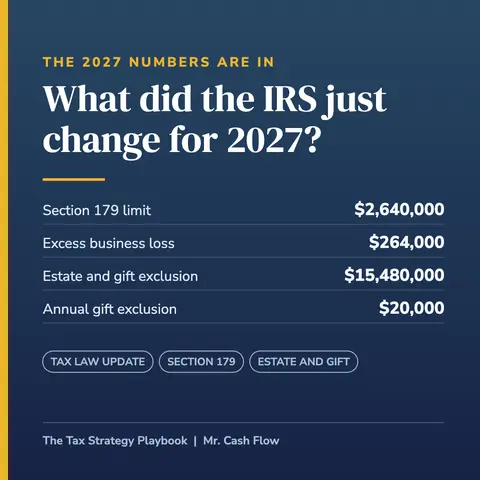
TL;DR: On November 5, 2026, the IRS released its 2027 inflation numbers in Revenue Procedure 2026-35. For tax years beginning in 2027, you can expense up to $2,640,000 of equipment and other qualifying property under section 179, and the excess business loss threshold rises to $264,000 ($528,000 on a joint return). For 2027, each person can pass $15,480,000 free of federal estate and gift tax, and the annual gift exclusion goes to $20,000 per recipient. Every one of these moved up. None of them moved much.
Key Takeaways
- Section 179 limit for 2027: $2,640,000, up from $2,560,000 in 2026 (Rev. Proc. 2026-35, section 3.26).
- The section 179 limit starts shrinking once you place more than $4,230,000 of section 179 property in service in 2027.
- Excess business loss threshold for 2027: $264,000, or $528,000 on a joint return, up from $256,000 and $512,000 (section 3.33).
- Estate, gift and generation-skipping basic exclusion for 2027: $15,480,000 per person, up from $15,000,000 (section 3.44).
- Annual gift exclusion for 2027: $20,000 per recipient, up from $19,000. Gifts to a spouse who is not a U.S. citizen: $201,000 (section 3.46).
What did the IRS release for 2027?
Every fall the IRS resets the dollar amounts in the tax code that Congress tied to inflation. This year's version came out November 5, 2026, as news release IR-2026-133, and the IRS says it adjusts nearly 70 provisions. The full list lives in Revenue Procedure 2026-35.
Most of the coverage you'll see this week leads with tax brackets and the standard deduction. Fair enough. Those touch everyone. This post skips them and goes straight to the four numbers that change real decisions for people who own property or run a business: how much you can write off at once, how much loss you can use in a year, and how much you can hand to the next generation without a tax bill.
One timing note before the numbers. The section 179 and excess business loss figures apply to tax years beginning in 2027. The estate and gift figures apply to transfers made in calendar year 2027 (Rev. Proc. 2026-35, sections 4.01 and 4.02). Nothing here changes your 2026 return.
How much can you deduct under section 179 in 2027?
Up to $2,640,000. That's the most a business can elect to write off in the first year for qualifying property instead of depreciating it over time, up $80,000 from 2026. The revenue procedure puts it this way: the aggregate cost of section 179 property a taxpayer elects to expense "cannot exceed $2,640,000" (section 3.26).
The ceiling comes with a trapdoor. Once the cost of section 179 property you place in service during 2027 passes $4,230,000, the limit drops dollar for dollar. By my arithmetic, a business that places $6,870,000 or more in service in 2027 has no section 179 deduction left at all.
Two more 2027 figures sit in the same section. The section 179 cap for a sport utility vehicle is $33,100, up from $32,000. And the dollar limit isn't the only limit. Publication 946 says the total you can elect "is subject to a dollar limit and a business income limit," so a business with thin profits can't use the full amount in one year no matter what the ceiling says. Your tax professional runs that test.
Real estate investors should read the next part closely. Section 179 is built mostly for equipment and other personal property. Buildings themselves don't qualify. Publication 946 (2025) does let you treat certain qualified real property as section 179 property, including qualified improvement property and these improvements to nonresidential real property made after the building was first placed in service: roofs; heating, ventilation and air-conditioning property; fire protection and alarm systems; and security systems. For the building itself, the bigger tool is usually bonus depreciation on the shorter-life pieces a cost segregation study identifies. I walk through how the two compare in Bonus Depreciation vs. Section 179.
Where do these numbers come from? The One Big Beautiful Bill Act reset section 179 to a $2,500,000 limit and a $4,000,000 phase-out threshold for property placed in service in tax years beginning after December 31, 2024, with inflation adjustments starting in 2026 (Rev. Proc. 2025-32, section 2.10). The 2027 figures are the second step up from that base.
What is the excess business loss limit for 2027?
$264,000 for a single filer and $528,000 on a joint return (Rev. Proc. 2026-35, section 3.33). If your business losses for 2027 exceed your business income by more than that, you can't use the extra against wages, investment income or anything else that year.
The excess carries forward. The draft 2026 Instructions for Form 461 (dated September 28, 2026) say "the excess business loss is treated as a net operating loss (NOL) carryover for subsequent years." You keep the deduction and use it later. Later still costs you something, because money you planned to save in April now waits a year or more.
This matters to property owners for one reason. A large first-year deduction, the kind a cost segregation study paired with bonus depreciation produces, is exactly the kind of number that can push a business loss past the threshold. A study is still worth doing. You just want your tax professional to model the excess business loss limit before you count on the whole deduction landing in one year.
The trend line here is odd, and worth knowing. The threshold was $313,000 ($626,000 joint) for 2025 (Rev. Proc. 2024-40). It dropped to $256,000 ($512,000 joint) for 2026 (Rev. Proc. 2025-32, section 4.31), and the 2027 bump only wins back $8,000 of that. The same draft Form 461 instructions say the One Big Beautiful Bill Act "amended section 461(l) to extend indefinitely the limitation on excess business losses." I covered why the number fell in The Excess Business Loss Limitation in 2026.
What is the estate and gift tax exemption for 2027?
$15,480,000 per person for estates of people who die in 2027, up from $15,000,000 in 2026 (Rev. Proc. 2026-35, section 3.44). That same number does three jobs. Per the revenue procedure, it sets the credit against estate tax, the credit against gift tax, and the generation-skipping transfer exemption.
Put simply, lifetime gifts and what you leave at death draw from one $15,480,000 bucket per person. The 2026 figure came straight from the One Big Beautiful Bill Act, which set the basic exclusion at $15,000,000 for 2026 and called for inflation adjustments starting in 2027 (Rev. Proc. 2025-32, section 2.14). This is the first of those adjustments.
For most of my audience, the estate tax is a someday problem. For someone holding a large real estate portfolio, it isn't. Property values climb, the portfolio grows, and the number that felt enormous at 50 can look tight at 75. If your holdings are anywhere near this range, that's an estate planning attorney conversation, and it's worth having while you have time to plan.
How much can you give away in 2027 without filing a gift tax return?
$20,000 per recipient, up from $19,000. The revenue procedure says the first $20,000 of gifts to any person in 2027 is not included in your taxable gifts, as long as the gift isn't a future interest in property (section 3.46). A future interest is a gift the recipient can't use or enjoy right away, which is often the case with gifts into a trust. That's a question for your estate planner, because it changes whether the $20,000 applies.
Give within the annual exclusion and you don't touch your $15,480,000 lifetime amount at all. A married couple with three kids, each parent giving from their own assets, could move $120,000 in 2027 that way: $20,000 from each parent to each child.
One more figure in the same section. Gifts to a spouse who is not a U.S. citizen get a larger annual exclusion of $201,000 for 2027, up from $194,000.
What should you do with these numbers now?
Nothing before December 31 changes because of them. All four apply to 2027, and 2026 still runs on the 2026 limits. If you're buying equipment or closing on a property this year, the 2026 section 179 limit of $2,560,000 is the one that counts, and the date the asset is placed in service decides which year you're in. I explain that date in When Is a Property Placed in Service?
Planning for 2027 is where these numbers earn their keep. Bring them to your tax professional, especially the excess business loss threshold if you expect a large depreciation year. This post is education, not tax advice. Your situation needs a professional who knows your whole return.
Frequently Asked Questions
What is the section 179 limit for 2027?
For tax years beginning in 2027, the section 179 limit is $2,640,000. It starts to phase out once the cost of section 179 property placed in service during the year exceeds $4,230,000. The source is Revenue Procedure 2026-35, section 3.26.
What is the excess business loss threshold for 2027?
For tax years beginning in 2027, the threshold is $264,000, or $528,000 for a joint return. Business losses above that amount are treated as a net operating loss carryover to later years.
What is the estate tax exemption for 2027?
The basic exclusion amount for estates of decedents dying in 2027 is $15,480,000 per person. The same amount sets the gift tax credit and the generation-skipping transfer exemption.
What is the annual gift tax exclusion for 2027?
For calendar year 2027, the annual exclusion is $20,000 per recipient, up from $19,000 in 2026. Gifts of future interests in property don't qualify. Gifts to a spouse who is not a U.S. citizen have a $201,000 annual exclusion.
Do the 2027 numbers affect my 2026 tax return?
No. Revenue Procedure 2026-35 applies to tax years beginning in 2027, and its estate and gift figures apply to transfers in calendar year 2027. Your 2026 return uses the 2026 amounts.
Is a cost segregation study worth it on your property?
A bigger section 179 limit helps with equipment. For a building, the larger first-year deduction usually comes from cost segregation: an engineering-based study, with an in-person site visit by a trained professional, that pulls the shorter-life components out of the building's cost so they can be depreciated faster. Want to know whether a study would even pay for itself on your property? That's what the no-cost analysis is for. It's delivered through my relationship with Cost Segregation Services, Inc. (CSSI), with no obligation and no pitch, and if a study won't pay for itself, I'll tell you so. Book a time at calendly.com/david-wiener/cs or call 770-224-8504, option two.
Sources
- IRS, IR-2026-133, "IRS releases tax inflation adjustments for tax year 2027," November 5, 2026: irs.gov
- Revenue Procedure 2026-35, sections 3.26, 3.33, 3.44, 3.46 and 4: irs.gov/pub/irs-drop/rp-26-35.pdf
- Revenue Procedure 2025-32, sections 2.10, 2.14, 4.24, 4.31 and 4.42: irs.gov/pub/irs-drop/rp-25-32.pdf
- Revenue Procedure 2024-40, section 2.32: irs.gov/pub/irs-drop/rp-24-40.pdf
- Instructions for Form 461 (2026), draft dated September 28, 2026: irs.gov/pub/irs-dft/i461--dft.pdf
- Publication 946 (2025), How To Depreciate Property: irs.gov/publications/p946

CEO of Cashflow Strategies, Inc., Tax Strategist, Speaker, Educator
David “Mr. Cash Flow” Wiener is a nationally recognized authority on real estate tax strategy and cash flow optimization, and the host of The Tax Strategy Playbook podcast. As Founder and CEO of Cash Flow Strategies, Inc., David has spent decades helping real estate investors, business owners, and their advisory teams legally reduce taxes, unlock hidden cash flow, and put more money back into productive assets instead of into the IRS.
Over the course of his career, David has become especially known for his work with cost segregation, 179D energy-efficient commercial building deductions, and other engineering-based tax incentives that accelerate depreciation and free up capital. He has also built a long track record in cash flow and accounts receivable optimization, helping clients improve profitability and financial stability without simply “working harder” or taking on more risk.
David is a sought‑after speaker, trainer, and educator, with audiences ranging from national industry conferences to small mastermind groups and professional associations. He is known for his clear, practical teaching style and his ability to translate complex tax concepts into simple, actionable plays that investors and advisors can use right away. Whether he is speaking to CPAs, medical and dental practice owners, or real estate investors, David’s message is consistent: tax strategy is one of the most powerful—and most overlooked—wealth multipliers available.
On The Tax Strategy Playbook, David brings that same real‑world experience and teaching approach to the microphone. Each epis… Read More

Who Depreciates Tenant Improvements, the Landlord or the Tenant?