
 YouTube
 Apple Podcasts
 Spotify
 iHeartRadio
 Pandora
 Deezer
 Amazon Music
 Podchaser
 PocketCasts
 R&D Tax Credit for Startups: Get Paid Even If You're Losing Money

Key Takeaways
- Startups with no taxable income can still monetize the R&D tax credit by electing to use up to $500,000 annually against their employer portion of payroll taxes.
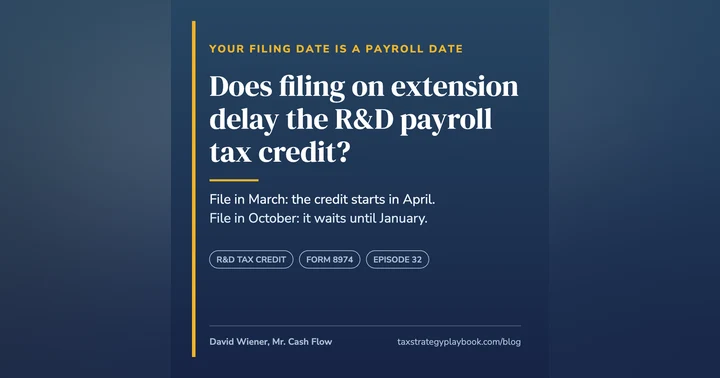
- The timeline for receiving R&D payroll tax cash is directly tied to your filing date; filing in March versus October on extension can delay cash flow by as much as nine months.
- Qualifying for the R&D payroll offset requires meeting two specific gross receipts tests: under $5 million in annual receipts and being within your first five years of generating receipts.
- Small businesses setting up a new retirement plan under SECURE 2.0 can leverage stacked tax credits worth over $60,000 across five years for startup costs, automatic enrollment, and employer contributions.
- The paid family and medical leave tax credit requires a written policy to be put in place before leave is taken, as retroactive policies will not qualify for the credit.
- Tax credits must be claimed on timely filed original returns, unlike deductions, and cannot generally be added via amended returns when it comes to the payroll tax election.
The R&D tax credit can pay a startup that is losing money, through payroll taxes it already owes. Miss one box or one date and the cash waits, or never comes.
Most small business tax credits aren't hidden. They're missed, because every one of them runs on a clock. In this solo episode of The Tax Strategy Playbook, David Wiener, Mr. Cash Flow, opens a four-part series on the research and development tax credit with the question founders ask most: we don't make money yet, does any of this help us? It does. A qualified small business, one under $5 million in gross receipts and within its first five years of receipts, can elect to use up to $500,000 a year of R&D credit against the employer share of Social Security and Medicare. David walks through the three clocks that decide whether that money shows up and when, including how a filing date moved one startup's $90,000 by nine months.
Then the lens widens to the tax credits for businesses with employees: the SECURE 2.0 retirement plan credits, worth about $65,000 over five years for one 18-person company, the small employer health care credit, the paid family and medical leave credit that changed for 2026, and the credits that are gone for 2026 hires.
Built for the founder or CFO of a young company paying engineers, developers or designers and not yet profitable, the owner of an established business with 10, 20 or 50 employees who has never been walked through the credits that come with having them, and the tax professional who wants to know where the traps sit in the middle of extension season.
CHAPTERS:
00:00 Small business tax credits: why they're missed, not hidden
03:50 Tax credit vs tax deduction: which one saves you more
05:53 What qualifies for the R&D tax credit (no lab required)
09:20 R&D tax credit for startups: using it against payroll taxes
10:37 Who qualifies for the R&D payroll tax offset: the $5 million and five-year tests
14:24 When does the R&D payroll credit start? The filing date that costs nine months
18:06 R&D tax credit example: a 12-person startup's $90,000, quarter by quarter
22:28 Retirement plan tax credits for small business: SECURE 2.0 and Form 8881
25:45 Small business health care tax credit and the paid family leave credit for 2026
29:33 Is the Work Opportunity Tax Credit gone? FAQ and the Playbook
Nothing in this episode is tax advice for your situation. Your facts are your facts, and they need a professional who knows them, so work with your own tax professional. Tax evasion is a crime, but tax avoidance is mandatory.
Your host: David Wiener, "Mr. Cash Flow"
David.wiener@cashflowstrategies.us
770-224-8504, option two
Book a no-cost analysis. No obligation, no pitch, and David will tell you if a study won't pay for itself:
https://calendly.com/david-wiener/cs
Subscribe to The Tax Strategy Playbook Podcast Channel:
https://www.youtube.com/@TaxStrategyPlaybookPodcast/?sub_confirmation=1
Get updates, special episodes and live streams, and free resources on the latest tax strategies:
https://www.taxstrategyplaybook.com/newsletter/
#RDTaxCredit #SmallBusinessTaxCredits #StartupTaxes #PayrollTaxCredit #TaxStrategyPlaybook
Frequently Asked Questions
Can a startup with no revenue claim the R&D tax credit?
Yes, revenue is not required to claim the credit, but you must have payroll and meet the gross receipts criteria of under $5 million and within your first five years of receipts.
Can I add the R&D payroll tax election on an amended return?
Generally, no. The IRS requires the payroll tax election to be made on an original tax return filed on time, though extensions do count.
Does a project have to succeed to qualify for the R&D tax credit?
No, success is not a requirement. The process of technological uncertainty, alternative testing, and experimentation is what qualifies the project.
What qualifies a small business for SECURE 2.0 retirement plan credits?
You generally need 100 or fewer employees earning at least $5,000, no prior plan for substantially the same employees in the past three years, and at least one rank-and-file employee participating.
David Wiener: Two software startups, same 12 people, same code, same R&D credit, $90,000 each. One files its tax return in March, the other files in October on extension, like most of the companies I talk to. The March company starts getting that $90,000 back in April, a little every payroll quarter until it's done by Christmas. The October company doesn't see the first dollar until January of the next year. Same credit. Same rules, nine months apart because of a filing date. And if either one had filed without making the right election, the credit wouldn't have touched payroll at all. That's what today's all about. Small business tax credits aren't hidden, they're missed because every one of them runs on a clock, and almost nobody tells you where the clock is. Welcome back to the Tax Strategy Playbook. I'm David Wiener. Some of you know me as Mr. Cash Flow. Today is a solo show and it's the first of four. Every other week or so I'm taking one piece of the R&D tax credit that doesn't get enough airtime. Today's piece matters most to a young company. How a startup with no profit at all can use the R&D credit against the payroll taxes it's already paying. Then I'll widen out the lens a little bit to the other small business tax credits that I see miss the most. Here's what you'll be able to do by the end of this episode. You'll know whether your company can turn the R&D credit into cash this year, even if it's losing money, and the one box on the return that decides it. You'll know the three clocks that decide when that money shows up and how a filing date can move it by nine months. and you'll know which credits come with having employees, a retirement plan, health coverage, and paid leave, and which credits you've heard about. That are gone for 2026. Stay with me into the back half. I'm going to put real numbers on two companies: a 12-person software startup quarter by quarter, and an 18-person company starting its first retirement plan where the credits add up to more than $60,000 over five years. And if you only catch the first 10 minutes, you'll know the payroll offset exists, and you won't know whether you're on time for it. If you're the founder or CFO of a young company that's paying engineers, developers, or designers and isn't profitable yet, the first half of this episode was written specifically for you. If you own an established business with 10, 20, 50 employees and nobody's ever walked you through the credits that come with having them, stay for the second half. That's where most of the money in this episode is for you. And if you're a tax professional, I'll come to your side of the desk a few times because a couple of these land on it in a form you might not see very often, and one of them has a deadline that's easy to miss in the middle of extension season. You're the person most likely to catch it for a client, so I want you to hear exactly where the traps are. If you heard episode 9 with Brian Broussard, You've got the foundation on what qualifies for an R&D tax credit. I'm not going to reteach it here. I'm picking up where it stops with the question I get the most from founders. We don't make money yet. Does any of this help us? Short answer is yes, and sooner than you'd think. Before any of the credits, 90 seconds of foundation, because it changes how you hear the rest of this. A tax deduction is something that you subtract from your income. It reduces how much of your income gets taxed. If you made $200,000 and you have $20,000 in deductions, only $180,000 is being taxed. That helps. but a deduction's only worth your tax rate. $20,000 of deductions at a 24% rate saves you $4,800. A tax credit's much more direct. It's a dollar for dollar reduction of your tax bill. If you owe $5,000 and you've got a $500 credit, you owe $4,500. A dollar of credit is worth a dollar in any bracket. That's why a $20,000 credit is worth about four times what a $20,000 deduction is to most business owners. Too many business owners obsess over deductions. They want to write everything off the mileage, the home office, the equipment, and they completely overlook credits. You want both. But here's what matters for today. Deductions are mostly forgiving. Miss one, and you can often go back and fix it. Credits are less forgiving. A lot of them are won or lost before the year is even over by a policy you wrote, a plan you set up. Or a box you checked on the original return. That's the clock I keep talking about. A deduction's usually a question of how much. A credit's often a question of when. Did you set it up in time? Did you file it in time? Did you check the box in time? One more wrinkle for startups. A credit reduces income tax. If you don't owe income tax because you're not profitable yet, the credit usually just sits there and carries forward, up to 20 years for most business credits. And a credit you can't use for five years is a coupon for a future that might never come. Which is exactly the problem Congress fixed for young companies. They wrote a version of the R&D credit that doesn't need a profit to pay you. Let's go there. When you hear R&D, you might picture lab coats and billion-dollar tech companies. In reality, a lot of small and mid-sized companies qualify and they don't even know it. The tests in section 41 of the tax code, and Brian laid it out in episode 9. If you haven't heard it, I suggest you go back and listen to that episode or watch it on YouTube. You're trying to create or improve something your business uses or sells. The works grounded in engineering, computer science, physics, chemistry, or biology. You started out not knowing whether you could do it or how you could do it, and you work through it by trying alternatives and testing. Most software development that's building something genuinely new fits that test. Most bug fixes on code that already works don't. And here's the part that surprises people. You don't have to succeed. A project that tried four approaches and failed can qualify because the uncertainty and the testing are the whole point. A machine SHOP that keeps getting warped parts and tries three fixtured designs before one holds tolerance. A food company reformulating a sauce so it stays shelf stable without a preservative it used to rely on. An architecture firm working out a cantilever that nobody in the office has built before. A software team that doesn't know whether its scheduling engine will scale. None of them wear lab coats. All of them qualify for a look at the R&D tax credit. The biggest misconception I hear from people is we don't have an R&D department. Almost nobody has an R&D department. The credit doesn't care what the department's called or whether there's a lab, it cares what the work was. Engineers, developers, designers, machinists, food scientists, the project manager running the build. If they spend their week trying to figure out something nobody at the company knew how to do yet, some of their wages may count. The companies I see miss this most aren't hiding anything, they just never connected the word research to what their people do every day. What doesn't count? Research done outside the US, work after the products in commercial production. Routine testing and quality control, market research, and research somebody else paid for where they kept the risk or the results. That last one's episode two of this series. What does count is mostly wages, the people doing the work, directly supervising it, and directly supporting it, plus supplies used up in research and part of what you pay to US contractors. Brian's rule of thumb in episode nine was about 10% of qualified spending for a company with some history. But I'll give you a more careful number for a startup in a few minutes because the math's different when you're new. You claim it on form sixty seven sixty five, and the documentation matters, like most things. What projects you worked on, what you didn't know at the start, who did the work, and what you spent. The IRS has been tightening exactly that, and the audit side is episode three of this series. For today the rule is simple. The records that hold up are the ones written while the work is happening, not reconstructed two years later. Quick one before we keep going. If this is the kind of thing you want in your week, follow the show wherever you're listening. One tap, and it's how new people find us. Here's the problem Congress was looking at. For the first 35 years, the R&D credit only came off income tax, and startups don't pay income tax. They burn cash. So young company could spend half its budget on engineers and get nothing. While a mature, profitable company doing incremental work collected every single year. The rule rewarded the companies that needed it the least. So Congress gave qualified small businesses a different door. You can elect to use the credit against payroll taxes instead. First the employer's share of Social Security, the 6.2%, then the employer's share of Medicare, the 1.45%. Those are taxes you pay every payroll, profit or no profit. The coupon becomes the cash flow. Think about what it means for a company with 12 engineers. Every two weeks it runs payroll, and every quarter it sends the IRS its share of Social Security and Medicare on those wages. That money goes out whether the company made a dollar or not. The payroll offset says, take the credit you earn for the research those same people did and use it to pay that bill. It's the closest thing in the tax code to the research paying for itself. So who qualifies? Two tests, both about gross receipts and not profit. One, gross receipts under $5 million for the year you're claiming. A company doing $4 million in revenue while losing $2 million qualifies. A company doing $6 million doesn't, however much it's losing. Two, you're within your first five years of having gross receipts. That clock starts with your first dollar of receipts, not the day you incorporated. The company formed in 2019 that booked its first revenue in 2023 can still qualify for 2026. And if you own other companies, or another company owns a big piece of yours, their receipts can count too. Related companies are generally added together. How does a company actually get there? Three steps. A study that identifies the qualifying projects and wages behind them, the credit calculated on Form 6765 with the income tax return, with the payroll election made on that same return, and then your payroll provider applies the elected amount against your employer payroll taxes quarter by quarter. You don't get a check in the mail, you just send the IRS less with every payroll until the credit's used up, which takes care of the first myth. We incorporated six years ago and were too old for this. Maybe not. Now the trap that runs the other direction. For this test, gross receipts include interest, dividends, rents, and royalties, even if they've got nothing to do with your business. So if your company parked its seed round in an interest bearing account back in 2020, your five year clock may have started in 2020 before you sold a single thing. That's the first question I'd ask about any startup's history. How much? Up to $500,000 of credit a year can go against payroll, and you can make the election in up to five years. The company makes the election, and for a partnership or S corporation, the entity makes it, not each owner. Over a startup's early life, that's as much as two and a half million dollars pointed at payroll instead of sitting on a shelf. Here's how I think about the size. In the example I'll walk you through in a few minutes, a startup that's spending one and a half million on research wages earns about $90,000 a year, not $500,000. The $500's a ceiling, not a promise. But $90,000 a year for five years is $450,000 back into a company that needs every single dollar. And it grows as the team grows. And that's the second myth. We don't owe income tax, so credits don't apply to us. For this credit, that's backwards. The payroll offset was written for exactly the company that doesn't owe income tax. So that's the door. Now the part that almost nobody explains, the clocks that decide whether you get through the door and when. Here's where we are. A company that's losing money can still get paid by the R&D credit through its payroll taxes up to $500,000 a year. What decides whether it does isn't the research, it's the calendar. Two things. The Tax Strategy Playbooks newsletter is free at Taxstrategeplaybook.com slash newsletter, and it'll give you free access to my twenty twenty six tax planning guide and playbook notes or a cheat sheet for each episode at No Charge. The notes for this one lay out the payroll offset rules and both worked examples. So subscribe today and and send me one word back. Yes or no. Has your company ever claimed the R&D credit? If your answer is I don't know, put that down as a no. So three clocks. Each one costs real money if you miss it. Clock one. The election has to be made on the original return filed on time. Extensions count. Amended returns don't. The IRS says it in those words: an election can't be made with amended returns. Here's the scenario that I see every year. A founder hears about the payroll offset in the fall. Last year's return went in back in the spring, maybe with the credit calculated, but without the box check that elects the payroll offset. For that year, the payroll door is generally closed. If that's you, call your tax professional this week, not next month, and ask what's still possible. The credit itself doesn't vanish. It can sit against income tax and carry forward. But the cash this year version, the reason a startup cares, is a plan ahead item, not a cleanup item. The analysis has to happen before you file, not after. Clock two. When the money shows up, the credit doesn't come back as a check. It comes off your payroll taxes starting with the first calendar quarter that begins after you file the income tax return. Your payroll provider handles it on a short form with quarterly filing. That's the cold open. File in March and the next quarter begins April 1st. File in October on extension and the next quarter doesn't begin until January. The date you filed moved the cash by nine months. That's for a corporation, which is how most venture-backed startups are set up. For an S corporation or a partnership, the extended deadline's September 15th, so the gap's closer to six months. Still real money. I'm not telling you never to extend. I'm telling you that extension has a price measured in months of runway. Have that conversation in January, not in October. And notice who usually makes the filing date decision, not the founder. It's whoever's doing the return, working through a stack of extensions in the fall, for perfectly good reasons. Nobody's thinking about payroll quarters when they file. That's why it has to be your question asked early. And then clock three is the five-year windows. Two of them run at once. The gross receipts window, which closes on schedule whether you claimed anything or not, and the five elections you're allowed. Every eligible year you don't claim is a year you don't get back. So if I were the founder, here's the order that I would do it in. In the fall, get the study scoped while the engineers still remember what they tried this year. In December, confirm two things with your tax professional. Your first year of gross receipts, interest included. And whether any related company's receipts count. In January, decide when you're filing, knowing that every quarter you wait is a quarter the credit isn't working. And when the return goes out, make sure the payroll election box is checked and the amounts right. Four steps. None of them are hard. All of them have to happen before the return is filed. Here's one piece of good news on the paperwork side. Starting with tax years that begin in 2026. So the returns most of you file in 2027, the IRS wants the R&D credit broken out project by project on a new part of Form 6765 called Section G. A qualified small business that takes the payroll election is exempt from that section. That's not a reason to keep sloppy records. It's one less form standing between a startup and the credit. Episode three of this series is about what the IRS asks for when it does look. An illustration, not a client, a software startup, 12 people, about $1.8 million of payroll a year. Nobody above the Social Security wage base of $184,500 for 2026. 10 of the 12 are engineers and their managers, and about 1.5 million of the payroll is qualifying research wages. The rate depends on history. A company with three years of research spending behind it gets 14% of the amount above half its recent average. With flat spending, that's about 7% and it climbs as spending grows. That's the neighborhood Brian's 10% rule of thumb lives in. But if you had no qualifying research spending in any of the three prior years, which is most startups, the rate's a flat 6%. 6% of $1.5 million is $90,000. The payroll side. Employer Social Security at 6.2% on $1.8 million is about $27,900 a quarter. Employer Medicare at 1.45% is about $6,500 a quarter. Together, roughly $34,400 every quarter. That $90,000 comes off that. Social Security first, then Medicare. $34,400 the first quarter, the same the second. About $21,000 the third. Anything unused rolls into the next quarter. Over a full year, that's $111,600 of employer Social Security and $26,100 of employer Medicare. So a $90,000 credit doesn't even cover a year of this company's employer payroll taxes. That's normal. It's why $500,000 cap almost never binds for a company this size. Now the calendar. File the 2026 return in March of 2027 and the offset starts April 1st. The full 90,000 is back in the operating account by the end of 2027. Extend it and file in October, and the first dollar shows up in January of 2028. For a company that's burning through cash, that's three quarters of runway decided by a filing date. And 90,000 is more than half of an engineer's salary in this example paid for by taxes the company was going to pay anyway. Tax professionals, two notes. Nail down the elected amount and the gross receipts history before the return goes out, including that interest income question. And the reduced credit election under section 280C interacts with all of this. It's episode 4 of this series. For today, it's another box on the same form that can't be changed after filing. Now, if your company's over 5 million in receipts or past its five-year window, the payroll door is closed for you. The R&D credit isn't. It comes off income tax, where it always lived. And for a profitable company, that's every bit as good. With history, plan on something around 7% of qualifying spending, more if you're growing. The question shifts from, can we use it, to have we been claiming it? I talked to owners of 30-year-old manufacturing companies and engineering firms who never claimed it once. Episode 9 covers picking up prior years on amended returns with the normal window. Notice the difference. The income tax credit can often be fixed on an amended return. The payroll election cannot. And for the established company, the documentation question matters even more because you're the one with years of history an examiner can ask about. A study that ties wages to specific projects is what holds up. A percentage of payroll with a hopeful assumption behind it doesn't. And if you're a young company that's eligible but never elected, don't assume the window's gone. If you're in year three of receipts, you may have three years left. The years you missed are generally missed for payroll, but the years ahead aren't. Start with the next return. And if you're at four and a half million and growing fast, This might be your last year inside the payroll window. The election you don't make this year is gone for good. That's a conversation with your tax professional now, not after the year you cross the line. That's the R&D credit, both sides of the line. Now let's widen the lens out because most of you have employees and there are some credits that come with having them. If you've been on the fence about offering a retirement plan because of the cost, this is your nudge. There are three credits stacked together under Secure 2.0 and all claimed on Form 8881. Generally, you need a hundred or fewer employees who earned at least $5,000 last year, no plan for substantially the same employees in the prior three years, and at least one rank and file employee who can participate. You can't set it up just for the owners. Credit one covers startup costs, setting up and running the plan and educating employees. With 50 or fewer employees, it's 100% of those costs, capped each year at the greater of $500 or $250 per eligible rank and file employee, topping out at $5,000. It runs three years, and it works for $401Ks, simple IRAs, and SEPS. Credit two is the one most people have never heard of, and it's the biggest. A credit for what you contribute to your employees' accounts. Up to $1,000 per employee, 100% in years 1 and 2, then 75, 50, and 25%. It phases out above 50 employees, and it doesn't count employees earning more than about $100,000 indexed. Credit 3. Most new 401k plans now have to enroll employees automatically anyway, with exceptions for very small and very new businesses. When yours does, there's another $500 a year for three years. Here's what that looks like stacked up. An illustration. An 18-person company, 15 of them rank and file, all under that $100,000 line. It starts with a 401K with automatic enrollment, spends about $4,000 a year running it, and puts in at least $1,000 for each of those 15 people. Startup credit, $3,750 a year for three years. 11,250. Contribution credit, 15,000, 15,000, then eleven two fifty and seventy five hundred and thirty-five and thirty-seven fifty, fifty-two thousand five hundred. Auto enrollment, fifteen hundred, about sixty-five thousand dollars over five years for giving your people an retirement plan. Tax professionals. The contribution credits five year schedule counts from the years the plan established. And the two percent per employee phase down above fifty employees catches people. Run the headcount before you quote your client a number. Look at years one and two again. Up to the thousand dollar line, the credit covers the whole contribution for those employees. That's not a reason to start a plan you don't want. It's a reason to stop using cost as the reason you haven't. And once the plan exists, you can defer your own salary into it like everybody else. The credit makes the plan cheap. The plan does the rest. One fairness note the slice the credit covers isn't also deductible. You get the credit instead of the deduction on that slice, and the credit's worth more. Next, health insurance. This one's real narrow and it only lasts two years. You generally need fewer than 25 full-time employees, average wages under an inflation-adjusted limit, coverage through the SHOP marketplace, and you pay at least half the premium for the employee-only coverage. Then the credit can be up to 50% of the premiums you pay. 35% for a tax-exempt employer. The full credit goes to the employer with 10 or fewer full-time equivalents and average wages of about 34,000 or less for 2026. It shrinks as you grow and it's gone at 25 full-time equivalents or about 68,000 in average wages. Think of a landscaping company, a small restaurant or a home care agency with 8 or 9 people and wages in the 30s. And an owner who's wanted to offer coverage but couldn't make the premiums work. For that business, a credit of up to half the premiums changes the math for two years. For higher wages or more people, it shrinks fast, and I'd rather you know that before you spend an afternoon on paperwork. Owners and their families don't count, and your own premium doesn't generate a credit. Premiums are figured at the average for the small group market where you are, and even if your plan costs more. And the clock. Two consecutive years, and once you start, the second year's your last, you claim it on Form 8941. The paid leave credit changed the most this year. The One Big Beautiful Bill Act made it permanent, and for tax years starting in 2026, it got easier to use. The base rule hasn't changed. A written policy that gives qualifying employees at least two weeks of paid family and medical leave a year at no less than half their normal wages. gets you a credit of 12.5% of the leave wages rising to as much as 25% at full pay. Up to 12 weeks per employee. For leave in 2026, the employee can't have earned more than about $96,000 the year before. Someone earning $1,000 a week takes six weeks at full pay, $6,000 in wages, $1,500 in credit. At half pay, $3,000 in wages, $300 at $75 in credit. Not life-changing on one employee, but is meaningful across a team, and it's money for something a lot of you already do. New for 2026, you can elect a six-month tenure requirement instead of a year for employees working at least 20 hours a week. You can take the credit on premiums for paid leave insurance policy instead of the wages, whether or not anyone took leave, which finally makes it something that you can plan around. Owners used to tell me this credit only paid off in a year when somebody happened to take leave. Now a predictable premium can carry a predictable credit. If you've been weighing that kind of policy anyway, put the credit in the decision And leave your state already requires can count toward meeting the policy, though that portion isn't part of the credit. And here's the clock, and it's unforgiving. The credit only counts leave taken after your written policy's in place. You can't write a policy in December and reach back to the leave someone took in June. If you already pay people when they're out for a new baby or a sick parent and you just haven't written it down, you're paying for the benefit and leaving the credit on the table. Write the policy first. Then the leave counts. You claim it on Form 8994, and the wages it covers aren't also deductible. Tax professionals. The IRS puts out its first guidance on the 2026 changes in August. Notice 2026-28, mostly on the insurance premium option. The form instructions haven't caught up yet. The work opportunity tax credit used to lead this list. It's ended for anyone who starts work after December 31st, 2025. And as of this recording, Congress hasn't brought it back. It's lapsed and been revised before, so I'll tell you if that changes. If you hired from those groups in 2025, that's a 2025 return conversation with your tax professional. The Empowerment Zone Employment Credit is in the same spot. And the New Markets Tax Credit is alive, made permanent last year. But it's an investor credit through the community development funds, not something most owners can claim directly. Last thing, most of these credits, including the R&D credit against income tax, roll into what the IRS calls a general business credit. If you can't use them this year, you can generally carry them back a year and forward 20. For a corporation that isn't profitable yet, that means the credits stack up and wait for your first profitable year, though a big ownership change. Like some funding rounds can limit them. So ask before you close a round. In an S corporation or partnership, they pass through to the owners. Either way, a credit you claimed is worth something later. A credit you never claimed is worth nothing. Picture our startup a few years on. In its early years, it points the R&D tax credit at payroll and turns it into cash. Then revenue passes $5 million. The payroll door shuts and the credit goes back into income tax. If it's still not profitable, those credits can pile up. The year it finally turns a profit, they're waiting. The company that claimed every year walks into its first profitable year with a stack of credits. The company that didn't bother because it didn't owe anything walks in empty handed. Same company, same work. One of them did the paperwork. That's the list. Let's go fast for a couple of minutes. The questions I get the most. Answer first. One, can a company with no revenue use the payroll offset? Yes, revenue isn't required, payroll is. Two, formed six years ago, are we out? Not necessarily. The clock starts with your first receipts, but interest counts, so can related companies. Three, can I add the payroll election on an amended return? Generally no. Original return on time extensions included. Four, when does the money show up? The money shows up the first quarter that begins after you file. File earlier, get it sooner. Five. Over five million. Is the R&D credit still worth it? Yes. It comes off income tax instead. 6. Does a simple IRA qualify for the startup cost credit? Yes. So do 401ks and SEPs. 7. Does my own health insurance count toward the healthcare credit? No. Owners and families are left out. 8. I already pay people during family leave. Do I get the credit? No. Only for leave after the written policy exists. 9. Is the work opportunity tax credit still around? Not for 2026 hires as of this recording. 10. Can we pick up R&D credits from past years? Often on amended returns against income tax, not the payroll election. 11. Do contractors count toward the R&D tax credit? Part of what you pay U.S. contractors for the research does. 12. Can I get the retirement credits if I already have a plan? Generally not for the same employee if you had one in the prior three years. 13. Does a project have to succeed to qualify for R&D tax credit? No. The testing is the point, not the success. 14. Does state required leave count toward the paid leave credit? It can help you meet the policy starting in 2026, but the portion isn't credited. And then 15, what does an R&D study cost? That depends on the size of the company. The estimate comes first. It's free. Contact me if you'd like one. And here's your playbook. 1. Write down three dates for your company. Not someday, this week. The year you first had any gross receipts, interest included, the date your last income tax return was filed, and the due date of the next one with extensions. If you're paying engineers or designers, those three dates tell you whether the payroll offset's open to you, whether you already missed a year and how much time you've got. Number two, before your next return's filed, get an R&D credit estimate and make the payroll election decision on purpose. Put a reminder in January and ask your tax professional one question. If we file in March instead of October, when does the credit start hitting payroll? If the answer surprises either of you, you just found the nine months. 3. If you have employees and no retirement plan, stop treating cost as the reason. Get one quote this month for a plan with automatic enrollment and ask the provider to put the startup credit and the contribution credit on the same page as the cost. Bring Form 8881 to that conversation. Look at the cost after credits for the first two years before you decide anything. Number four, if you already pay people when they're out for family or medical reasons, write the policy down this week. Two weeks minimum, at least half pay, in writing before the next leave. Then ask your tax professional about the paid leave credit, including the new insurance premium option. You're already paying for the benefit. The policy is what turns it into a credit. And then five, if you have fewer than 25 employees with modest wages and you're thinking about health coverage, check the SHOP marketplace and do the two-year math before you claim the first year of the healthcare credit. Once you start, the clock's running. Six, if you want to know whether your company has an R&D credit worth claiming and whether the payroll offset fits, I'll look at it at no cost through CSSI. Book it at calendly.com/david-wiener/cs That's W-I-E-N-E-R. Or call me at 770-224-8504 and take option two. No obligation, no pitch. And if the credit's too small to be worth a study or your history puts you outside the window, I'll tell you that because I'd rather be the person that you call next time. Write it down. One ask, and we are done. Think of one person you know who runs a company with employees and has never set up a retirement plan, or one founder who's paying engineers and losing money. Send them this episode. There's a decent chance nobody ever brought this up with them, and one conversation changes that. Founders talk to other founders, business owners talk to other business owners, and almost every one of the credits in this episode is missed because nobody mentioned it at the right time. So you could be the person who mentions it at the right time. That's worth more to them than you would guess, and it takes you 10 seconds. Just one person, not a list, not a group chat. And here's what I want you to leave with. The tax credits in this episode aren't secret, and they aren't loopholes. Congress wrote every one of them on purpose for businesses doing exactly what you're doing. Handling something new, hiring people, taking care of the people you hire. What separates the companies that get them from the companies that don't isn't size and it isn't sophistication. It's the calendar. A box checked on time, a policy written before the leave, a plan started this year instead of next year. Nothing in this episode is tax advice for your particular situation. I always say your facts are your facts, and they need a professional who knows them. What I can do is make sure you walk into that conversation knowing which clocks are running. In a couple of weeks, I'll give you episode two of this series, What happens to your R&D credit when a client paid for the work? If you do engineering, design, or development under contract, your contract may have already decided the answer. Next Tuesday, we're back with another regular episode of the show. Remember, tax evasion is a crime, but tax avoidance is mandatory. I'm David Wiener, Mr. Cashflow, and I will see you next Tuesday.