Does Filing on Extension Delay the R&D Payroll Tax Credit?
TL;DR
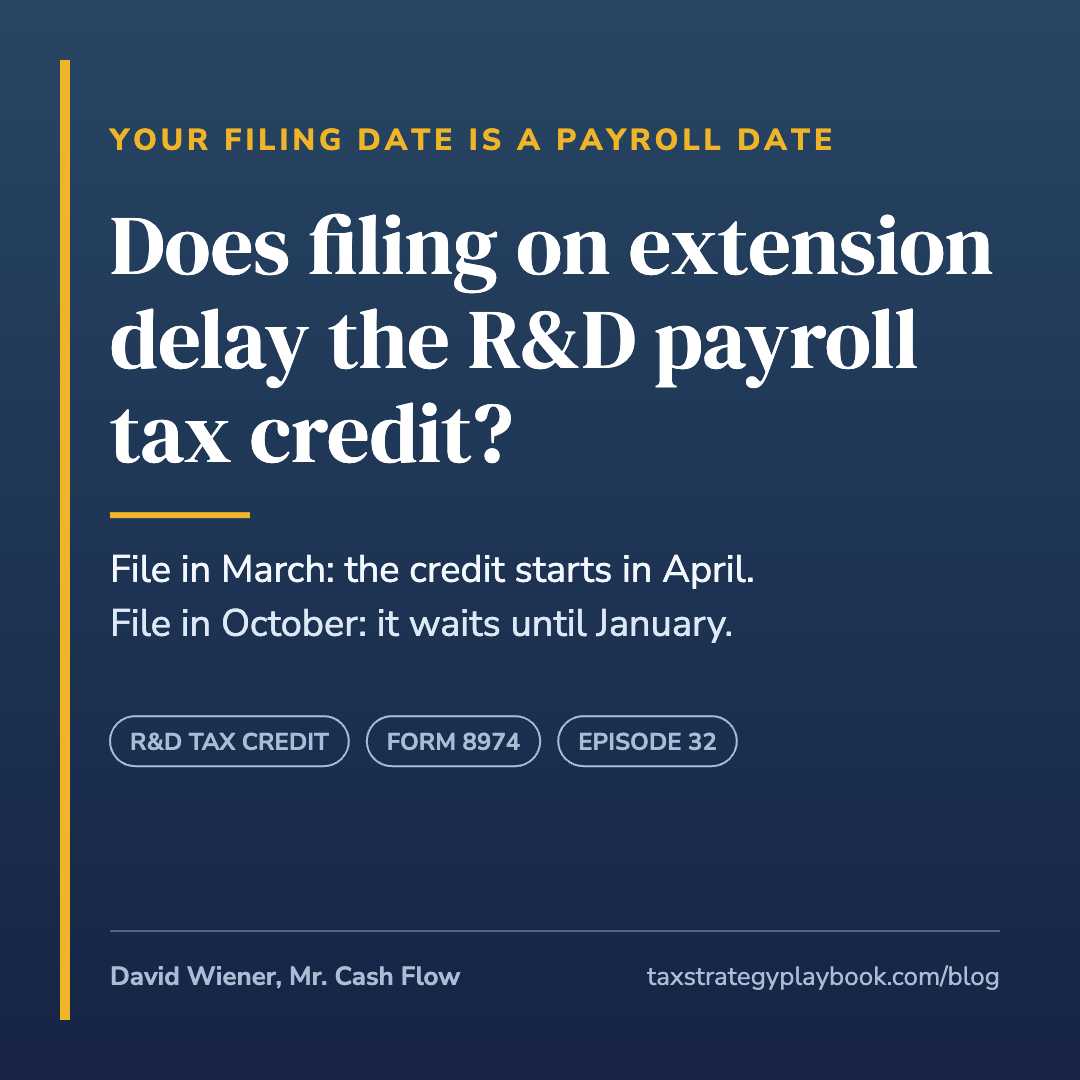
Filing on extension does not cost a startup the R&D payroll tax credit, but it does delay it. The credit starts reducing your payroll taxes in the first calendar quarter that begins after you file the income tax return that makes the election. A calendar-year C corporation that files in March starts in April. One that files in October on extension starts in January, nine months later. For an S corporation or a partnership the gap is about six months. The only difference is the date on the return.
I walked through this, with the full quarter-by-quarter math, in Episode 32 of The Tax Strategy Playbook: how a startup that's losing money gets paid by the R&D credit. This post is the timing piece on its own, written down so you can hand it to whoever files your return.
Key Takeaways
- A qualified small business can elect to apply up to $500,000 a year of R&D credit against the employer share of Social Security tax, then Medicare tax.
- The election has to be on a timely filed original return. Extensions count. The IRS says plainly that "an election cannot be made with an amended return."
- The credit starts with "the first calendar quarter which begins after the date on which the taxpayer files the return," in the words of Section 3111(f).
- Filing in March instead of October moves a C corporation's first dollar from January of the next year to April of this one.
- The cutoff is the quarter line, not the due date. A return filed March 31 starts the credit April 1. A return filed April 1 starts it July 1.
- Calendar-year C corporations on extension for 2025 have until October 15, 2026. Whether they file on October 13 or October 15, the credit starts January 1, 2027.
When does the R&D payroll tax credit start?
It starts with the first quarter that begins after your income tax return is filed. The day the year closes doesn't start it, and neither does the day the study is finished. The filing date does.
The rule comes from the statute. Section 3111(f) of the Internal Revenue Code allows the credit against payroll taxes for "the first calendar quarter which begins after the date on which the taxpayer files the return" that carries the election. The IRS repeats it in the Form 8974 instructions, with an example: a calendar-year business that files its 2024 return on March 17, 2025 takes the credit first on its Form 941 for the second quarter of 2025.
You don't get a check. Your payroll provider claims the credit on Form 8974, attached to your quarterly Form 941, and you send the IRS less. The credit goes first against the employer's 6.2 percent share of Social Security tax and then against the employer's 1.45 percent share of Medicare tax for the same quarter. Whatever is left rolls to the next quarter until it's used up.
So the filing date is a payroll date. Most people never treat it that way.
Does filing on extension cost you the R&D payroll election?
No. An extension keeps the election alive. It just pushes the start date back.
Section 41(h)(4) requires the election to be made "on or before the due date (including extensions)" of the return. The Form 6765 instructions (Rev. December 2025) say the same. So a C corporation that extends to October and files on time can still make the election. The election isn't the problem.
The problem is the return that goes in without it. The IRS page on the qualified small business payroll credit says it in one line: "An election cannot be made with an amended return." I see this every fall. A founder hears about the payroll offset in September. Last year's return went in back in March. The credit may be on it. The box that sends it to payroll isn't. For that year, the payroll door is generally closed. The credit doesn't vanish; it can still sit against income tax and carry forward. But the cash this year is gone.
That's two different mistakes with two different prices. Missing the box loses the payroll benefit for the year. Filing late in the year only delays it. Both are decided before the return is filed.
How much time does an extension actually cost?
For a calendar-year C corporation, nine months. For an S corporation or a partnership, about six.
Here's why. A calendar-year C corporation's return is due April 15, and an extension on Form 7004 generally adds six months, to October 15. File in March and the next quarter starts April 1. File in October and the next quarter doesn't start until January 1.
S corporations and partnerships are due March 15, with an extended date of September 15. File by March 15 and the credit starts April 1. File on September 15 and it starts October 1. Six months apart. Smaller gap, still real runway.
The quarter line is where the money moves. Because the credit starts with the quarter that begins after you file, a single day can cost you three months. File March 31 and you start April 1. File April 1 and you wait for July 1, because the April quarter didn't begin after you filed. If you're close to a quarter line, the calendar matters more than the deadline.
What does a nine-month delay look like in dollars?
Take the startup from the episode. It's an illustration, not a client. Twelve people, about $1.8 million of payroll a year, and nobody earns above the 2026 Social Security wage base, which the Social Security Administration set at $184,500. Ten of the twelve are engineers and their managers, and about $1.5 million of the payroll is qualifying research wages.
The company had no qualifying research spending in any of the three prior years, which is true of most startups. Under the alternative simplified method in Section 41(c)(4)(B), that makes the credit a flat 6 percent of this year's qualifying spending. Six percent of $1.5 million is $90,000. That figure is before any Section 280C choice. For a company running the credit through payroll, taking the full credit is usually the better answer; the Section 280C election post walks through why.
Now the payroll side, assuming payroll runs evenly through the year:
- Employer Social Security: 6.2 percent of $1.8 million is $111,600 a year, or $27,900 a quarter.
- Employer Medicare: 1.45 percent of $1.8 million is $26,100 a year, or $6,525 a quarter.
- Together: $34,425 a quarter.
The $90,000 comes off that bill in three pieces. $34,425 in the first quarter. $34,425 in the second. $21,150 in the third.
File the 2026 return in March 2027 and those three quarters are April through December of 2027. The whole $90,000 is back in the operating account by New Year's Eve. File in October 2027 on extension and the first dollar shows up in the quarter that starts January 1, 2028. The last of it lands by September 30, 2028.
Same credit. Same rules. Nine months apart because of a date on a return. For a company burning cash, that's three quarters of runway decided by someone working through a stack of extensions.
And notice who usually picks that date. It isn't the founder. It's whoever prepares the return, sorting a busy fall for perfectly good reasons. Nobody in that chair is thinking about payroll quarters. That's why the question has to come from you, and early.
Should a startup avoid filing on extension?
Not automatically. I'm not telling you never to extend. Returns get extended for real reasons: late K-1s from investments, a messy first year of books, a study that isn't done yet. A rushed return with a wrong credit number is worse than a late one, because the statute lets you revoke the election only with IRS consent.
Here's where I stand. The filing date should be a decision, not a default. Make it in January, with the payroll math in front of you, and with the person who prepares your return in the room. If the answer is still October, fine. At least you'll know that choice cost you nine months, and you'll have chosen it.
The order I'd use as a founder looks like this:
- In the fall, get the R&D study scoped while your engineers still remember what they tried this year.
- In December, confirm with your tax professional that you're still inside the qualified small business window: under $5 million of gross receipts for the year, and no gross receipts in any year before the five-year period ending with this one.
- In January, pick the filing date on purpose. Ask one question: if we file in March instead of October, when does the credit start hitting payroll?
- When the return goes out, check that the payroll election is on it and the amount is right.
None of those steps is hard. All four happen before the return is filed. If the eligibility rules are new to you, start with who qualifies to use the R&D credit against payroll taxes. It covers the gross receipts tests this post skips.
What if your 2025 return is on extension right now?
If you're a calendar-year C corporation, your extended due date for 2025 is October 15, 2026. That's two days from when this post went up.
The payroll election for 2025 has to be on that return when it goes in. After it's filed, an amended return can't add it. The start date, on the other hand, is already set. Any return filed between October 1 and December 31, 2026 starts the credit on January 1, 2027. Filing a day early doesn't help the timing. Missing the box costs the whole year.
S corporations and partnerships on extension were due September 15, 2026. If yours went in without the election, talk to your tax professional this week about what the credit is still worth against income tax. It may also be worth a look at how long an unused R&D credit carries forward before it expires.
Frequently Asked Questions
When does the R&D payroll tax credit start?
It starts with the first calendar quarter that begins after you file the income tax return that makes the election. A calendar-year business that files in March starts with the quarter that begins April 1. The credit is claimed on Form 8974, attached to the quarterly Form 941.
Does filing on extension cost you the R&D payroll election?
No. The election must be made by the due date of the return, including extensions, so an extended return filed on time can still carry it. The extension only delays when the credit starts reducing your payroll taxes.
Can I add the R&D payroll election on an amended return?
No. The IRS states that an election cannot be made with an amended return. If the original return went in without it, the payroll benefit for that year is generally lost, though the credit itself can still apply against income tax and carry forward.
How long does an extension delay the credit for a C corporation?
About nine months. A calendar-year C corporation that files in March starts the credit in April. One that files in October on extension starts it the following January.
How long does an extension delay the credit for an S corporation or partnership?
About six months. These returns are due March 15, with an extended date of September 15. File by March 15 and the credit starts April 1. File on September 15 and it starts October 1.
Can one day really move the start by a full quarter?
Yes. The credit starts with the quarter that begins after the filing date. A return filed March 31 starts the credit April 1. A return filed April 1 starts it July 1.
Is your filing date costing you runway?
Most founders I talk to have never been asked what their filing date costs. The person who could ask is busy, and the founder doesn't know the question exists. You do now.
Want to know whether an R&D study would even pay for itself for your company? That's what the no-cost analysis is for. I deliver it through my relationship with CSSI (Cost Segregation Services, Inc.). You can book a time at calendly.com/david-wiener/cs or call 770-224-8504 and press option two. No obligation and no pitch. If the credit is too small to be worth a study, or your history puts you outside the window, I'll tell you that.
And if you want the whole picture, including the retirement plan and paid leave credits that come with having employees, listen to Episode 32 for the full $90,000 walkthrough and the other credits that run on a clock. Then tell me: when did your last return go in, and did anyone mention what that date was worth?
Sources
- 26 U.S.C. Section 41(h), election to apply the research credit against payroll taxes, and Section 41(c)(4)(B), the 6 percent rate when there were no qualified research expenses in any of the three prior years. law.cornell.edu/uscode/text/26/41
- 26 U.S.C. Section 3111(f), credit for research expenditures of qualified small businesses. law.cornell.edu/uscode/text/26/3111
- IRS, Instructions for Form 8974 (Rev. December 2024). irs.gov/instructions/i8974
- IRS, Instructions for Form 6765 (Rev. December 2025). irs.gov/instructions/i6765
- IRS, Qualified Small Business Payroll Tax Credit for Increasing Research Activities (page last reviewed June 28, 2026). irs.gov
- IRS, Instructions for Form 7004 (Rev. December 2025). irs.gov/instructions/i7004
- 26 U.S.C. Section 6072, time for filing income tax returns. law.cornell.edu/uscode/text/26/6072
- Social Security Administration, Contribution and Benefit Base, 2026. ssa.gov/oact/cola/cbb.html
This article is educational and is not tax advice. Your filing date, your gross receipts history and your payroll all need a professional who knows your facts before anything goes on a return.

CEO of Cashflow Strategies, Inc., Tax Strategist, Speaker, Educator
David “Mr. Cash Flow” Wiener is a nationally recognized authority on real estate tax strategy and cash flow optimization, and the host of The Tax Strategy Playbook podcast. As Founder and CEO of Cash Flow Strategies, Inc., David has spent decades helping real estate investors, business owners, and their advisory teams legally reduce taxes, unlock hidden cash flow, and put more money back into productive assets instead of into the IRS.
Over the course of his career, David has become especially known for his work with cost segregation, 179D energy-efficient commercial building deductions, and other engineering-based tax incentives that accelerate depreciation and free up capital. He has also built a long track record in cash flow and accounts receivable optimization, helping clients improve profitability and financial stability without simply “working harder” or taking on more risk.
David is a sought‑after speaker, trainer, and educator, with audiences ranging from national industry conferences to small mastermind groups and professional associations. He is known for his clear, practical teaching style and his ability to translate complex tax concepts into simple, actionable plays that investors and advisors can use right away. Whether he is speaking to CPAs, medical and dental practice owners, or real estate investors, David’s message is consistent: tax strategy is one of the most powerful—and most overlooked—wealth multipliers available.
On The Tax Strategy Playbook, David brings that same real‑world experience and teaching approach to the microphone. Each epis… Read More

If a Client Paid for the Work, Can You Still Claim the R&D Tax Credit?