The R&D Tax Credit You Earned Might Expire Before You Use It
TL;DR: Earning an R&D tax credit and actually using it are two separate events. Carryforward provisions protect unused credit value, but the rules vary wildly between federal and state levels. Federal credit carries forward 20 years. State rules range from 3 years to indefinite, with some states offering fully refundable credits instead. Businesses operating across multiple states are the most exposed to lost value when these differences go unexamined.
-
The federal R&D credit carries forward up to 20 years under IRC Section 39.
-
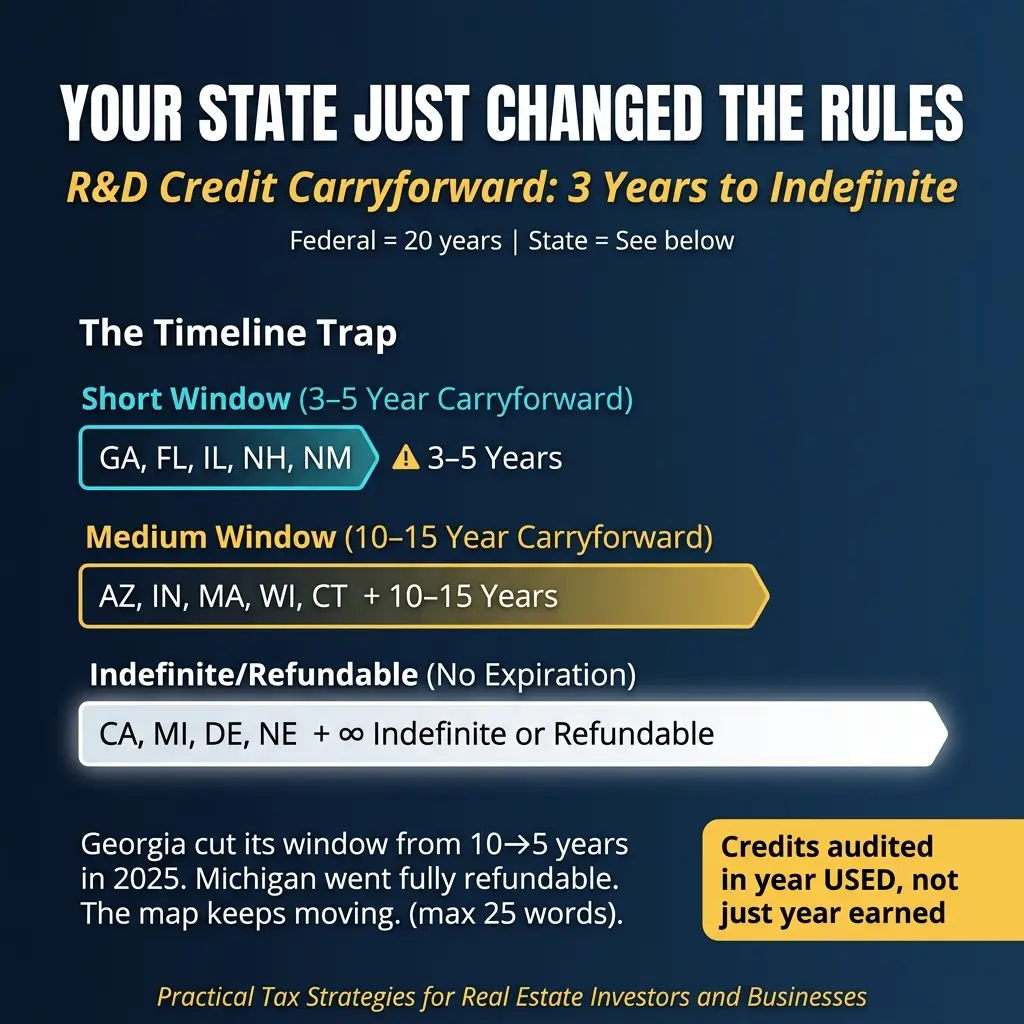
State R&D credit carryforward periods range from 3 years (New Mexico) to indefinite (California).
-
Some states, including Delaware, Hawaii, and Michigan, offer fully refundable credits, eliminating the need for carryforward.
-
Several states, including Colorado, Kansas, and South Carolina, cap annual usage even when the total carryforward period is long or unlimited.
-
Georgia reduced its carryforward window from 10 years to 5 years for credits generated after January 1, 2025, which is exactly the kind of shift that costs businesses real money when they're not watching.
Why the Gap Between Earning and Using the Credit Matters
Here's a detail that surprises business owners more than almost anything else in the R&D tax credit conversation. Earning the credit and using the credit are two different events. A company can qualify, document everything correctly, and generate a substantial credit, then discover it owes too little in tax that year to absorb the full value. Early growth stages, slow years, and heavy investment periods all create this exact situation.
Carryforward is the provision that protects that unused value. Instead of the credit disappearing the moment it goes unused, carryforward lets you apply the remaining balance against tax liability in future years. The concept is straightforward, and at the federal level it mostly is. The state level tells a very different story, and that's where the planning conversation gets interesting.
How the Federal Carryforward Rule Works
Under Internal Revenue Code Section 39, unused federal R&D credit generally carries forward for up to 20 years after a mandatory one-year carryback. That's a long runway. A company generating credits during unprofitable years gets two full decades to reach profitability and capture the benefit.
Consider what that looks like in practice. One medical device company conducted qualified research for five straight years while operating at a loss, banking roughly $75,000 in credits per year. In year six, the company turned profitable and owed $400,000 in federal income tax. The accumulated $375,000 in carryforward credits offset nearly the entire bill, leaving a federal liability of about $25,000 in its first profitable year. The company claimed credits during years when those credits looked useless, and those claims funded a dramatic reduction later.
💡 Qualified Small Businesses with under $5 million in gross receipts can also elect to offset up to $500,000 in payroll taxes annually with R&D credits, creating cash savings before profitability ever arrives.
Key Point: The federal 20-year carryforward is predictable and generous, giving businesses a reliable long-term window to capture value from credits generated during loss years or heavy investment periods.
Why State Rules Turned This Into a Patchwork
Many states offer their own R&D credit on top of the federal one, and each state writes its own rules for eligibility, calculation, and how long unused credit survives. An emerging pattern has been accelerating for years: states are actively reshaping these programs, and the differences between them keep widening.
Some states allow generous carryforward windows. Some cap the window at a handful of years. A few structure their credit as fully refundable, which removes the need for carryforward entirely because the value arrives as cash regardless of tax liability. At least one state limits how much of the carried-forward balance you can use in any single year, even though the total carryforward period technically never ends.
Carryforward periods across states currently range from as short as 3 years to indefinite. Georgia recently reduced its window from 10 years to 5 for credits generated after January 1, 2025. Michigan launched a fully refundable program in 2025. Wisconsin appears headed toward an extension. The map keeps moving, and businesses that treat every state as if it follows the federal playbook are leaving real money on the table.
Key Point: State R&D credit rules are fragmented, frequently updated, and impossible to generalize. Multi-state businesses face the most exposure when these differences go unexamined.
State-by-State Carryforward Rules
Here's the current landscape for states that offer an R&D tax credit. These rules shift from year to year, which is exactly why reviewing your position regularly matters.
-
Alaska: 20 years
-
Arizona: 10 years for credits generated after 2021, 15 years for older credits
-
Arkansas: 9 years
-
California: indefinite, with no expiration on unused credit
-
Colorado: no fixed year limit, usable up to 25 percent of the original credit per year
-
Connecticut: 15 years
-
Delaware: fully refundable, so carryforward generally isn't needed
-
Florida: 5 years
-
Georgia: 5 years for credits generated on or after January 1, 2025, and 10 years for credits generated before that date
-
Hawaii: fully refundable
-
Idaho: 14 years
-
Illinois: 5 years, with the credit currently scheduled to sunset in 2031
-
Indiana: 10 years
-
Iowa: carryforward allowed under its newly overhauled program, though the state hasn't clearly published a specific year count yet
-
Kansas: no set expiration, usable up to 25 percent of the credit per year
-
Kentucky: 10 years, applied specifically to research facility construction
-
Louisiana: 5 years
-
Maine: 15 years
-
Maryland: 7 years
-
Massachusetts: 15 years for most unused credit, with a portion tied to a liability cap carrying forward indefinitely
-
Michigan: fully refundable under its new 2025 program
-
Minnesota: 15 years
-
Missouri: 12 years
-
Nebraska: structured as a continuing refundable benefit rather than a traditional carryforward
-
New Hampshire: 5 years
-
New Jersey: 7 years standard, 15 years for priority sectors such as advanced computing and biotechnology
-
New Mexico: 3 years
-
New York: delivered through a separate incentive program rather than a standard carryforward credit
-
North Dakota: 15 years, and one of the few states that also allows a 3-year carryback
-
Ohio: 7 years
-
Oregon: the general credit expired in 2017, though a narrower semiconductor industry credit is currently active
-
Pennsylvania: 15 years, and the credit can be sold or assigned to another Pennsylvania taxpayer
-
Rhode Island: 7 years
-
South Carolina: 10 years, usable up to 50 percent of remaining state liability per year
-
Texas: 20 report periods under its updated franchise tax credit rules
-
Utah: 14 years for two components of its credit, with no carryforward on a third, flat-rate component
-
Vermont: 10 years
-
Wisconsin: current guidance reflects 15 years, though a recent law change may extend this as updated guidance arrives
States without a state-level R&D credit: Alabama, Oklahoma, Washington, Nevada, West Virginia, Mississippi, South Dakota, Wyoming, Montana, Tennessee, North Carolina, and Virginia currently offer no state R&D tax credit.
Key Point: No two states apply the same carryforward rules, and several have updated those rules recently. The only reliable approach is checking your specific states annually.
What This Patchwork Signals About the Bigger Trend
These state-level variations are more than administrative trivia. They signal an emerging competition among states for research investment. States offering refundable credits or long carryforward windows are making themselves measurably more attractive to companies that invest heavily in development work. Delaware even combines a zero expenditure cap with a refundable credit, a structure no other state currently matches.
The complexity itself has become a barrier. Small businesses remain some of the most active contributors to research and product development, yet many operate without specialized tax expertise in-house. The result is a convoluted, tangled system where the businesses that would benefit most are often the least equipped to work through it. That gap is a specialization issue, and it's exactly why dedicated study providers and tax professionals working together deliver so much value.
⚠️ One more timing reality worth knowing: R&D credits are audited in the year they're used, in addition to the year they're earned. Credits generated in 2024 and applied in 2027 bring that 2024 research work under review years later. Thorough documentation protects you across the entire carryforward window.
Key Point: State-level carryforward complexity isn't neutral. It actively disadvantages businesses without specialized tax guidance, and the businesses doing the most qualifying research are often the ones most underserved by it.
Planning With Confidence Instead of Assumptions
The encouraging news is that none of this complexity reduces the value of the credit itself. It raises the standard for planning, but that's a manageable shift once the variables are visible. When you know your state's carryforward window, any annual usage caps, and whether refundability applies, you can time investments, model future liability, and expand into new states with clear eyes. Businesses that stop guessing and start mapping these rules deliberately often see their entire tax position change.
Because these rules change frequently and vary this dramatically, a free analysis remains the most reliable way to understand what your federal and state R&D credits actually look like, including how much carryforward flexibility applies to your specific situation.
The Recap
The federal R&D credit carries forward for 20 years, protecting value through loss years and early growth stages. State credits follow their own rules, ranging from 3-year windows to indefinite carryforward, with some states offering fully refundable credits and others capping annual usage. These differences are consistently overlooked and cost multi-state businesses real money. Documentation matters across the full carryforward period because audits follow the year of use, not just the year of generation. A free analysis gives you a clear picture of your federal and state position, and that clarity is where confident planning begins.
Frequently Asked Questions
How long does the federal R&D tax credit carry forward?
Under IRC Section 39, unused federal R&D credit carries forward for up to 20 years after a mandatory one-year carryback. This applies to credits generated in any qualifying year, including years when the business operated at a loss.
Do all states offer an R&D tax credit?
No. States including Alabama, Oklahoma, Washington, Nevada, West Virginia, Mississippi, South Dakota, Wyoming, Montana, Tennessee, North Carolina, and Virginia currently offer no state R&D tax credit.
What does a fully refundable R&D credit mean?
A fully refundable credit means the state pays out the credit value as cash even if your tax liability is zero. Delaware, Hawaii, and Michigan's 2025 program all use this structure, which eliminates the need for carryforward entirely.
What happens if my state's carryforward period expires before I use the credit?
Unused credit beyond the carryforward window typically expires with no recovery option. This is why understanding your state's specific window at the time you generate the credit matters, not after the fact.
Can a state change its carryforward rules after I've already generated credits?
Yes, and this happens regularly. Georgia's 2025 reduction from 10 years to 5 years applies to newly generated credits, while older credits retain the 10-year window. State law changes often include transition rules for credits already earned.
What is an annual usage cap on R&D carryforward?
Some states, including Colorado, Kansas, and South Carolina, limit how much of a carried-forward credit you can apply in any single tax year, even when the total carryforward period is long or unlimited. This slows down the rate at which you can recover credit value.
Are R&D credits audited in the year they're generated or the year they're used?
Both. Credits are subject to audit in the year they're generated and in the year they're applied. Credits generated in 2024 and used in 2027 can bring 2024 research activity under review years later, which is why documentation needs to span the entire carryforward window.
Does operating in multiple states increase R&D credit complexity?
Significantly. Each state operates under its own eligibility rules, carryforward windows, usage caps, and refundability structures. A business operating in three states with different carryforward rules needs a separate planning strategy for each, and assuming federal rules apply at the state level is a costly mistake.
Key Takeaways
-
The federal R&D credit carries forward for up to 20 years, giving businesses a reliable window to use credits generated during unprofitable periods.
-
State R&D carryforward rules range from 3 years (New Mexico) to indefinite (California), with no uniformity across states.
-
Fully refundable state credits, currently offered by Delaware, Hawaii, and Michigan, eliminate the need for carryforward by paying out the value as cash.
-
Several states impose annual usage caps that limit how quickly carryforward credits can be applied, even when the overall window is long or unlimited.
-
State rules change frequently, and changes often apply only to newly generated credits, which means businesses need to track their credit vintage alongside current law.
-
R&D credits are auditable in both the year generated and the year used, so documentation needs to remain intact across the entire carryforward period.
-
Multi-state businesses carry the most exposure when they treat state R&D rules as a mirror of the federal rules, and a structured analysis is the most direct way to close that exposure.

CEO of Cashflow Strategies, Inc., Tax Strategist, Speaker, Educator
David “Mr. Cash Flow” Wiener is a nationally recognized authority on real estate tax strategy and cash flow optimization, and the host of The Tax Strategy Playbook podcast. As Founder and CEO of Cash Flow Strategies, Inc., David has spent decades helping real estate investors, business owners, and their advisory teams legally reduce taxes, unlock hidden cash flow, and put more money back into productive assets instead of into the IRS.
Over the course of his career, David has become especially known for his work with cost segregation, 179D energy-efficient commercial building deductions, and other engineering-based tax incentives that accelerate depreciation and free up capital. He has also built a long track record in cash flow and accounts receivable optimization, helping clients improve profitability and financial stability without simply “working harder” or taking on more risk.
David is a sought‑after speaker, trainer, and educator, with audiences ranging from national industry conferences to small mastermind groups and professional associations. He is known for his clear, practical teaching style and his ability to translate complex tax concepts into simple, actionable plays that investors and advisors can use right away. Whether he is speaking to CPAs, medical and dental practice owners, or real estate investors, David’s message is consistent: tax strategy is one of the most powerful—and most overlooked—wealth multipliers available.
On The Tax Strategy Playbook, David brings that same real‑world experience and teaching approach to the microphone. Each epis… Read More

What Counts as a Land Improvement, and Why Does It Depreciate Over 15 Years?