Section 280C Election: Take the Full R&D Credit, or Keep the Full Deduction?
TL;DR
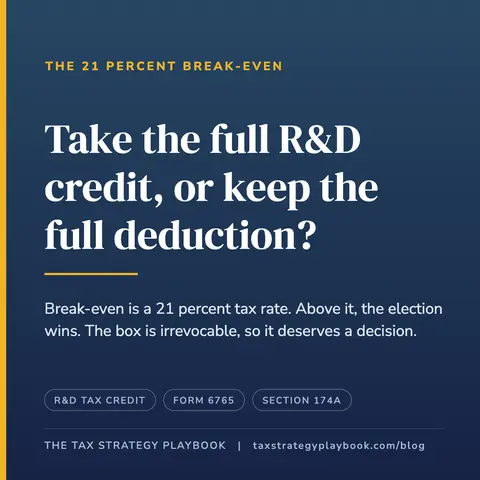
Every business claiming the federal R&D credit answers the Section 280C election on Form 6765, and most of them answer it by accident. Take the full credit and your domestic research deduction gets cut by the same number of dollars. Elect under Section 280C(c)(2) and the deduction stays whole while the credit drops to 79 percent. Break-even is a 21 percent tax rate. Above 21 percent the election wins. Below it, the full credit wins. The box sits on page one of the form, it cannot be fixed by amending, and once you check it you own that answer for the year.
Key Takeaways
- Section 280C(c)(1) reduces your domestic research expenditures by the amount of the credit allowed under Section 41(a). One dollar of spending does not produce both a full credit and a full deduction.
- The Section 280C election reverses which side takes the hit. You keep the deduction and accept a credit reduced by the maximum corporate rate under Section 11(b). That rate is 21 percent, so the election leaves you 79 percent of the credit.
- The 21 percent reduction inside the election is the same for everyone. The cost of skipping the election is your own marginal rate. That is why 21 percent is the break-even.
- Pass-through owners taxed at 32, 35, or 37 percent usually come out ahead by electing. A C corporation sitting at 21 percent is close to a coin flip on the federal arithmetic alone.
- A startup running the credit against payroll taxes is the clearest case for not electing. There the 21 percent comes out of cash it can spend this quarter.
- The election goes on Item A, page one of Form 6765, with an original timely filed return including extensions. The IRS instructions are blunt: it "cannot be made or changed on an amended return."
- File Form 6765 with the box answered even when you have not finished computing a credit. Skip the form and the election is gone if you find a credit later.
- The special retroactive window for 2022 through 2024 under Revenue Procedure 2025-28 closed on July 6, 2026.
What is the Section 280C election, in plain terms?
It is the choice between a smaller credit and a smaller deduction.
Start with why the choice exists. You pay an engineer $200,000 to solve a technical problem. Those wages are a business deduction. Those same wages also feed the calculation for the R&D credit under Section 41. Congress did not want you recovering more than you spent, so it wrote a coordinating rule.
That rule is Section 280C(c)(1), and the current version says the domestic research or experimental expenditures "otherwise taken into account as a deduction or charged to capital account under this chapter shall be reduced by the amount of the credit allowed under section 41(a)." Claim a $100,000 credit and your deduction drops by $100,000. Your taxable income goes up by that much.
Section 280C(c)(2) offers the trade. Make the election and paragraph (1) does not apply to you. The deduction stays exactly where it was, and the credit gets cut instead.
One wrinkle worth knowing if you or your CPA go looking this up. The regulation that describes how to make the election, Reg. 1.280C-4, still refers to it as the Section 280C(c)(3) election. That paragraph got renumbered years ago and the regulation was never updated to match. Same election, older address.
How much is the reduced credit worth?
Seventy-nine cents on the dollar.
The statute builds it as a subtraction. Section 280C(c)(2)(B) takes "the amount of credit determined under section 41(a) without regard to this paragraph," then subtracts the product of that amount and "the maximum rate of tax under section 11(b)." Section 11(b) sets the corporate rate at 21 percent.
So a $100,000 gross credit becomes $79,000. A $600,000 credit becomes $474,000.
Here is the part almost nobody catches on the first pass. That 21 percent is the corporate rate, and it applies to you whether or not you are a corporation. A sole proprietor in the top bracket takes the same 21 percent haircut as Apple. Which is exactly why the answer is different depending on who you are.
Which choice puts more money in your pocket?
Compare 21 percent to your own marginal rate. Higher, elect. Lower, do not.
Run a $100,000 credit both ways and it falls out fast.
| No election, full credit | Section 280C election | |
|---|---|---|
| Credit you claim | $100,000 | $79,000 |
| Research deduction | Cut by $100,000 | Untouched |
| Net benefit at a 37% rate | $63,000 | $79,000 |
| Net benefit at a 21% rate | $79,000 | $79,000 |
| Net benefit at a 15% rate | $85,000 | $79,000 |
At 37 percent, giving up the deduction costs $37,000 and giving up part of the credit costs $21,000. The election is worth $16,000 to you on a single $100,000 credit. At 21 percent the two paths tie to the dollar. At 15 percent the full credit pulls ahead by $6,000.
Most of the businesses I talk to that qualify for this credit are S corporations, partnerships, and LLCs where the credit and the add-back both land on the owner's personal return. Those owners are usually well above 21 percent. For them the election is not a close call.
What changed when Section 174A brought back immediate expensing?
The deduction you are protecting got five times bigger in year one.
From 2022 through 2024, research costs had to be capitalized and amortized rather than deducted. During those years, the deduction on the other side of this trade was a sliver, so protecting it mattered less. A lot of the guidance floating around online was written in that window and still reads that way.
The One Big Beautiful Bill Act, Public Law 119-21, signed July 4, 2025, created Section 174A and put domestic research costs back on the immediate-deduction path for amounts paid or incurred in tax years beginning after December 31, 2024. It also rewrote Section 280C(c)(1) to point at those Section 174A expenditures. Revenue Procedure 2025-28 notes that the amendment "does not create any inference" about how Section 280C(c) applied to earlier years, and that the OBBBA "made no amendments to § 280C(c)(2)."
Practical effect: the thing you keep by electing is now a full current-year deduction again. That restores the election's value for anyone paying tax above 21 percent, which is most profitable claimants.
There was a companion door for small businesses that went back and applied Section 174A to 2022 through 2024. They could make a late Section 280C(c)(2) election, or revoke an old one, on an amended return. Revenue Procedure 2025-28 set the outside date at July 6, 2026. That date has passed. If you were chasing those refunds, I wrote about the deadline while it was still open in that post on the six-figure R&D refund window, and what is left now is the ordinary annual decision on the return in front of you.
When is taking the full credit the better move?
Four situations, and the first one is not close.
You are monetizing the credit against payroll taxes. A qualified small business can apply up to a set amount of the credit against the employer share of Social Security tax instead of income tax. That is real money leaving the IRS and arriving in your operating account. Elect, and 21 percent of it evaporates. Meanwhile the deduction you protected is worth nothing this year because you have no taxable income to shelter. Take the full credit. I walked through how that offset works in the piece on the R&D credit most startups miss.
You are in a loss year. The add-back does not create a tax bill. It just makes your net operating loss smaller. That looks free, and it is not, because a smaller loss means a smaller carryforward to use against future income. It is a timing question rather than a giveaway, and it turns on when you expect to be profitable again.
Your marginal rate sits under 21 percent. Below that line the arithmetic reverses and the full credit is worth more. Narrower than people assume once state tax is in the picture, but it happens.
You elected to capitalize instead of deduct. Section 174A lets you capitalize and amortize domestic research costs rather than expensing them. Choose that path and the Section 280C(c)(1) reduction hits the capitalized amount, so the cost spreads out over the amortization period instead of landing all at once. Different math, different answer.
One more that cuts the other direction. If your credit is larger than the tax you owe, the unused portion carries forward while the deduction add-back raises your income right now. You pay today for a benefit you collect later. I covered how long those credits survive in the post on R&D credits expiring before you use them.
How do you make the Section 280C election, and when is it too late?
Item A, page one of Form 6765, on the original return. There is no second chance.
The Instructions for Form 6765 revised December 2025 put it this way: "You must check 'Yes' to elect or 'No' to not elect the section 280C reduced credit on your original timely filed return, including extensions." Then the sentence that decides everything: "This election cannot be made or changed on an amended return. Once made, the election is irrevocable for that tax year."
The statute says the same thing in fewer words. An election "shall be made not later than the time for filing the return of tax for such year (including extensions), shall be made on such return... Such an election, once made, shall be irrevocable."
Now the part that saves people real money. The instructions also say that if you are electing the reduced credit, "you must complete Form 6765 (even if no research credits are claimed on the original return)." Read that as an instruction rather than a footnote. Plenty of companies finish a study in October for a return they filed in April. If Form 6765 never went in with the original return, the election is not available to them, and they are locked into the full credit and the deduction cut whether that serves them or not.
So if there is any chance you will identify a credit for the year, file the form and answer the box. It costs you nothing to preserve the option.
The failure I see is almost never a bad decision. It is no decision. The box gets filled in during the last hour before a return goes out the door, by whoever is holding the file, with nobody having run the two numbers. It is irrevocable and it cannot be amended, which makes it one of the few boxes on a business return that deserves an actual conversation.
Does your state follow the federal choice?
Not reliably, and this is the piece that gets skipped.
Some states operate their own version of the reduced credit election. Some ignore the federal answer entirely and compute their own way. A federal election that gains you $16,000 can be neutral at the state level, or it can cost you there. The federal and state positions have to be modeled together, and I cannot tell you which way your state runs without knowing which state.
The same split shows up on depreciation, by the way. I went through how badly state conformity can bite in the post on bonus depreciation and state conformity.
None of this matters if the credit itself will not hold up
The election is a decision about a number. The number still has to be defensible.
For tax years beginning after 2025, Section G of Form 6765 stops being optional, which means the IRS wants your credit reported project by project rather than as one figure at the bottom. The documentation now has to exist on the day you file, well before anyone opens an exam. I broke down what Section G asks for in the post on what changed with Form 6765, and what an examiner actually does with an R&D credit in the post on R&D credits in a tax audit.
A credit built from a real study, with the qualifying activity identified, the wages traced, and the technical uncertainty documented, survives that scrutiny. A credit built from a percentage of payroll and a hopeful assumption does not. Whether you elect under Section 280C changes what the credit is worth. It does not change whether you were entitled to it. If you want to see what a proper R&D study covers, that is what I do through my relationship with CSSI, and there is more on it on my R&D tax credit services page. CSSI's own write-up on choosing between the full and reduced credit walks the same election from the study side.
If you would rather hear this than read it, Brian Broussard and I spent an episode on who actually qualifies for the credit and how big it gets: the $100K+ R&D tax credit you're leaving on the table.
Frequently Asked Questions
How much smaller is the reduced credit under Section 280C?
It is the full Section 41 credit minus that credit multiplied by the maximum corporate rate under Section 11(b), which is 21 percent. That leaves 79 percent. A $100,000 credit becomes $79,000. The 21 percent reduction is the same for every taxpayer, including individuals and pass-through owners who are taxed at rates well above 21 percent.
Can I change the Section 280C election after I file?
No. The IRS instructions for Form 6765 state that the election cannot be made or changed on an amended return, and that once made it is irrevocable for that tax year. The statute requires the election to be made no later than the time for filing the return, including extensions, and made on that return. If the box was answered wrong, it is answered wrong for that year.
Should a startup using the payroll tax offset make the election?
Usually not. Electing cuts the credit by 21 percent, and for a company applying the credit against the employer share of Social Security tax, that is cash it would otherwise have kept this quarter. The deduction the election protects has little current value to a business with no taxable income. Model it, but expect the full credit to win.
Did Section 174A change the answer to this question?
For most profitable claimants, yes. From 2022 through 2024, research costs were amortized rather than deducted, so the deduction being protected by the election was thin. Section 174A restored immediate deduction of domestic research costs for tax years beginning after December 31, 2024, which makes the protected deduction a full current-year deduction again and pushes the election back in favor for anyone taxed above 21 percent.
What is the break-even rate for the Section 280C election?
Twenty-one percent, in a straightforward current-year comparison where both the credit and the deduction are fully usable. Above a 21 percent marginal rate the election is worth more, because the deduction you keep is worth more than the 21 percent of credit you give up. Below 21 percent the full credit is worth more. At exactly 21 percent the two are identical.
Do I have to file Form 6765 even if I have not calculated a credit yet?
You do if you want the election available. The instructions say that to elect the reduced credit you must complete Form 6765 even if no research credits are claimed on the original return, and the form has to be filed with the original timely filed return including extensions. Companies that finish a study after filing and never sent in the form have lost the option.
Can I still make a late Section 280C election for 2022, 2023, or 2024?
No. Revenue Procedure 2025-28 gave eligible small business taxpayers a window to make a late Section 280C(c)(2) election, or revoke one, on an amended return or administrative adjustment request for those years, and set the outside date at July 6, 2026. That date has passed.
Answer the Box on Purpose
If you have an R&D credit on a return that has not been filed yet, someone is going to answer Item A. Make sure it is a person who has run both numbers.
The arithmetic is not hard. Compare 21 percent to your marginal rate, then check the four exceptions above, then look at your state. What makes this worth an hour is that you cannot go back and fix it. Most tax mistakes come with a repair path. This one does not.
My father was a CPA, and he told me that tax evasion is a crime but tax avoidance is mandatory. Congress wrote the research credit to pay American companies for solving hard technical problems. It also wrote the election that decides how you take it. Using both on purpose is the job.
If you want to know whether you have a credit worth claiming, and what the election is worth on your numbers, I can set up a no-cost analysis through CSSI. No obligation, no pitch, and nothing for you to gather before we talk. If the numbers say a study will not pay for itself in your business, that is what I will tell you.
Grab a time at calendly.com/david-wiener/cs, or call 770-224-8504 and press option two.
Sources
- 26 U.S.C. 280C, Certain expenses for which credits are allowable. Office of the Law Revision Counsel, text reflecting laws in effect on August 24, 2026. uscode.house.gov
- 26 U.S.C. 11(b), Tax imposed, setting the corporate rate at 21 percent.
- Instructions for Form 6765, Credit for Increasing Research Activities, Rev. December 2025, Item A, Section 280C Election. irs.gov/instructions/i6765
- Rev. Proc. 2025-28, sections 2.05, 4.03 and 5.03, effective August 28, 2025. irs.gov/pub/irs-drop/rp-25-28.pdf
- 26 CFR 1.280C-4, Credit for increasing research activities, on the manner of making the election. law.cornell.edu/cfr/text/26/1.280C-4
- One Big Beautiful Bill Act, Public Law 119-21, section 70302, enacted July 4, 2025.
- CSSI, The Section 280C Election: Choosing Between the Full and Reduced R&D Credit, August 27, 2026. cssiservices.com/section-280c-election
This article is educational and is not tax advice. The election turns on facts about your return that no article can see, so run it with a professional before you file.

CEO of Cashflow Strategies, Inc., Tax Strategist, Speaker, Educator
David “Mr. Cash Flow” Wiener is a nationally recognized authority on real estate tax strategy and cash flow optimization, and the host of The Tax Strategy Playbook podcast. As Founder and CEO of Cash Flow Strategies, Inc., David has spent decades helping real estate investors, business owners, and their advisory teams legally reduce taxes, unlock hidden cash flow, and put more money back into productive assets instead of into the IRS.
Over the course of his career, David has become especially known for his work with cost segregation, 179D energy-efficient commercial building deductions, and other engineering-based tax incentives that accelerate depreciation and free up capital. He has also built a long track record in cash flow and accounts receivable optimization, helping clients improve profitability and financial stability without simply “working harder” or taking on more risk.
David is a sought‑after speaker, trainer, and educator, with audiences ranging from national industry conferences to small mastermind groups and professional associations. He is known for his clear, practical teaching style and his ability to translate complex tax concepts into simple, actionable plays that investors and advisors can use right away. Whether he is speaking to CPAs, medical and dental practice owners, or real estate investors, David’s message is consistent: tax strategy is one of the most powerful—and most overlooked—wealth multipliers available.
On The Tax Strategy Playbook, David brings that same real‑world experience and teaching approach to the microphone. Each epis… Read More

Can You Claim the R&D Tax Credit for Research You Pay a Contractor to Do?