If a Client Paid for the Work, Can You Still Claim the R&D Tax Credit?
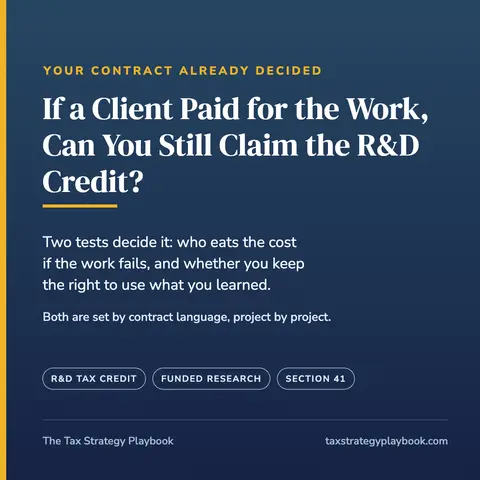
TL;DR: Sometimes, and your contract already decided it. The R&D tax credit has an exclusion called funded research. It takes the credit away from work somebody else paid for unless two things are true: you were on the hook if the work failed, and you kept the right to use what you learned. Miss either one and the research counts as funded, which means none of those wages and supplies count toward the credit. This gets decided project by project, in language written before anyone did any work.
Key Takeaways
-
Internal Revenue Code Section 41(d)(4)(H) excludes "any research to the extent funded by any grant, contract, or otherwise by another person (or governmental entity)."
-
There are two separate tests, and you have to pass both: economic risk and substantial rights.
-
If you get paid whether or not the work succeeds, that payment is funding. The regulation says amounts contingent on the success of the research are not treated as funding.
-
If you keep no substantial rights in the results, the research is treated as fully funded and none of your expenses on that project qualify. There is no partial credit for failing this one.
-
The determination is made separately for each project, not once for your whole firm.
-
A structural engineering firm lost roughly $190,000 in credits in 2024 because its contracts never tied payment to whether the work succeeded.
-
This is an actively litigated area. Two federal appeals courts have read the same regulation and reached different-feeling results on similar facts.
What Does "Funded Research" Actually Mean?
It means the credit follows the risk, not the labor.
Congress built the R&D credit to reward whoever puts money at risk solving a technical problem. If somebody else paid for the work and walked away with the results, that somebody else took the risk. So the statute takes the credit away from the firm that did the work and hands it to the party that funded it.
The operative language is short. Section 41(d)(4)(H) says qualified research does not include "any research to the extent funded by any grant, contract, or otherwise by another person (or governmental entity)."
Two words in there do a lot of work. "To the extent" means this is not all or nothing across your firm. And "or otherwise" means the IRS is not limited to reading the document with the word "contract" on the cover.
The regulation makes that second point explicit. Treasury Regulation Section 1.41-4A(d)(1) says "All agreements (not only research contracts) entered into between the taxpayer performing the research and other persons shall be considered in determining the extent to which the research is funded." Your master service agreement counts. Your standard terms and conditions count. The purchase order counts. The one-page work order that references a fifteen-page agreement nobody has opened since 2019 counts.
That is the part most firms get wrong. They read the project contract, decide it looks fine, and never notice that the framework agreement sitting behind it assigns every scrap of work product to the client.
Test One: If the Work Fails, Who Eats the Cost?
This is the risk test, and it turns on one question. When the technical problem turns out to be harder than anyone thought, whose money pays for the extra attempts?
The regulation approaches it from both directions. Looking at the firm performing the work, Section 1.41-4A(d)(1) says amounts "contingent on the success of the research and thus considered to be paid for the product or result of the research" are not treated as funding. Looking at the party writing the checks, Section 1.41-2(e)(2) says the agreement has to require that payer to "bear the expense even if the research is not successful."
Same idea from two angles. Somebody has to be exposed, and whoever is exposed is the one holding the credit.
Here is what that looks like on a real job. An engineering firm agrees to a fixed fee of $180,000 to design a foundation system for a site with bad soil. The first approach fails review. The second one fails too. The third works, and by then the firm has spent well past the fee. The firm ate that. It carried the risk, and it has a real argument that the work was not funded.
Now change one term. Same firm, same soil, same three attempts, except the firm bills hourly and the client pays for every hour including the two failed approaches. The client carried the risk. The firm was going to get paid either way. That work was funded, and the credit is not the firm's to claim.
Nothing else about the engineering changed. The technical uncertainty was identical. The only thing that moved was who was exposed when it went wrong.
Test Two: Do You Keep the Right to Use What You Figured Out?
The second test is separate, and it is the harsher of the two.
Section 1.41-4A(d)(2) says: "If a taxpayer performing research for another person retains no substantial rights in research under the agreement providing for the research, the research is treated as fully funded for purposes of section 41(d)(4)(H), and no expenses paid or incurred by the taxpayer in performing the research are qualified research expenses."
Read "fully funded" carefully. Fail the risk test and you may still get a partial result, because funding reduces your qualified expenses to the extent of what you were paid. Fail the substantial rights test and the project is gone. Zero. No proration.
The regulation also closes the door most firms try to walk through. "Incidental benefits to the taxpayer from performance of the research (for example, increased experience in a field of research) do not constitute substantial rights in the research." Getting better at your job is not a right. Neither is a nice photo for the website.
And there is one more line worth knowing: "A taxpayer does not retain substantial rights in the research if the taxpayer must pay for the right to use the results of the research." If you have to license back your own work, you did not keep anything.
This is where professional services firms lose the credit without noticing. Work-for-hire language, and clauses assigning all intellectual property and work product to the client, are ordinary in architecture, engineering, and software contracts. Clients ask for them and firms sign them, because on the day of signing it feels like a formality about drawings. It is also a decision about a tax credit, made years before anyone computes one.
The standard is lower than people assume, though. You do not need exclusive rights. A nonexclusive right to use the results in your own business is enough. The distinction that matters is between the deliverable the client bought and the underlying technique you developed to produce it. Firms that keep the second one keep the argument. That is a conversation for whoever writes your contracts, and it is worth having before the next one gets signed rather than after.
What Happened When Two Engineering Firms Took This to Court
The clearest way to see how this plays out is to read what courts actually did.
In Geosyntec Consultants, Inc. v. United States, 776 F.3d 1330 (11th Cir. 2015), an environmental and engineering consulting firm sought a refund for research expenses on client projects across 2002 through 2005. The sample contracts split into two shapes. Some were fixed-price, where the firm did the work for an agreed total. Others were capped, where the firm billed its costs up to a maximum. The courts accepted the fixed-price work as eligible. The capped contracts were held to be funded, and the credit was denied for those.
In Meyer, Borgman & Johnson, Inc. v. Commissioner, 100 F.4th 986 (8th Cir. 2024), a structural engineering firm claimed roughly $190,000 in credits across fiscal years ending September 30 of 2010, 2011, and 2013. Its contracts were not careless documents. They provided for inspections at project phases, and they let the client terminate for substantial failure to perform. The Tax Court was not persuaded and the Eighth Circuit affirmed. What the contracts never did was make payment turn on whether the research itself succeeded. The credits were denied.
Put those side by side and the lesson is not "fixed-price good, hourly bad." The lesson is that the label on the contract does not decide it. The terms do, and the terms get read closely by people looking for a specific thing.
This is contested ground, and it deserves to be labeled that way. Those are two different circuits reading the same regulation, and practitioners genuinely disagree about how much exposure a contract has to create before the risk test is satisfied. The IRS has examined these claims hard. Anyone who tells you the answer is obvious for your contracts has not read your contracts.
Why This Gets Decided Project by Project
Because the regulation says so, in one sentence. Section 1.41-4A(d)(3)(iii): "The provisions of this paragraph (d)(3) shall be applied separately to each research project undertaken by the taxpayer."
So a firm can have one project that qualifies and another that does not, in the same year, for the same client, out of the same office. Two jobs, two sets of terms, two answers.
That matters more now than it used to, because the form is finally asking the same question. Section G of Form 6765 makes you report the credit business component by business component rather than as one number, and that section stops being optional for tax years beginning after 2025. A firm that has been computing one credit for the whole company is about to be asked to show its work project by project. If the funded research analysis was never done at that level, this is the year it surfaces.
What to Look at Before You Sign the Next One
Four things, and none of them require a tax background to spot.
How you get paid when the work does not succeed. Not when the client is unhappy, and not when you miss a deadline. When the technical approach genuinely does not work. Most contracts are silent on this, and silence tends to mean you get paid anyway.
Who owns the results, and whether you keep any right to use them. Look for work-for-hire language and blanket assignments of work product.
Whether there is a second document. An intellectual property clause buried in a master agreement will override the friendly language in the work order.
Whether the client is a government entity, because the statute names governmental entities specifically.
None of this is something to fix on your own the week before you file. It is a conversation with the attorney who papers your agreements, held early, and a separate one with whoever computes your credit. The two rarely talk to each other, which is most of the reason this problem exists.
Who This Hits Hardest
Architecture, engineering, construction, and software firms, because nearly everything they do is under somebody else's contract.
That is not a reason for those firms to skip the credit. Plenty of them qualify and never claim anything, and the work that qualifies is ordinary project work rather than anything that looks like a laboratory. CSSI has published its own overview of how R&D credits apply to architects if you want a second read on the qualifying activities.
It does mean the answer lives in the paperwork rather than in the engineering. Two firms can do identical technical work and get opposite results because one of them reserved a right and the other did not.
If you are earlier than that and still working out whether your activities qualify at all, start with how the credit works for a small business and which of the common beliefs about it are wrong. Funded research is a question you reach after you have decided the work itself counts. And if you want to know what the examination actually looks like when it comes, the IRS goes project by project there too.
We covered the qualifying side of this in more depth on the podcast, in the episode on the R&D credit most business owners never claim.
Frequently Asked Questions
What is funded research for the R&D tax credit?
Funded research is research paid for by someone else. Internal Revenue Code Section 41(d)(4)(H) excludes any research to the extent it is funded by a grant, contract, or otherwise by another person or governmental entity. The idea is that the credit belongs to whoever put money at risk, so if a client paid for the work and took the results, the firm doing the work generally cannot claim the credit for it.
If a client pays me, does that automatically disqualify the work?
No. Being paid is not the same as being funded. The research is funded only if you were going to be paid whether or not the work succeeded, or if you kept no substantial rights in the results. A firm that bears real cost when a technical approach fails, and that keeps the right to use what it developed, can still have qualified research even though a client paid the invoice.
What counts as retaining substantial rights?
Keeping the right to use the results of the research in your own business. It does not have to be exclusive. Treasury Regulation Section 1.41-4A(d)(2) is explicit that incidental benefits, such as increased experience in a field of research, are not substantial rights. The regulation also says you do not retain substantial rights if you have to pay for the right to use the results.
Does a fixed-price contract guarantee I can claim the credit?
No. A fixed-price structure helps on the risk test because cost overruns land on you, and in the Geosyntec case fixed-price work was accepted while capped contracts were not. But in Meyer, Borgman & Johnson the Eighth Circuit denied credits to an engineering firm because its contracts did not make payment depend on whether the research succeeded. Contract structure is evidence, not a guarantee, and you still have to pass the substantial rights test separately.
Can part of a project qualify and part not qualify?
Yes, and the analysis is done separately for each project. Treasury Regulation Section 1.41-4A(d)(3)(iii) says the funding provisions are applied separately to each research project undertaken by the taxpayer. Where you retain substantial rights but were partly funded, the regulation reduces your qualified expenses by the amount of funding rather than eliminating them, and it allows a pro rata allocation in certain circumstances.
Does government contract work count as funded?
Government funding counts, because Section 41(d)(4)(H) names governmental entities directly. There is a narrower rule for federal contractors: Treasury Regulation Section 1.41-4A(d)(4) provides that independent research and development costs and bid and proposal costs paid to a contractor by reason of a government contract are generally not treated as funding the underlying research, except to the extent those costs are properly severable from the contract. Government contracting is its own specialty and this is a place to get specific advice rather than general guidance.
What happens if I claim the credit and the IRS disagrees?
Funded research is one of the first things an examiner tests, and the answer comes out of your contracts rather than your engineering records. Both of the cases described in this article were decided on contract language. That is why the documentation worth having is the agreements themselves, read before the work starts, alongside the technical records you keep as the project runs.
Can I fix this in future contracts?
Contract terms are negotiable, and the clauses that decide this are ordinary commercial terms rather than tax provisions. What that looks like for your business depends on your clients, your leverage, and what you are willing to trade for. It is a conversation with the attorney who drafts your agreements, and it belongs at the front of a project rather than at the end of a tax year.
Where to Start
If you run a firm that does technical work under contract and you have never looked at this, the useful first step is not a tax question. It is pulling three or four of your current agreements and reading what they say about failure and about ownership.
I offer a no-cost analysis of R&D credit, cost segregation, and 179D opportunities, delivered through my relationship with CSSI. There is no obligation and no pitch. If the numbers do not work for your situation, I will tell you that, which happens often enough that I lead with it.
You can book a time at calendly.com/david-wiener/cs or call 770-224-8504 and choose option two. Do not gather documents first. Bring the questions and we will figure out together whether there is anything here worth pursuing.
If it turns out there is, the next conversation is with your CPA and your attorney, and I am happy to be in the room for it. More on how the R&D credit work gets done is here.
This article is educational and is not tax or legal advice. The funded research rules turn on the specific language of your agreements, and this is an area where courts have reached different results on similar facts. Talk to a qualified tax professional and an attorney about your own situation before acting on any of it.

CEO of Cashflow Strategies, Inc., Tax Strategist, Speaker, Educator
David “Mr. Cash Flow” Wiener is a nationally recognized authority on real estate tax strategy and cash flow optimization, and the host of The Tax Strategy Playbook podcast. As Founder and CEO of Cash Flow Strategies, Inc., David has spent decades helping real estate investors, business owners, and their advisory teams legally reduce taxes, unlock hidden cash flow, and put more money back into productive assets instead of into the IRS.
Over the course of his career, David has become especially known for his work with cost segregation, 179D energy-efficient commercial building deductions, and other engineering-based tax incentives that accelerate depreciation and free up capital. He has also built a long track record in cash flow and accounts receivable optimization, helping clients improve profitability and financial stability without simply “working harder” or taking on more risk.
David is a sought‑after speaker, trainer, and educator, with audiences ranging from national industry conferences to small mastermind groups and professional associations. He is known for his clear, practical teaching style and his ability to translate complex tax concepts into simple, actionable plays that investors and advisors can use right away. Whether he is speaking to CPAs, medical and dental practice owners, or real estate investors, David’s message is consistent: tax strategy is one of the most powerful—and most overlooked—wealth multipliers available.
On The Tax Strategy Playbook, David brings that same real‑world experience and teaching approach to the microphone. Each epis… Read More

Does Filing on Extension Delay the R&D Payroll Tax Credit?