
Bought a Building in 2026? 7 Things to Know About Cost Segregation Before Year-End
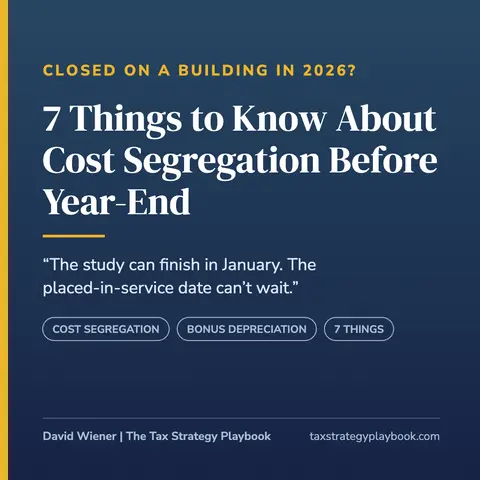
TL;DR: If you bought a rental or commercial building in 2026, the date that matters most for cost segregation before year-end is the day the building is placed in service, not the day you closed. The study itself can finish in the new year, as long as its numbers make the 2026 return, which can run to October 15, 2027 on extension. Buildings acquired after January 19, 2025 can get 100 percent bonus depreciation on the shorter-life components a study identifies. Whether that deduction helps you in 2026 depends on the passive loss rules, and the bonus choice is made class by class on the return.
Key Takeaways
- The building has to be ready and available for rent or use by December 31 for 2026 depreciation to start.
- The study does not need to be done by December 31. It needs to be done before the 2026 return is filed, including extensions.
- Property acquired after January 19, 2025 can qualify for 100 percent bonus depreciation, but a contract signed before January 20, 2025 can change that.
- A large deduction only helps in 2026 if the passive loss rules let you use it. Unused passive losses carry forward.
- Bonus is elected out class by class on the return, and a partial disposition election on a replaced roof or HVAC has a return-date deadline too.
You closed on a building this year, and now December is coming. Somebody told you to "do cost segregation before year-end," and you're not sure what that actually requires. Here are the seven things that matter for cost segregation before year-end, in the order you'll run into them.
1. Make sure the building is placed in service by December 31
A building counts for 2026 only if it is placed in service in 2026, and that date belongs to the building, not to the closing. The regulations define it as the day property is first placed "in a condition or state of readiness and availability for a specifically assigned function" (Treas. Reg. 1.167(a)-11(e)(1)(i)).
For a rental, that usually means ready and offered for rent, even if no tenant has moved in yet. Close on December 18 on a duplex that still needs new flooring and a working furnace, and you may not have a 2026 placed-in-service date at all. Your depreciation, and every dollar a study would accelerate, then starts in 2027.
The date has more wrinkles than most owners expect, especially for buildings that aren't habitable on day one. We walked through them in When Is a Property Placed in Service?
2. The study itself does not have to be finished by December 31
No rule says the cost segregation study has to be done by year-end. What matters is that the building is placed in service in 2026 and the study's numbers make it onto the 2026 return.
That return is due April 15, 2027 for an individual filing on a calendar year (IRC 6072(a)), and an automatic six-month extension on Form 4868 pushes the deadline to October 15, 2027 (Treas. Reg. 1.6081-4(a)). Partnerships and S corporations file a month earlier, on March 15 (IRC 6072(b)).
So the December job is smaller than people think. Get the date right, and get the study on the calendar. The engineering can finish in the new year.
3. Check the date you acquired the building, not just the date you closed
Your acquisition date decides whether the components a study identifies can get 100 percent bonus depreciation. The 2025 law restored the full 100 percent for property "acquired after January 19, 2025" (Pub. L. 119-21, section 70301(c)).
Most buildings bought in 2026 clear that line easily. The trap is a contract signed earlier. If your written binding contract was signed before January 20, 2025, the property can be treated as acquired on that earlier date, even if you closed this year. Property like that stays under the 2017 law's phase-down, which stepped down 20 percentage points a year from 40 percent in 2025 (IRS Notice 2026-11, section 2.01). That leaves 20 percent for property placed in service in 2026.
If that describes your purchase, read Contract Signed Before January 20, 2025? before you plan around a full write-off.
4. Find out whether you can use the deduction this year
A big depreciation deduction only saves tax if it can offset income you actually have. For most rental owners, that's the real question, and it gets answered by the passive activity rules, not by the study.
Under IRC 469, rental activity is generally passive, and passive losses can't offset wages or business income. The disallowed loss isn't lost; IRC 469(b) carries it forward to the next year. Qualifying as a real estate professional, or running a short-term rental you materially participate in, can change the answer.
We covered how those rules sort your losses in the episode Your Rental Losses Might Be Useless Unless You Know This IRS Rule. Run this question with your tax professional before you count on a 2026 refund.
5. You choose bonus depreciation class by class, on the return
Bonus depreciation is not all or nothing, and the choice happens when the return is filed, not on December 31. IRC 168(k)(7) lets you elect out "with respect to any class of property for any taxable year."
Under Treas. Reg. 1.168(k)-2(f)(1), a class means the recovery classes in the Code, such as 5-year or 15-year property. So you could take bonus on the 5-year carpet and appliances a study finds while electing out on the 15-year parking lot, or the reverse. The election is due by the due date, including extensions, of the return for the year the property is placed in service.
One thing a study never changes: the building's own shell stays on its long schedule, 27.5 years for residential rental property and 39 years for nonresidential real property (IRC 168(c)). Bonus reaches only property with a recovery period of 20 years or less (IRC 168(k)(2)(A)(i)(I)). That is why the study does the work.
6. If you replaced a roof or HVAC this year, say so before the return is filed
When you replace a major part of a building you already own, you may be able to write off what's left of the old part's basis, but only if you make the election in time. This is called a partial disposition election.
Treas. Reg. 1.168(i)-8(d)(2)(ii) says it must be made "by the due date, including extensions, of the original Federal tax return for the taxable year in which the portion of an asset is disposed of." Say you replaced the roof in 2026 on a building you've owned since 2015. The old roof still has years of undepreciated basis buried in the building's number. Tell your tax professional about the project now, while the 2026 return is still open.
7. Start before filing season fills everyone's calendar
A real engineering-based study takes weeks, not days. By CSSI's own estimate, a study generally takes two to four weeks once the information and the site visit pictures are in, and four to six weeks during tax season.
That site visit is in person, walked by a trained professional, because the report has to stand on what was actually observed in the building. Your tax professional is about to have the busiest three months of their year. Getting the study started in late fall or early winter means the numbers land on their desk before the crunch, instead of in the middle of it.
Frequently Asked Questions
Do I need to finish a cost segregation study before December 31?
No. The building needs to be placed in service in 2026 for the deduction to start in 2026, but the study only has to be done in time for the 2026 return, including extensions.
Can I do a cost segregation study on a building I bought in 2026 if I file my return first?
Yes, though the cleanest path is to have the study done before the return is filed. If the return goes in first, the depreciation isn't lost. Your tax professional can pick it up later, and the route depends on how many returns have been filed since.
Does the building itself get 100 percent bonus depreciation?
No. The building shell stays on 27.5 years for residential rental property or 39 years for nonresidential real property. Bonus depreciation applies to property with a recovery period of 20 years or less, which is what a study identifies.
What if I closed in 2026 under a contract I signed in 2024?
The property can be treated as acquired when the written binding contract was signed. If that was before January 20, 2025, the 100 percent rate in the 2025 law does not apply, and the 2017 law's 20 percent rate for property placed in service in 2026 applies instead.
Do I need to gather documents before asking about a study?
No. The first conversation is short and no specific numbers are needed. If a study looks like it might fit, a questionnaire follows to collect what the analysis needs.
Where to go from here
Most of this list is a conversation with your tax professional, and it goes better when you walk in with the date your building was placed in service and a sense of what a study would find. If you'd like that second piece, here is how a study works and what it covers: engineering-based cost segregation studies.
Not sure this applies to you? That's exactly what the no-cost analysis is for. If a study won't pay for itself on your property, you'll hear that from me first. No obligation, no pitch. Schedule at https://calendly.com/david-wiener/cs or call 770-224-8504, option two. Cost segregation, 179D and R&D studies are delivered through my relationship with CSSI (Cost Segregation Services, Inc.).
This article is educational and is not tax, legal, or accounting advice. Every situation is different; work with a qualified tax professional before acting on any strategy described here.

CEO of Cashflow Strategies, Inc., Tax Strategist, Speaker, Educator
David “Mr. Cash Flow” Wiener is a nationally recognized authority on real estate tax strategy and cash flow optimization, and the host of The Tax Strategy Playbook podcast. As Founder and CEO of Cash Flow Strategies, Inc., David has spent decades helping real estate investors, business owners, and their advisory teams legally reduce taxes, unlock hidden cash flow, and put more money back into productive assets instead of into the IRS.
Over the course of his career, David has become especially known for his work with cost segregation, 179D energy-efficient commercial building deductions, and other engineering-based tax incentives that accelerate depreciation and free up capital. He has also built a long track record in cash flow and accounts receivable optimization, helping clients improve profitability and financial stability without simply “working harder” or taking on more risk.
David is a sought‑after speaker, trainer, and educator, with audiences ranging from national industry conferences to small mastermind groups and professional associations. He is known for his clear, practical teaching style and his ability to translate complex tax concepts into simple, actionable plays that investors and advisors can use right away. Whether he is speaking to CPAs, medical and dental practice owners, or real estate investors, David’s message is consistent: tax strategy is one of the most powerful—and most overlooked—wealth multipliers available.
On The Tax Strategy Playbook, David brings that same real‑world experience and teaching approach to the microphone. Each epis… Read More
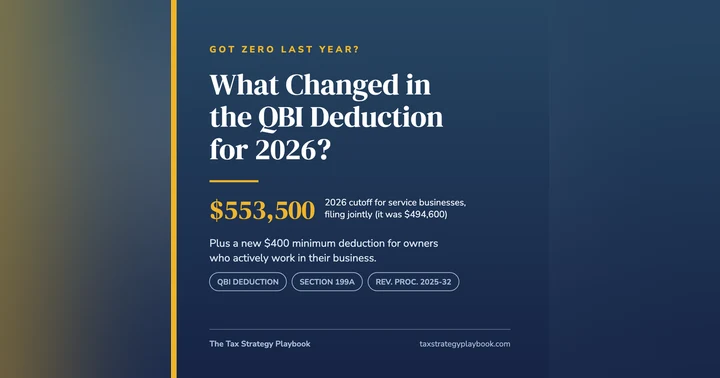
What Changed in the QBI Deduction for 2026? The $400 Minimum and the Wider Phase-In for Service Businesses