Your QOZ Tax Bill Is Coming December 31. Here's What to Model Now
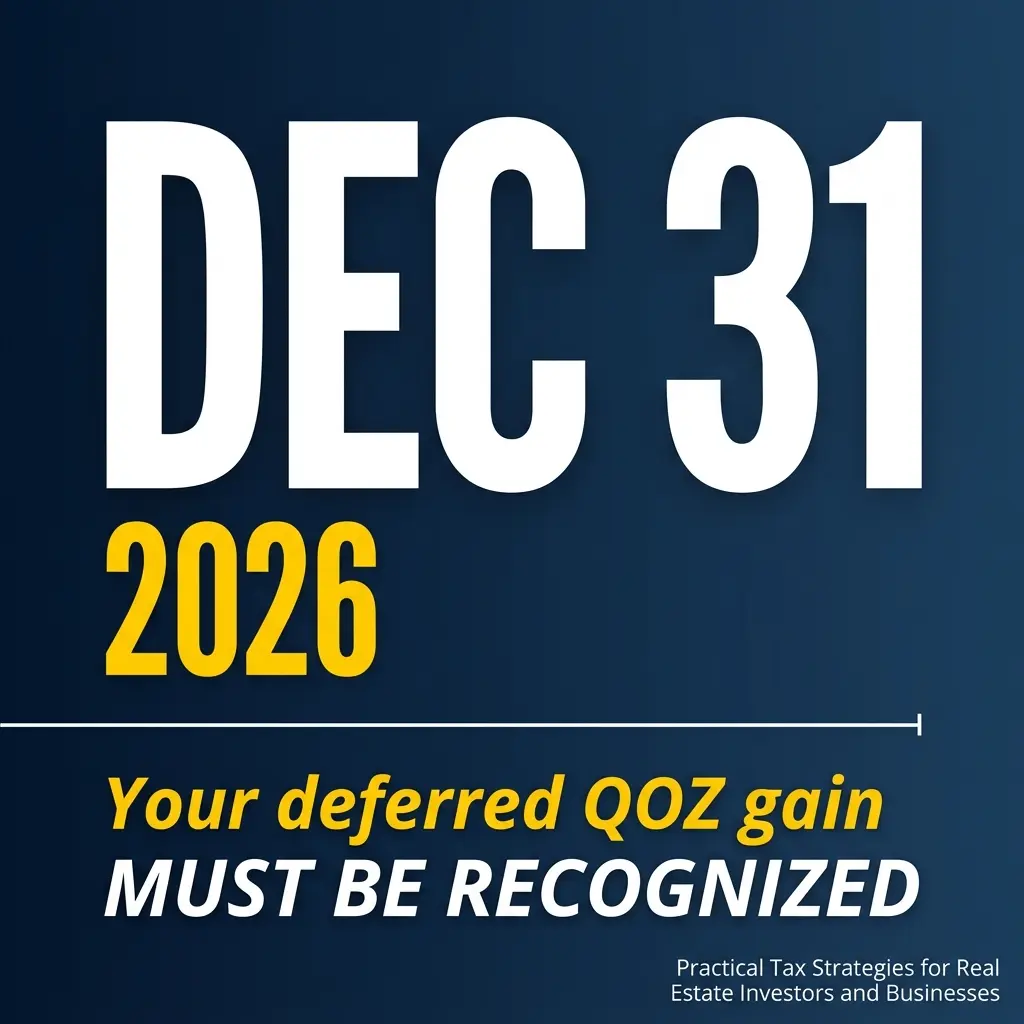
TL;DR: If you invested in a qualified opportunity fund before 2027, the tax you've been putting off is due on December 31, 2026. No exceptions. A new law called the One Big Beautiful Bill Act made the QOZ program permanent, but it didn't push that deadline back. Here's what to look at, what options are still open, and what to do before the year ends.
-
Investors who put money into a qualified opportunity fund before 2027 must report their deferred gain as income on December 31, 2026.
-
For most investors that deferred gain is taxable in full. The 5 and 7 year basis step-ups were not repealed for money already in a fund, but they run on holding periods that most people can no longer reach.
-
The tax on your original deferred gain and any tax exclusion on new gains inside the fund are two separate things. They don't cancel each other out.
-
Certain deductions (cost segregation, Section 174, Section 179) can reduce your 2026 tax bill if you use them before year-end.
-
The updated QOZ program now offers ongoing opportunities to defer new capital gains going forward.
Updated September 16, 2026. Two things have changed since this went up in July. The IRS has quietly redrawn the form you report this on, which is covered in a new section below. And one line in the summary above needed correcting, which is at the end of that same section. There are 106 days left before the recognition date.
The Clock Is Running
If you put money into a qualified opportunity fund before 2027, a tax bill is coming on December 31, 2026. It's not optional, it's not avoidable, and it doesn't matter whether you sold anything this year.
Here's how the original deal worked: you deferred a capital gain by rolling the money into a QOF within 180 days of the sale. That deferred gain has to be reported as taxable income no later than December 31, 2026. Congress set that date in the original law, and the One Big Beautiful Bill Act didn't change it.
What OBBBA did do is make the QOZ program permanent, with new 10-year designation cycles starting July 1, 2026. That's a real development for future gains. But it does nothing to delay the tax event hitting investors this year.
Key Point: The December 31, 2026 deadline is set in law and won't move. The new permanent QOZ structure only applies to gains you generate going forward.
What You Need to Model Before Year-End
Three numbers shape the tax planning decision for every QOZ investor right now:
1. The gain amount. How much did you originally defer by investing in the QOF? That's the number that becomes taxable on December 31. Your original K-1 from the fund should show that figure.
2. The basis adjustment. Under the original rules, investors who held their QOF investment for at least five years could reduce their taxable gain by 10%, and by 15% at seven years. But those holding periods had to be met before December 31, 2026, which means only investors who got in by December 31, 2021 at the latest qualify for the 10% step-up, and only those who invested by December 31, 2019 qualify for the full 15%. If you invested after 2021, the holding period math simply doesn't work, and the full original deferred gain is taxable in 2026.
3. The exit calculation. If you've held your QOF investment for at least 10 years, any growth in value inside the fund is still tax-free when you eventually sell. That's separate from the original deferred gain coming due December 31. They're two different calculations. Don't mix them up.
Key Point: Your K-1, your basis adjustment status, and your holding period are the three things that define your 2026 tax exposure. Get clear on all three before Q4 starts.
The Planning Moves That Are Still Open
Step one: Get an updated K-1 and confirm your deferred gain amount. Investors who walk into Q4 planning with the wrong number end up with expensive surprises.
Step two: Calculate your 2026 tax liability now. For many investors, this is a six-figure tax bill. It needs to be factored into your quarterly estimated tax payments. Otherwise you risk paying penalties on top of the tax itself.
Step three: Look at whether you can speed up your 2026 deductions. Cost segregation bonus depreciation, Section 174 R&D deductions, and Section 179 equipment elections can all lower your 2026 taxable income. When timed right, they directly reduce the impact of the QOZ recognition event.
Step four: Look at new QOZ investments under the permanent program. The new rolling 10-year designation cycle means there are fresh chances to defer gains going forward. Under OBBBA, new funds can start accepting capital on a rolling basis with the program's long-term future now guaranteed.
Key Point: The time to act on offsetting strategies is now, not in December. Steps one through three should already be on your calendar.
How This Gets Reported, and What the IRS Just Changed
Added September 16, 2026.
The form is Form 8997, the Initial and Annual Statement of Qualified Opportunity Fund (QOF) Investments. Anyone holding a QOF investment at any point during the year files it with their return. It's where you tell the IRS what you're holding, what you deferred, and what has come due.
The IRS posted a draft of the 2026 version on August 4, and it isn't a cosmetic refresh. They rebuilt the parts of the form that deal with the end of the deferral period. Three things moved.
Part III got split in two. On the form in force for 2025, Part III is one undivided section covering inclusion events, which is the catch-all for selling, gifting, or otherwise disposing of a QOF interest during the year. The 2026 draft breaks it into Section A and Section B. Section A keeps the inclusion events, retitled to cover events "Before End of Deferral Period." Section B is brand new. It's titled "Recognition of Remaining Deferred Gains Due to End of Deferral Period," and one of its columns is headed "Date deferral period ends."
A line on a federal tax form, built for exactly one event. The one this article is about.
Part IV got emptied. On the 2025 form, Part IV is where you list the QOF investments you still hold with deferred gain attached at year end. On the 2026 draft, every single column in Part IV reads "Reserved." Blank. Which follows once you think it through, because after December 31, 2026, under the rules that govern money already sitting in a fund, nobody is still carrying a deferred gain into the next year. There's nothing left to put there.
And there's a new Part V. "Total Qualifying Investments in QOF Held After End of the Deferral Period." One of its columns reads "Basis in QOF investment after end of the deferral period."
That last one is the part I'd pay attention to.
Paying the Bill Raises Your Basis, and 2026 Is When That Gets Recorded
When you recognize the deferred gain on December 31, something happens alongside the tax bill. Your basis in the fund investment goes up by the amount of gain you just recognized. The statute is direct about it: the basis "shall be increased by the amount of gain recognized."
That higher basis is the number everything downstream runs on. Hold the investment ten years, take the exclusion on the appreciation, and basis is where that calculation starts. Part V looks like where the figure gets written onto the record.
So there's a second reason to get the 2026 return right, beyond paying the correct amount. It's the year the number governing your eventual exit gets set down in writing.
Two Limits on All of This
It's a draft. The IRS stamps a warning on every draft form telling you not to file it and that things can change before the final release. Don't hand this to your CPA as settled.
And there are no instructions yet. The 2025 form carries its instructions right on the page. The 2026 draft drops them and points you to the IRS website instead, which reads like a separate instruction product is on the way. Until it lands, what belongs in that new Part V "Event code" column isn't public information. Nobody knows, including the firms writing about this.
Which is the practical reason I'm telling you any of it. Most of what you'll find published about Form 8997 right now describes a four-part form and tells you to complete Part III when your deferral ends. That was accurate when it was written. It may not describe the return you file for 2026. If your CPA is working from a summary rather than from the form itself, that's worth one conversation before year end.
A Correction to This Post
The summary at the top of this article used to say the new law removed the partial tax breaks earlier investors had access to. That was wrong, and the difference is worth real money to some of you, so I'm fixing it in the open rather than quietly editing it out.
The 10 percent and 15 percent basis increases are still in the law for anyone whose money is already in a fund. OBBBA did rewrite that section of the statute, but the rewrite applies to amounts invested after December 31, 2026. If your money went in before then, the original rules still govern you, both step-ups included.
What actually happens is less dramatic and more annoying. The step-ups run on holding periods, and the recognition date doesn't move. Get in by the end of 2021 and you reach five years on December 31, 2026, which earns the 10 percent. Get in by the end of 2019 and you reach seven, which earns the full 15. Invest after 2021 and the clock runs out on you. The breaks weren't repealed. They expire by arithmetic.
If you're a 2019 or 2021 vintage investor, confirm the step-up is actually being claimed on your return. Nobody applies it for you.
The New Structure for Future Gains
The updated QOZ program under OBBBA works differently from how the original program was set up:
-
Zone designations now renew on a rolling 10-year cycle instead of expiring on a fixed date
-
New reporting rules apply to funds formed under 2026 designations
-
The program now has long-term stability, which makes it easier for large institutions to form funds around it
For investors who recognized a major capital gain in 2026, through a real estate sale, a business exit, or a portfolio adjustment, the QOZ program is back as a serious long-term deferral option, not a program winding down in its final months.
Key Point: OBBBA turned QOZ from a closing window into a lasting planning tool. That shift matters for how both advisors and investors should approach it going forward.
The Bottom Line
Two things are true right now. Pre-2027 QOZ investors have a tax bill arriving in a little over three months, and the QOZ program itself is more appealing than it's been since 2019. Which of those facts matters more depends entirely on where you stand.
If you're in a qualified opportunity fund and haven't had a direct conversation with your tax strategist about your December 31 recognition event, that conversation needs to happen this month, not December.
Where to Start
The QOZ recognition itself belongs with whoever prepares your return. Your K-1, your investment date, your holding period, and now a form that's still in draft. Take all of it to them, and take it before December.
What I can help with is the other half of the page: the deductions that land in the same tax year and pull the 2026 number down. Cost segregation on a building you own. The 179D deduction. An R&D credit study. I offer a no-cost analysis on all three, with no obligation and no pitch, and if a study won't pay for itself I'll tell you that instead of selling you one.
-
Book a call: calendly.com/david-wiener/cs
-
Or call 770-224-8504, option two.
Don't gather documents first. Bring the address and we'll go from there.
Frequently Asked Questions
What is the December 31, 2026 QOZ recognition event?
It's the date by which all deferred capital gains that were rolled into a qualified opportunity fund before 2027 must be reported as taxable income. Congress built this deadline into the original QOZ law, and it hasn't changed.
Did the One Big Beautiful Bill Act extend the QOZ deferral deadline?
No. OBBBA made the QOZ program permanent and created rolling 10-year designation cycles, but it didn't push back the December 31, 2026 deadline for gains that were already deferred.
What form do I use to report the December 31, 2026 QOZ gain?
Form 8997, the Initial and Annual Statement of Qualified Opportunity Fund (QOF) Investments. You file it with your return for any year in which you held a QOF investment, and the gain itself also flows onto Form 8949. The IRS posted a draft 2026 version in August that adds a section built specifically for gain recognized because the deferral period ended.
Has the IRS changed Form 8997 for 2026?
Yes, in draft. The 2026 draft splits Part III into a section for inclusion events before the end of the deferral period and a new Section B titled "Recognition of Remaining Deferred Gains Due to End of Deferral Period." Part IV, which reported deferrals still held at year end, is marked Reserved. A new Part V tracks qualifying investments held after the deferral period ends, including your basis. It's a draft, no instructions have been published yet, and the final form could differ.
Do I still get a basis step-up on my QOZ investment?
It depends on when you invested. The 10% basis reduction required a five-year holding period before December 31, 2026, meaning you needed to invest by December 31, 2021. The full 15% required a seven-year hold, meaning you needed to invest by December 31, 2019. If you invested after 2021, the holding period can't be met in time, and the full original deferred gain is generally taxable in 2026. These step-ups were not repealed by OBBBA for money already in a fund, so if you do qualify, make sure it's being claimed.
Are appreciation gains inside the fund also taxable on December 31, 2026?
No. If you've held your QOF investment for at least 10 years, any growth in value inside the fund stays tax-free when you sell. That exclusion is separate from the December 31 recognition event. They're two different calculations.
What deductions can offset the 2026 QOZ recognition event?
Cost segregation bonus depreciation, Section 174 R&D deductions, and Section 179 elections can all lower your 2026 taxable income, because they're applied in the same tax year as the recognition event when timed right.
Can I invest in a new QOF to defer the gain I'm recognizing in 2026?
The gain you recognize on December 31, 2026 doesn't automatically qualify to be rolled into a new QOF. Your tax strategist can review your specific situation to determine whether that's an option.
What should I do right now if I'm a QOZ investor?
Pull your current K-1, confirm your deferred gain amount, model your 2026 tax liability, and get a meeting on the calendar with your tax strategist, all before Q4. Waiting until December puts you at real risk of underpayment penalties.
Is the QOZ program worth considering for new 2026 capital gains?
Yes. With permanent designations and rolling 10-year cycles, the program now has the kind of stability it never had before. If you have a significant capital gain in 2026, it's worth running the numbers on a QOZ investment as a deferral option.
Key Takeaways
-
Investors who put money into a QOF before 2027 face a required, unavoidable gain recognition event on December 31, 2026.
-
OBBBA made QOZ permanent and added rolling designations. It didn't push the 2026 deadline back.
-
The 5 and 7 year basis step-ups were not repealed for money already in a fund. They run out on the calendar instead. Investors who got in by the end of 2021 or the end of 2019 should confirm theirs is being claimed.
-
The IRS has redrawn Form 8997 for 2026 with a new section for gain recognized at the end of the deferral period, a Part IV marked Reserved, and a new Part V that records your basis after the deferral. It's still a draft and has no instructions.
-
Paying the December 31 tax raises your basis in the fund, and that basis drives the 10-year exclusion later. The 2026 return is where it gets recorded.
-
Any growth in fund value at exit is still separately excludable. It's a different calculation from the December 31 recognition event.
-
Speeding up deductions through cost segregation, Section 174, or Section 179 can directly reduce your 2026 tax bill.
-
The permanent QOZ program creates real new opportunities for investors with capital gains in 2026 and beyond.
-
The conversation with your tax strategist needs to happen this month. Three months sounds like a long time until it isn't.

CEO of Cashflow Strategies, Inc., Tax Strategist, Speaker, Educator
David “Mr. Cash Flow” Wiener is a nationally recognized authority on real estate tax strategy and cash flow optimization, and the host of The Tax Strategy Playbook podcast. As Founder and CEO of Cash Flow Strategies, Inc., David has spent decades helping real estate investors, business owners, and their advisory teams legally reduce taxes, unlock hidden cash flow, and put more money back into productive assets instead of into the IRS.
Over the course of his career, David has become especially known for his work with cost segregation, 179D energy-efficient commercial building deductions, and other engineering-based tax incentives that accelerate depreciation and free up capital. He has also built a long track record in cash flow and accounts receivable optimization, helping clients improve profitability and financial stability without simply “working harder” or taking on more risk.
David is a sought‑after speaker, trainer, and educator, with audiences ranging from national industry conferences to small mastermind groups and professional associations. He is known for his clear, practical teaching style and his ability to translate complex tax concepts into simple, actionable plays that investors and advisors can use right away. Whether he is speaking to CPAs, medical and dental practice owners, or real estate investors, David’s message is consistent: tax strategy is one of the most powerful—and most overlooked—wealth multipliers available.
On The Tax Strategy Playbook, David brings that same real‑world experience and teaching approach to the microphone. Each epis… Read More
What Counts as a Land Improvement, and Why Does It Depreciate Over 15 Years?